On this page
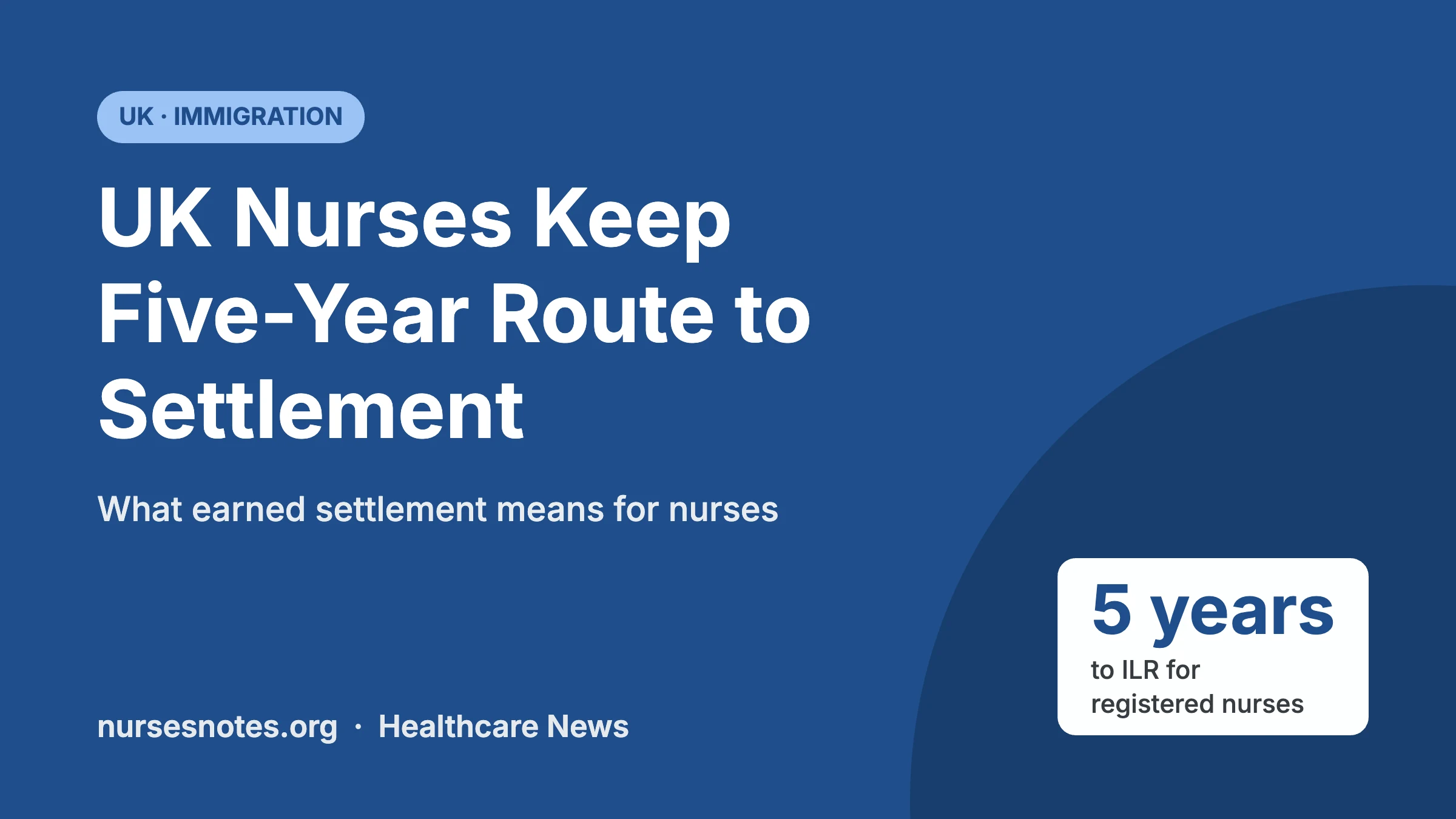
Registered nurses in the UK will keep a five-year route to settlement (indefinite leave to remain, or ILR) under the government’s new “earned settlement” rules, Home Secretary Shabana Mahmood confirmed on 2 November 2026. Most other migrant workers will now wait 10 years. The Royal College of Nursing (RCN) welcomed the decision for nurses but warned that wider changes could still worsen staff shortages.
Key points
- Registered nurses and other qualifying public service workers keep a 5-year route to ILR.
- The new default for most migrant workers is 10 years.
- Care workers and nursing support workers who arrived before May 2025 keep a 5-year route if they meet their visa conditions; later arrivals face 10 years.
- New Immigration Rules will be laid from December 2026 and phased in through 2027. Until then, current rules apply.
What changed
The announcement is the government’s response to its “A fairer pathway to settlement” consultation, which ran from November 2025 and received 204,667 responses, according to law firm Lewis Silkin. Under earned settlement, how quickly you can settle depends on your job, earnings, and immigration record.
| Pathway | Who it covers |
|---|---|
| 3 years | Exceptional contribution, such as earnings of £125,141 in three of the last four years |
| 5 years | Registered nurses and other public service workers on national pay scales; people earning £50,271 in three of the last five years; people with a British connection |
| 5 years (transitional) | Care workers and health workers below degree level, such as nursing auxiliaries, who arrived before May 2025 and meet their visa conditions |
| 10 years | The new default for most migrants who follow the rules |
| 20 years | People with a qualifying adult immigration breach or recent use of public funds |
Which nurses are covered?
Lewis Silkin explains that the five-year public service route covers health and education roles at degree level (RQF level 6 and above) that the Immigration Rules treat as paid on national pay scales, including nurses, midwives, doctors, pharmacists, and paramedics. The full list is in Annex C of the government’s response.
The RCN says it will seek urgent clarification on whether the five-year route applies to registered nurses in every sector, including private hospitals and care homes, not only the NHS.
Rules every applicant must meet
Whatever the pathway, applicants will need to meet mandatory requirements, according to Lewis Silkin’s summary:
- no criminal record in the UK, including most convictions, cautions, and fines
- no debt to the government, including NHS debt and unpaid tax
- English at CEFR level B2, up from B1, for applications from 26 March 2027
- a pass in the Life in the UK test
- no use of public funds in the previous five years for the 3-, 5-, and 10-year pathways
What the RCN said
RCN General Secretary Professor Nicola Ranger said nursing staff had “fought hard” to see the worst of the reforms pared back. The RCN still describes the overall changes as unfair and says the UK has one of the most hostile systems for migrant nursing staff, with longer waits for settlement than comparable countries. It is calling for a fully funded plan to grow the domestic nursing workforce.
What it means for Filipino and international nurses
Filipino nurses are one of the largest international groups in the NHS; CHED recently cited more than 35,000 Filipino nurses working in the UK health service, according to The Philippine Star.
- If you are a registered nurse on a Health and Care Worker visa, you are expected to keep a five-year path, subject to the new mandatory requirements.
- Start preparing for the B2 English requirement now if your current English scores are lower.
- Keep your record clean. Breaches such as overstaying can push you onto the 20-year route.
- Wait for the final rules. Nothing has changed in the Immigration Rules yet, and the details could still shift.
Frequently asked questions
Do nurses still get ILR after five years in the UK?
Under the announced plans, yes. Registered nurses in qualifying public service roles keep a five-year route to settlement. The change still needs to be written into the Immigration Rules, which will be laid from December 2026.
When do the new settlement rules start?
The government plans to lay new Immigration Rules from December 2026 and implement them through 2027. The higher B2 English requirement is due to apply to settlement applications from 26 March 2027.
Related on Nurses Notes
- Towne Nursing settlement for Filipino nurses
- October 2026 visa bulletin for EB-3 nurses
- Nursing jobs and migration news
Sources
- Indefinite leave to remain: immigration reforms scaled back after campaigning by nursing staff. Royal College of Nursing (2 November 2026).
- Home Office sets out revised earned settlement framework. Lewis Silkin (3 November 2026).
- Immigration news update: 6 November 2026. HJT Training (6 November 2026).
- Nurse shortage could reach 250,000 by 2030 – CHED. The Philippine Star (7 November 2026).
This summary is for information only and does not replace official guidance or advice from a qualified professional. It is not legal or immigration advice.