On this page
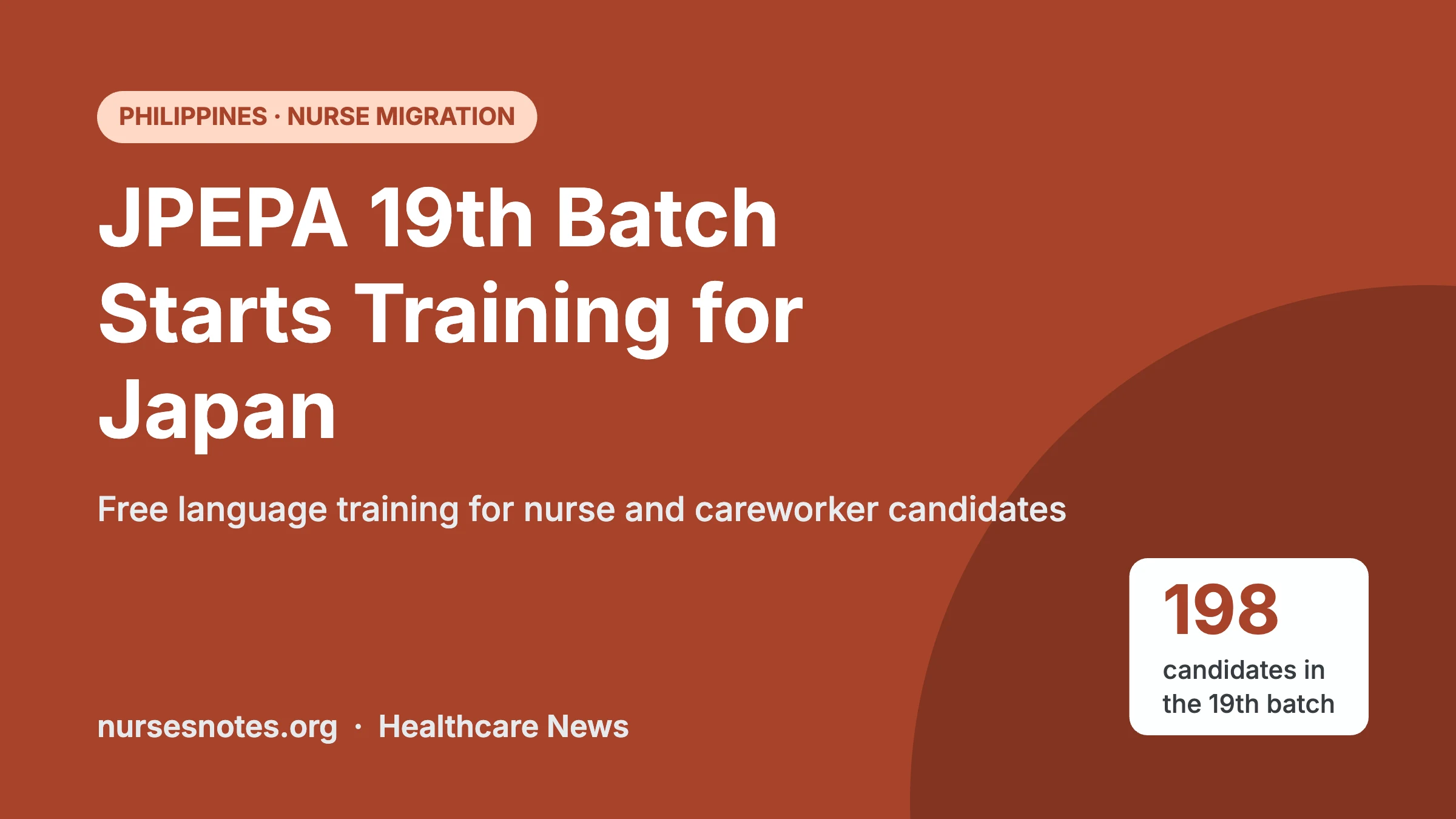
The 19th batch of Filipino nurse and careworker candidates bound for Japan under the Japan-Philippines Economic Partnership Agreement (JPEPA) started free Japanese language training on 4 November 2026. The 198 candidates will study for six months in the Philippines and another six months in Japan before working in Japanese hospitals and care facilities.
Key points
- 198 candidates make up the 19th JPEPA batch: 121 are training online and 77 face to face.
- The free training covers Japanese language, culture, and social etiquette, with a daily living allowance during language training.
- Candidates must later pass Japan’s national exam for nurses (kangoshi) or certified careworkers (kaigofukushishi) to stay and work longer term.
- The news comes as CHED warns the Philippines could be short of 250,000 nurses by 2030.
What happened
Japanese Ambassador Kitagawa Katsuro joined the opening ceremony of the Preparatory Japanese Language Training for the 19th batch on 4 November 2026, alongside Department of Migrant Workers (DMW) Secretary Hans Leo Cacdac, The Manila Times reported. The Philippine Star reported that 121 candidates are attending online classes while the other 77 are being taught in person.
Both training programmes are free as part of the government-to-government deployment arrangement. After the six months in the Philippines, candidates complete another six months of language training on arrival in Japan before starting their assignments at hospitals and caregiving facilities.
How the JPEPA nurse programme works
JPEPA has sent Filipino candidates to Japan every year since 2009. Recruitment is handled by the DMW together with the Japan International Corporation of Welfare Services (JICWELS).
- Positions: for the current recruitment cycle, the Embassy of Japan announced 50 nurse and 300 careworker positions, with applications extended to 24 April 2026.
- Training: 6 months of Japanese in the Philippines, then 6 months in Japan, both free, with a daily living allowance.
- Work term: 3 to 4 years at Japanese hospitals and care facilities.
- Licence: candidates are encouraged to pass the Japanese national licence exam, which opens the door to a longer stay.
Until they pass the national exam, nurse candidates work under supervision and cannot practise as fully registered nurses in Japan. Language is the biggest hurdle, because the national nursing exam is taken in Japanese.
The bigger picture: nurse migration and the local shortage
The new batch leaves as the Philippines debates how to keep enough nurses at home. On 5 November, the Commission on Higher Education (CHED) launched the Philippine Nursing Education Roadmap 2030 and said the country’s nurse shortage was between 127,000 and 190,000 in 2025 and could reach 250,000 by 2030 if trends continue, according to The Philippine Star.
The government’s stated position is to support both goals: training nurses who can compete internationally while strengthening the local workforce. JPEPA is a small programme next to the flows of Filipino nurses to countries such as the United States and the United Kingdom, but it offers a structured, government-run pathway with free language training, which is rare.
What it means for Filipino nurses
- If you are interested in Japan, watch the DMW and Embassy of Japan pages for the next JPEPA call for applications, which in recent years has closed in April or May.
- Expect a long language commitment. Starting Japanese before applying can make the programme and the national exam more realistic.
- Compare pathways. Japan’s route takes time but is free and government-to-government; other countries may pay more but require costly exams and agency fees.
Frequently asked questions
Is JPEPA training free?
Yes. The six-month language training in the Philippines and the six months in Japan are free of charge under the government-to-government scheme, and a daily living allowance is provided during language training.
Do JPEPA nurses need to pass a Japanese board exam?
To work long term as a registered nurse in Japan, candidates need to pass Japan’s national nursing examination, which is held in Japanese. Candidates work in Japanese facilities while they prepare.
Related on Nurses Notes
- Philippine Nursing Education Roadmap 2030: key reforms
- Marcos on nurse-to-patient ratios for Filipino nurses
- Singapore-Philippines nurse educator scholarship
- Nursing jobs and migration news
Sources
- Ambassador Kitagawa attends opening of Japanese language training for JPEPA candidates. The Manila Times (10 November 2026).
- Nurse shortage could reach 250,000 by 2030 – CHED. The Philippine Star (7 November 2026).
- JPEPA nurse and certified careworker candidates: applications extended. Embassy of Japan in the Philippines (2026).
- Japanese-language pre-training programme for EPA nurse and careworker candidates. The Japan Foundation.
This summary is for information only and does not replace official guidance or advice from a qualified professional. It is not legal or immigration advice.