On this page
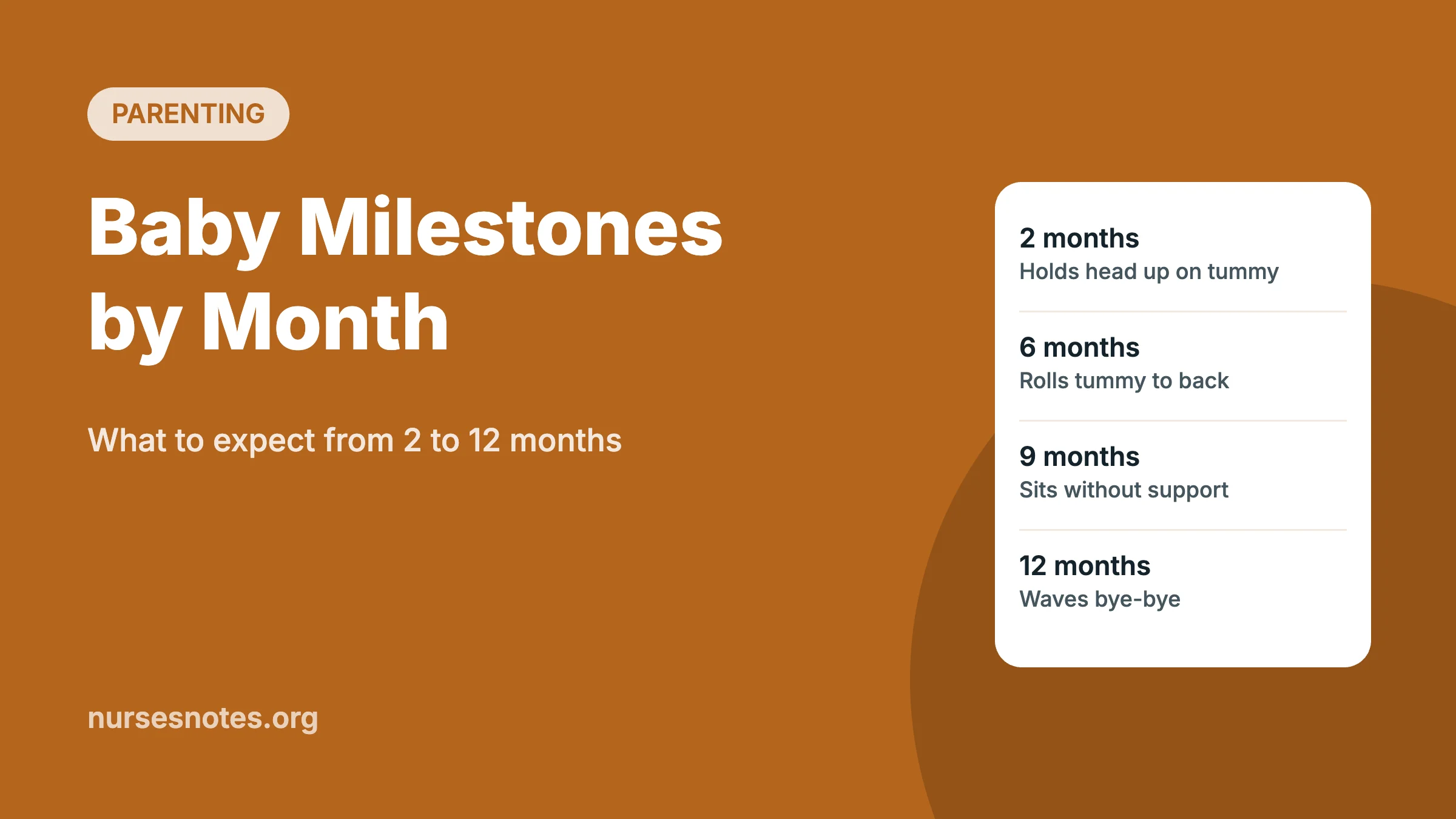
Baby milestones by month are the skills most babies show by a certain age, such as holding up their head by 2 months, rolling from tummy to back by 6 months, and waving bye-bye by 12 months. The US Centers for Disease Control and Prevention (CDC) defines a milestone as something at least 75% of children can do by that age, so missing one is a reason to talk to your doctor, not a reason to panic.
Key points
- Milestones cover four areas: social and emotional, language, thinking and learning, and movement.
- Every baby develops a little differently, but CDC advises acting early rather than waiting if you have concerns.
- Losing a skill your baby already had is always worth raising with a doctor.
- If your baby was born early, tell the doctor, as development is often judged from the original due date.
What are developmental milestones?
Milestones are things like smiling, babbling, reaching for toys, and sitting up. Doctors and nurses check them at well-baby visits to see how a child is learning, moving, and connecting with others.
CDC’s milestone lists show what most babies (75% or more) can do by each age. Many babies reach them earlier, so the lists are a guide, not a race.
Baby milestones from 2 to 12 months
| By this age | Social and emotional | Language | Thinking and learning | Movement |
|---|---|---|---|---|
| 2 months | Calms when spoken to or picked up, and looks at your face | Makes sounds other than crying, and reacts to loud sounds | Watches you as you move | Holds head up when on tummy, and moves both arms and legs |
| 4 months | Smiles on their own to get your attention, and chuckles | Coos (“oooo”, “aahh”) and makes sounds back when you talk | Opens mouth when they see the breast or bottle if hungry | Holds head steady without support, and brings hands to mouth |
| 6 months | Knows familiar people and likes looking in a mirror | Takes turns making sounds with you, and blows “raspberries” | Reaches for a toy they want, and mouths things to explore them | Rolls from tummy to back, and leans on hands to sit |
| 9 months | May be shy or clingy with strangers, and reacts when you leave | Makes sounds like “mamamama”, and lifts arms to be picked up | Looks for objects dropped out of sight, and bangs two things together | Gets to sitting alone, and sits without support |
| 12 months | Plays games such as pat-a-cake | Waves bye-bye, calls a parent “mama” or “dada”, and understands “no” | Puts things in a container, and looks for hidden toys | Pulls up to stand, walks holding furniture, and picks up small items with thumb and finger |
These are examples only. The full CDC checklists for each age list more skills and are free to view online (see Sources).
If your baby was born early
Babies born prematurely often reach milestones later than babies born on their due date. The NHS explains that a premature baby’s development is usually measured from their original due date until about age 2. Always tell your doctor or nurse if your baby was born early so they can check progress fairly.
How to support your baby’s development
- Talk, sing, and read to your baby every day, and answer their coos and babbles as if you are having a conversation.
- Give supervised tummy time while your baby is awake, to build neck, shoulder, and arm strength. Always place your baby on their back to sleep (see our safe sleep guide for babies).
- Play simple games such as peek-a-boo and pat-a-cake, which build social and thinking skills.
- Offer safe toys to reach for, hold, and bang together, and let your baby explore on a clean, safe floor.
- Limit screens and give your baby your face and voice instead; babies learn best from real people.
- Keep well-baby visits and vaccinations up to date, and bring your questions.
Developmental screening checks
The American Academy of Pediatrics (AAP), quoted by CDC, recommends developmental screening with a standard tool at 9, 18, and 30 months, and autism screening at 18 and 24 months or whenever a parent or doctor is concerned. In the UK, health visitors review babies at set ages, including at 9 to 12 months. In the Philippines, ask your pediatrician or local health centre about growth and development checks.
When to talk to your doctor
CDC advises parents not to wait. Talk with your child’s doctor or nurse and ask about developmental screening if your baby:
- Is not meeting one or more milestones for their age
- Has lost skills they once had, such as no longer babbling or smiling
- Does not respond to sounds or does not seem to see things
- Seems very stiff or very floppy compared with other babies
- Gives you any other worry about how they play, learn, speak, act, or move
If you or the doctor are still concerned, ask for a referral to a specialist or early intervention service. Getting support early gives a child the best chance to make progress.
Get medical help the same day or go to emergency care if your baby suddenly becomes floppy or unusually hard to wake, has a seizure (fit), has trouble breathing, stops feeding, or loses skills suddenly. These are not normal variations in development and need urgent assessment.
Frequently asked questions
What should a 6-month-old baby be doing?
By 6 months, CDC says most babies know familiar people, laugh, take turns making sounds with you, and blow “raspberries”. They reach for toys they want, put things in their mouth to explore them, roll from tummy to back, and lean on their hands to sit. Many are also getting ready for starting solid foods.
Is it normal for my baby to be late on a milestone?
Babies develop at slightly different rates, and milestones show what 75% or more of babies can do by an age, so some healthy babies get there later. Still, do not just wait and see. Tell your doctor at the next visit, or sooner if your baby has lost skills or you have several concerns.
When do babies start rolling over?
CDC lists rolling from tummy to back as a milestone most babies reach by 6 months, and many roll earlier. Regular supervised tummy time while your baby is awake helps build the strength needed. Once your baby can roll, never leave them alone on a bed, sofa, or changing table, as falls happen quickly.
Related on Nurses Notes
- Safe sleep for babies: how to lower the risk of SIDS
- When to start solid foods
- Teething symptoms and how to soothe your baby
- More parenting articles
Sources
- CDC’s Developmental Milestones — Centers for Disease Control and Prevention, 2026
- Milestones by 2 Months, Milestones by 4 Months, Milestones by 6 Months, Milestones by 9 Months, and Milestones by 1 Year — CDC, 2026
- Checkup Checklist: 9 Months Old — American Academy of Pediatrics (HealthyChildren.org), 2021
- Baby’s development — NHS, 2026
- Your baby’s health and development reviews — NHS, reviewed 2023
This article is for education only and does not replace advice from your own doctor, nurse, or other qualified health professional.