On this page
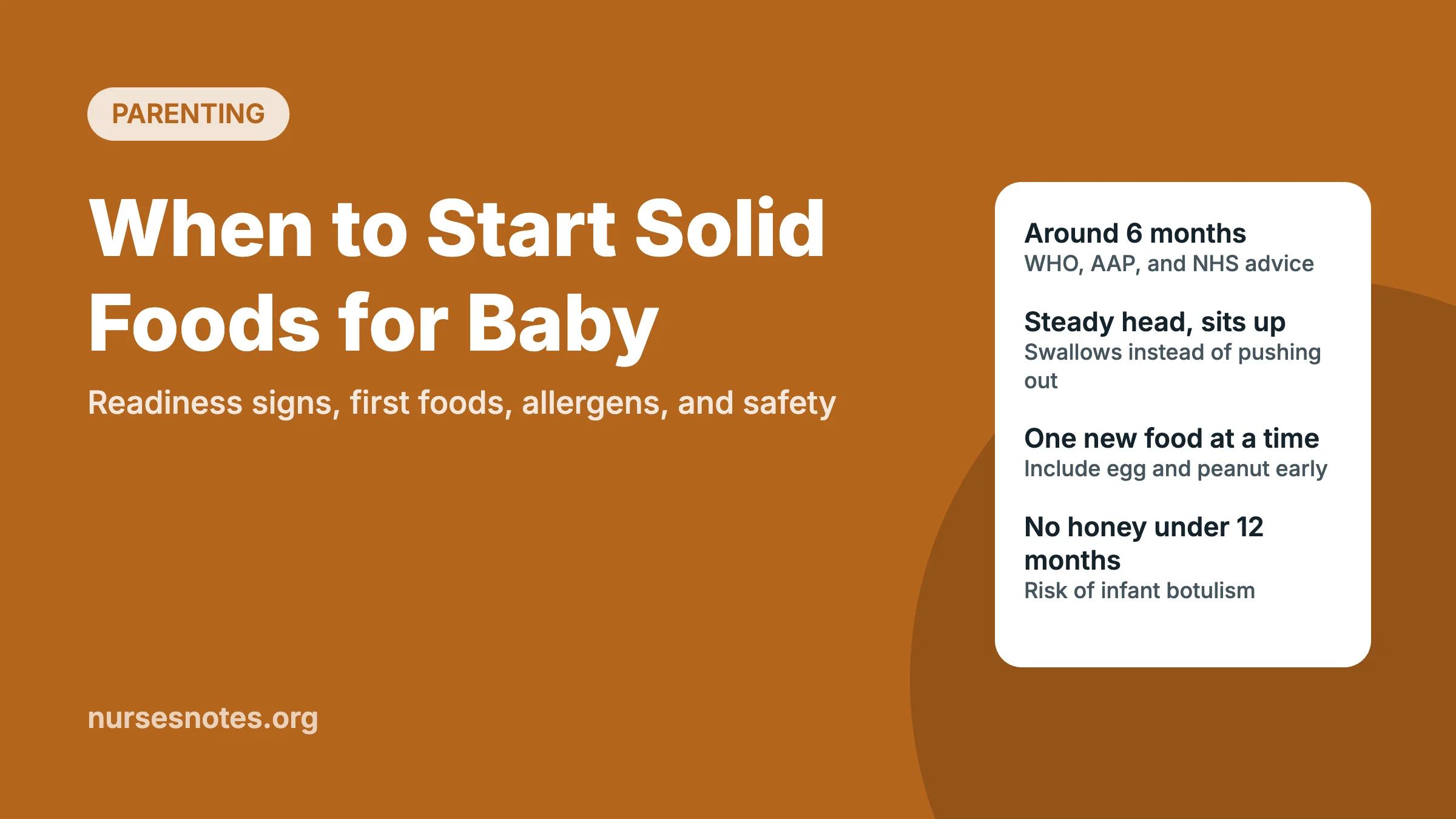
The best time to start solid foods for most babies is at around 6 months, when they show clear signs of readiness. Breast milk or infant formula stays the main drink through the first year, and first foods are added alongside it, not instead of it.
Key points
- WHO, the AAP, and the NHS advise starting solid foods at around 6 months of age.
- Look for readiness signs: steady head control, sitting with support, and swallowing food rather than pushing it out.
- Introduce one new food at a time, including common allergens such as egg and peanut, in small amounts.
- Never give honey before 12 months, and avoid added salt and sugar, juice, and hard foods that can cause choking.
When to start solid foods for baby
The World Health Organization recommends that babies start complementary foods at 6 months, because by then breast milk alone no longer meets all their needs for energy and nutrients such as iron. The American Academy of Pediatrics (AAP) and the NHS give similar advice.
Every baby develops at their own pace, so readiness signs matter more than the date on the calendar. If your baby was born early or has health problems, ask your doctor or health worker when to start.
Signs your baby is ready
- Sits up, with support if needed, and holds their head steady
- Can look at food, pick it up, and bring it to their mouth
- Opens their mouth when food comes near
- Swallows food instead of pushing it back out with the tongue
Chewing fists, waking more at night, or wanting extra milk are normal baby behaviours and do not on their own mean a baby is ready for solids.
Best first foods
- Iron-rich foods: soft, well-cooked mashed meat, poultry, fish, or egg, or iron-fortified infant cereal. The AAP highlights foods rich in iron and zinc.
- Vegetables and fruit: soft-cooked carrot, sweet potato, squash, broccoli, or mashed banana, apple, or pear. Include less sweet vegetables too.
- Family foods, adapted: plain rice porridge, mashed beans, or soft fish from the family meal, cooked without added salt, sugar, or stock cubes.
There is no need to start with fruit or vegetables first. It can take 10 or more tries before a baby accepts a new taste, so keep offering it calmly.
How to introduce solid foods: step by step
- Choose a time when your baby is alert and not too hungry or tired.
- Wash your hands, and use clean bowls and spoons.
- Seat your baby upright, in a high chair if you have one, and stay with them the whole time.
- Start with a teaspoon or two of a smooth or mashed food. Some families offer milk first and then a little food.
- Let your baby set the pace. Stop when they turn away, close their mouth, or lose interest. Never force food.
- Add one new single food every few days so you can spot any reaction.
- Move on to thicker, lumpier textures and soft finger foods as your baby manages. By around 12 months, most children can eat chopped family foods.
As a guide, WHO suggests 2 to 3 meals a day at 6 to 8 months, and 3 to 4 meals a day from 9 to 24 months, with 1 to 2 healthy snacks from 12 months. Keep breastfeeding as long as you and your baby wish.
Introducing allergenic foods
Foods such as egg, peanut, cow’s milk in cooking, wheat, soy, fish, and shellfish can be introduced from around 6 months. Offer them one at a time, in small amounts, and keep giving them regularly once your baby tolerates them. Peanuts must be smooth or finely ground, never whole.
If your baby has severe eczema or a known food allergy, or there is a strong family history of allergy, talk to your doctor before introducing these foods.
Foods to avoid in the first year
| Food or drink | Why to avoid it |
|---|---|
| Honey (including in food, water, or on pacifiers) | Can cause infant botulism before 12 months |
| Cow’s milk as a main drink | Not suitable before 12 months; small amounts in cooking are fine |
| Fruit juice and sugary drinks, tea, or coffee | No juice before 12 months; these crowd out nutritious foods |
| Added salt and sugar | Babies do not need them; skip salty sauces, stock cubes, and sweet snacks |
| Whole nuts, whole grapes, popcorn, and hard raw vegetables or apple | Choking hazards |
| High-mercury fish (such as shark, swordfish, and king mackerel) | Mercury can affect development |
| Unpasteurised milk, cheese, yogurt, or juice | Can carry harmful bacteria |
Keeping mealtimes safe from choking
- Always stay with your baby while they eat, and keep them sitting upright.
- Cut small round foods, like grapes and cherry tomatoes, into quarters.
- Remove bones, seeds, and pits, and cook hard vegetables until soft.
- Do not put cereal in a bottle unless your doctor advises it.
Gagging is a normal part of learning to eat: babies may cough or splutter and then carry on. Choking is silent or struggling and needs action straight away. Learn the infant steps in our choking first aid guide.
When to get medical help
Call your local emergency number immediately if your baby:
- Is choking and cannot cry, cough, or breathe
- Has swelling of the lips, face, or throat, or trouble breathing, after eating
- Turns blue or grey, becomes floppy, or is hard to wake
See your doctor soon if your baby:
- Gets a rash, hives, vomiting, or diarrhoea after a new food
- Has watery stools or mucus in the stools that keeps going (see our guide to diarrhoea in children)
- Refuses most foods for a long time, or you are worried about weight gain or growth
Frequently asked questions
Can I start solid foods at 4 months?
Most health bodies, including WHO and the NHS, recommend waiting until around 6 months, when babies are developmentally ready and need extra iron. Some babies show readiness signs a little earlier. If you are thinking of starting before 6 months, talk to your doctor or health worker first about your baby’s growth and development.
What should be baby’s first food?
There is no single best first food. Good choices include iron-rich foods such as mashed meat, egg, or iron-fortified cereal, and soft-cooked vegetables or fruit. Offer one new food at a time, keep textures smooth or mashed at first, and do not add salt, sugar, or honey to anything you give your baby.
How much solid food should a 6-month-old eat?
Start small, with a teaspoon or two once a day, and let your baby lead. At 6 months, solid foods are mostly about learning tastes and textures, while breast milk or formula still provides most nutrition. WHO suggests building up to 2 to 3 meals a day by 6 to 8 months.
Related on Nurses Notes
- Choking first aid, including steps for babies
- Teething symptoms: signs and safe relief
- Diarrhoea in children: care at home and warning signs
- All Parenting articles on Nurses Notes
- Choking first aid for babies: step-by-step infographic
Sources
- Complementary feeding. World Health Organization. Accessed October 2026.
- Starting Solid Foods. American Academy of Pediatrics, HealthyChildren.org. Updated 23 June 2026.
- Your baby’s first solid foods. NHS. Reviewed 19 February 2026.
- Baby food allergies. NHS Best Start in Life. Updated 6 October 2025.
- Foods and Drinks to Avoid or Limit. Centers for Disease Control and Prevention. 14 April 2026.
This article is for education only and does not replace advice from your own doctor, nurse, or other qualified health professional.