On this page
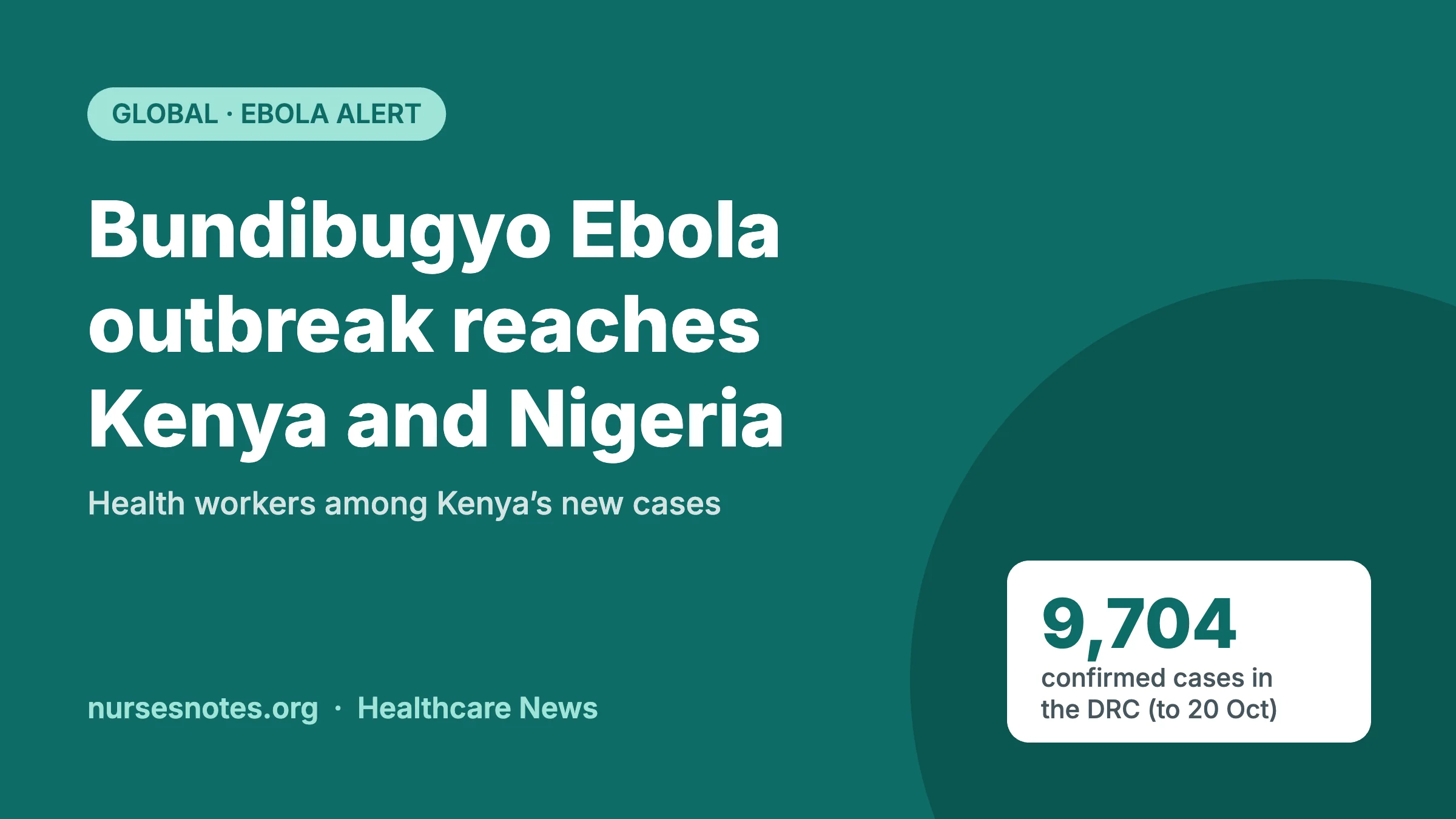
The Bundibugyo Ebola outbreak that began in the Democratic Republic of the Congo (DRC) has now reached Kenya and Nigeria, and four of Kenya’s nine confirmed cases are health and care workers, according to the World Health Organization (WHO). There is still no approved vaccine or specific treatment for Bundibugyo virus disease, so infection prevention and control in clinics and hospitals remains the main line of defence.
Key points
- The DRC had reported 9,704 confirmed cases and 4,687 deaths (a crude case fatality rate of 48.3%) as of 20 October 2026, according to WHO.
- Kenya has 9 confirmed cases, including 1 death; the 8 secondary cases are linked to one imported case and include four family members and four health and care workers.
- Nigeria confirmed its first imported case in Abuja on 20 October, and a Phase 2/3 vaccine trial (TUMAINI) began in Bunia, DRC, on 23 October.
What is happening in the Bundibugyo Ebola outbreak?
The outbreak was declared on 15 May 2026. Since then, WHO says cases have been reported in five countries: the DRC, Uganda, France, Kenya, and Nigeria.
Most cases are in eastern DRC. Ituri province alone has 7,040 cases and 3,271 deaths, and North Kivu has 2,146 cases and 1,199 deaths. Cases are spread across 66 health zones in eight provinces.
WHO noted 482 new deaths since its previous update, with 307 of them in the community rather than in treatment centres. Deaths outside care settings make contact tracing and safe burials harder.
| Country | Confirmed cases | Deaths | Notes |
|---|---|---|---|
| DRC | 9,704 | 4,687 | 66 health zones in 8 provinces |
| Kenya | 9 | 1 | 4 health and care workers among secondary cases |
| Nigeria | 1 | Not reported | Imported case in Abuja; 44 contacts identified |
How Ebola reached Kenya and Nigeria
Kenya’s first patient was an adult man who travelled from the DRC by road through Uganda and then flew to Nairobi on 3 October. He died on 5 October and was confirmed positive on 6 October, according to WHO Africa.
By 17 October, Kenya’s Ministry of Health said three of four newly confirmed cases were health workers who had cared for that first patient, Al Jazeera reported. The ministry said 128 of the first patient’s 130 contacts had been quarantined and that it saw no evidence of community spread.
In Nigeria, a woman who arrived from Uganda developed symptoms on 7 October and was admitted to a private hospital in Abuja on 11 October before Ebola was diagnosed, the Associated Press reported. Health Minister Muhammad Pate said 44 contacts had been identified and were being traced.
Is there a vaccine or treatment for Bundibugyo virus?
No. WHO states that no approved vaccines or specific treatments currently exist for Bundibugyo virus disease. Care focuses on early recognition and optimised supportive treatment.
A Phase 2/3 vaccine trial called TUMAINI enrolled its first participants in Bunia, DRC, on 23 October 2026. Results are not yet available.
WHO risk assessment and travel advice
- Risk is rated very high in the DRC, high in countries that share a land border with the DRC, and low for the rest of the African region and globally (assessed 14 August 2026; a revised assessment is in progress).
- WHO advises against any restriction of travel to, or trade with, affected countries.
- Kenya has screened 709,093 travellers at points of entry, and Kenya and Nigeria have received personal protective equipment (PPE) for health workers.
What it means for nurses
- The virus spreads through direct contact with the blood or body fluids of an infected person, or through contaminated materials. Standard and contact precautions, correct PPE use, and safe donning and doffing protect you and your colleagues.
- Ask every patient with fever about recent travel. Kenya’s and Nigeria’s cases were people who had travelled from the DRC or Uganda, and both were seen in health facilities before diagnosis.
- Know your facility’s isolation and referral pathway, and refresh your training on the WHO 5 Moments for Hand Hygiene.
- Nurses planning work in East or West Africa should follow official WHO and national health ministry updates rather than social media rumours.
Frequently asked questions
What is Bundibugyo virus?
Bundibugyo virus is one of the viruses that cause Ebola disease. It spreads through direct contact with the blood or body fluids of an infected person, or through contaminated materials. WHO says no approved vaccine or specific treatment exists yet for Bundibugyo virus disease, and the current outbreak has a crude case fatality rate of about 48% in the DRC.
Which countries have Ebola cases in 2026?
Since the outbreak was declared on 15 May 2026, WHO says cases have been reported in the DRC, Uganda, France, Kenya, and Nigeria. The DRC has by far the most cases. Kenya has nine confirmed cases, and Nigeria has one imported case in Abuja, according to WHO data to 20 October.
How are health workers being protected?
WHO and Kenya’s Ministry of Health have trained about 5,000 Kenyan health workers on Ebola prevention and management and delivered PPE kits and tests to high-risk counties. Nigeria’s disease control agency lists protecting health workers, isolation, and infection control among its priorities. Strict infection prevention remains essential.
Related on Nurses Notes
- 5 Moments for Hand Hygiene: nursing study guide
- Dengue cases in the Philippines in 2026
- Latest healthcare news for nurses
Sources
- Ebola disease caused by Bundibugyo virus, Democratic Republic of the Congo, Kenya and Nigeria (World Health Organization, 23 October 2026)
- Kenya confirms first imported Bundibugyo virus disease case (WHO Regional Office for Africa, October 2026)
- Kenya confirms four more Ebola cases, bringing total to seven (Al Jazeera, 17 October 2026)
- Nigeria confirms an Ebola case in Abuja (Associated Press via WUNC, 20 October 2026)
This summary is for information only and does not replace official guidance or advice from a qualified professional.