On this page
The WHO 5 moments for hand hygiene are: before touching a patient, before a clean or aseptic procedure, after body fluid exposure risk, after touching a patient, and after touching patient surroundings. Learn when each moment applies, how long to rub or wash, and the exam traps that catch nursing students out.
Key points
- The 5 moments are built around the patient zone: two moments come before contact and three come after.
- Alcohol-based handrub is the preferred method for routine care when hands are not visibly soiled; WHO’s handrub technique takes 20 to 30 seconds.
- Use soap and water when hands are visibly dirty or contaminated with body fluids, after using the toilet, and when spore-forming germs such as C. difficile are suspected, especially during outbreaks.
- Gloves never replace hand hygiene: clean your hands before putting gloves on and right after taking them off.
What are the 5 moments for hand hygiene?
WHO introduced “My 5 Moments for Hand Hygiene” in 2009 so health workers could remember exactly when to clean their hands during care. Each moment answers two questions: when to do it, and who you are protecting.
| Moment | When | Main purpose | Ward example |
|---|---|---|---|
| 1. Before touching a patient | As you approach the patient | Protects the patient from germs on your hands | Before taking a blood pressure or helping a patient sit up |
| 2. Before a clean or aseptic procedure | Immediately before the task | Protects the patient from germs, including their own, entering the body | Before inserting a cannula, preparing an injection, or doing wound care |
| 3. After body fluid exposure risk | Immediately after, and after removing gloves | Protects you and the care environment | After emptying a urine bag, suctioning, or handling a soiled dressing |
| 4. After touching a patient | When leaving the patient’s side | Protects you and the care environment | After a head-to-toe assessment or turning a patient |
| 5. After touching patient surroundings | When leaving, even if the patient was not touched | Protects you and the care environment | After adjusting an IV pump, bed rails, or the bedside table |
Why hand hygiene matters in nursing
WHO describes hand hygiene as the single most important measure for preventing infections linked to health care. Nurses touch patients, equipment, and shared surfaces more often than almost anyone else on the ward.
CDC notes that some health workers may need to clean their hands as many as 100 times in one shift. That is why fast, skin-friendly alcohol handrub at the point of care makes such a difference to real-world compliance.
Handrub vs handwashing: which one to use
Both methods work when done properly, but they are not interchangeable in every situation. Use this quick guide.
| Situation | Best method |
|---|---|
| Routine care, hands not visibly soiled | Alcohol-based handrub (CDC recommends at least 60% alcohol) |
| Hands visibly dirty or soiled with blood or body fluids | Soap and water |
| After using the toilet | Soap and water |
| Suspected or confirmed spore-forming germs (for example C. difficile), especially during outbreaks | Soap and water, plus gloves and gown as required |
| Patient with vomiting or diarrhoea (UK guidance) | Soap and water preferred |
| No handrub available | Soap and water |
CDC adds that even with C. difficile, the priority is correct use and removal of gloves and gowns, because spores can stay on hands after any cleaning method. Always follow your facility’s isolation policy.
Hand hygiene technique step by step
WHO’s posters break each method into simple steps. The goal is to cover every surface, including the areas most often missed: thumbs, fingertips, and the spaces between fingers.
Alcohol-based handrub (20 to 30 seconds)
- Apply a palmful of handrub into a cupped hand, enough to cover all surfaces.
- Rub palm to palm.
- Rub the right palm over the back of the left hand with fingers interlaced, then switch hands.
- Rub palm to palm with fingers interlaced.
- Rub the backs of the fingers against the opposite palm with fingers interlocked.
- Rub each thumb in a rotating motion inside the opposite clasped hand.
- Rub the fingertips of each hand in circles in the opposite palm.
- Keep rubbing until your hands are dry; then they are safe.
Handwashing with soap and water (40 to 60 seconds)
- Wet your hands with water and apply enough soap to cover all surfaces.
- Follow the same rubbing steps as the handrub technique.
- Rinse your hands well with water.
- Dry thoroughly with a single-use towel.
- Use the towel to turn off the tap.
CDC advises avoiding hot water, because repeated exposure dries the skin. Pat hands dry and use facility-approved hand lotion to protect your skin.
Nursing considerations
Good technique starts before you even reach the sink or dispenser. These points come up in practice and on exams.
- Gloves: Gloves do not replace hand hygiene. Clean hands before donning and immediately after removing gloves, and change gloves between patients or when moving from a soiled to a clean body site.
- Nails: Keep natural nails short. Do not wear artificial nails, especially when caring for high-risk patients such as those in ICUs or operating rooms.
- Jewellery: Remove wrist and hand jewellery before clinical work. Many facilities allow a plain band only, so check local policy.
- Cuts and skin: Cover cuts and abrasions with a waterproof dressing, and report damaged or irritated skin to occupational health.
- Dispensers: Do not top up partly empty soap or handrub containers, because this can lead to contamination.
Hand hygiene is also part of every procedure checklist you will learn, from neuro checks with the Glasgow Coma Scale to giving medicines from the types of insulin chart.
Exam tips
Board and NCLEX-style questions often test the “why” behind each moment. Keep these memory aids and traps in mind.
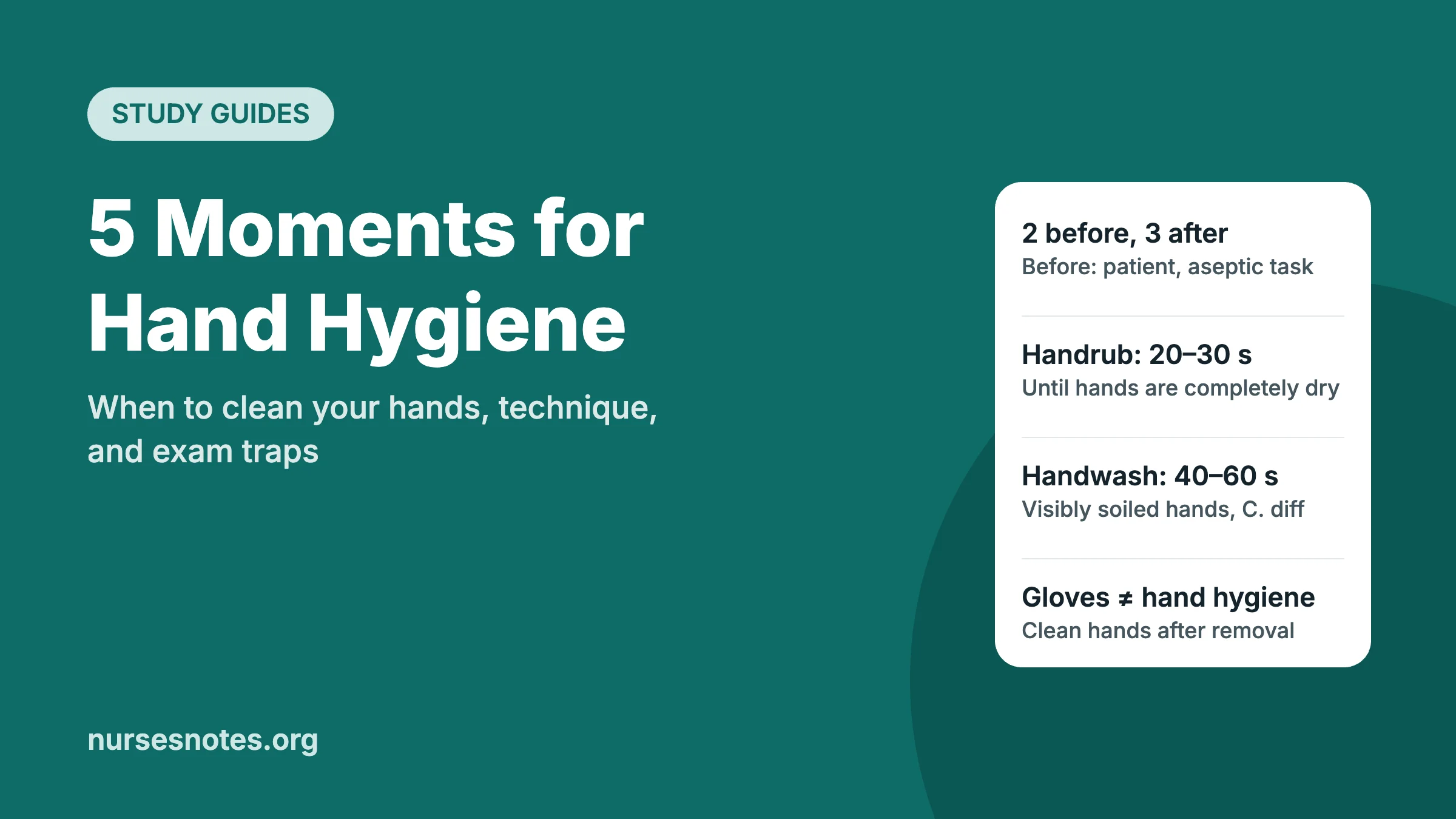
- Memory aid: “2 before, 3 after.” Moments 1 and 2 protect the patient; moments 3, 4, and 5 protect you and the environment.
- Trap 1: Wearing gloves does not cancel moment 3. You still clean your hands after removing gloves.
- Trap 2: Moment 5 applies even if you never touched the patient, such as after silencing an IV pump alarm.
- Trap 3: Moment 2 comes after moment 1 when you go straight from touching the patient to an aseptic task; clean your hands again right before the procedure.
- Trap 4: Visibly soiled hands always need soap and water, not handrub.
- Timing: Handrub 20 to 30 seconds; full WHO handwash 40 to 60 seconds. Some guidance (for example CDC) gives a shorter minimum rubbing time with soap, so learn the figure your exam and facility use.
Frequently asked questions
What are the WHO 5 moments of hand hygiene in order?
The five moments are: 1) before touching a patient, 2) before a clean or aseptic procedure, 3) after body fluid exposure risk, 4) after touching a patient, and 5) after touching patient surroundings. The first two protect the patient, while the last three protect the health worker and the care environment from patient germs.
How long should you rub alcohol hand sanitizer?
WHO’s handrub technique takes 20 to 30 seconds. Use enough product to cover every surface of both hands and keep rubbing until your hands are completely dry. CDC describes this as about 20 seconds. If your hands are still wet, you have not finished, and if they dry too quickly, you probably used too little.
When should nurses use soap and water instead of hand sanitizer?
Use soap and water when your hands are visibly dirty or soiled with blood or body fluids, after using the toilet, and when spore-forming germs such as C. difficile are suspected or confirmed, especially during outbreaks. Use it too if no handrub is available. Always follow your facility’s infection control and isolation policies.
Related on Nurses Notes
- Glasgow Coma Scale: scoring guide and nursing assessment
- Types of insulin chart: onset, peak, and duration
- Signs of nurse burnout and how to recover
- All nursing study guides
Sources
- Your 5 Moments for Hand Hygiene (poster) – World Health Organization, 2009
- How to Handrub? (poster) – World Health Organization, 2009
- How to Handwash? (poster) – World Health Organization, 2009
- Patient Safety Curriculum Guide handout: Infection prevention and control – World Health Organization, 2012
- Clinical Safety: Hand Hygiene for Healthcare Workers – Centers for Disease Control and Prevention, 2024
- Indications and Techniques for Hand Hygiene (literature review, version 2.0) – ARHAI Scotland, NHS National Services Scotland, 2023
This article is for education only and does not replace advice from your own doctor, nurse, or other qualified health professional. Always follow your facility’s policies and reference ranges.