On this page
Chickenpox in children usually starts with a mild fever and tiredness, followed by an itchy rash of spots that turn into blisters and then scabs over about a week. Most children recover at home with fluids, comfort care, and plenty of rest, but some signs mean you should get medical help quickly.
Key points
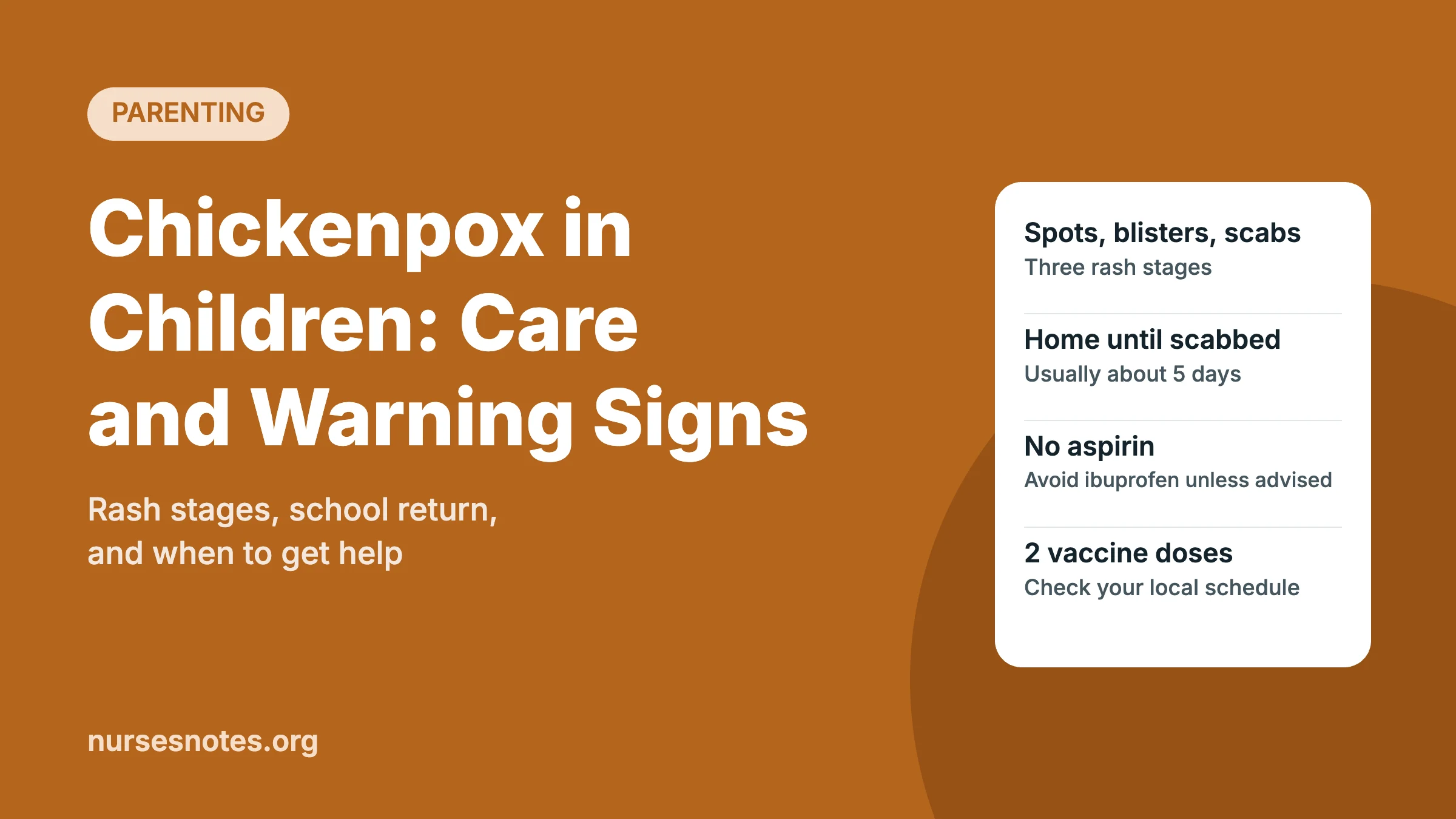
- The rash moves through three stages: spots, fluid-filled blisters, and scabs.
- Your child is infectious from about 2 days before the spots appear until all of them have scabbed, usually around 5 days after the rash starts.
- Do not give aspirin, and avoid ibuprofen unless a doctor advises it.
- Two doses of chickenpox (varicella) vaccine give strong protection; check your local schedule.
What is chickenpox?
Chickenpox is a very contagious infection caused by the varicella-zoster virus. It is most common in children, and while it is usually mild, CDC notes it can be more serious for babies, teenagers, adults, pregnant women, and people with weakened immune systems.
Chickenpox symptoms in children
CDC explains that 1 to 2 days before the rash, children may have a fever, tiredness, loss of appetite, or a headache. MedlinePlus adds that some children also have a stomach ache.
| Stage | What you may see |
|---|---|
| 1. Spots | Small, itchy red spots, often starting on the chest, back, and face before spreading. They can be harder to see on brown or black skin. |
| 2. Blisters | The spots fill with fluid and become blisters, which may burst. |
| 3. Scabs | The blisters dry out and form scabs. New spots can keep appearing for a few days, so all three stages may be seen at once. |
How chickenpox spreads
The virus spreads easily through the air when an infected person coughs or sneezes, and by touching fluid from the blisters. A person with shingles can also pass on chickenpox to someone who has never had it.
Spots usually appear 1 to 3 weeks after contact with the virus (NHS). MedlinePlus puts this at about 10 to 21 days.
When can my child go back to school?
Keep your child home from school, nursery, or daycare until all the spots have crusted over or formed scabs. The NHS says this is usually about 5 days after the spots first appeared.
While your child is infectious, keep them away from newborn babies, pregnant women, and anyone with a weakened immune system.
How to care for a child with chickenpox at home
- Give plenty of fluids. Offer water or milk often. Ice lollies can help if your child is not drinking well or has spots in the mouth.
- Ease fever and pain. Paracetamol can help. Doses depend on your child’s weight and the product, so follow the label or ask your doctor or pharmacist. See also how to bring down a child’s fever safely.
- Soothe the itch. Cooling gels or creams from a pharmacy, cool or lukewarm baths, and patting the skin dry can help. Ask a pharmacist whether an antihistamine is suitable for your child’s age.
- Prevent scratching. Keep nails short and put socks or mittens on your child’s hands at night to reduce infection and scarring.
- Dress them lightly. Loose, cotton clothes are more comfortable and less irritating.
Medicines to avoid
- Aspirin: do not give it to children with chickenpox. It has been linked with Reye syndrome, a rare but serious illness (MedlinePlus), and the NHS advises no aspirin for anyone under 16.
- Ibuprofen: the NHS advises avoiding it unless a doctor recommends it, as it may cause serious skin infections in chickenpox.
When to get medical help
Contact a doctor or your local health service urgently if:
- The skin around the blisters becomes red, hot, swollen, or painful, which can mean a skin infection
- Your child shows signs of dehydration, such as fewer wet nappies or passing less urine than usual
- Your child is more short of breath than usual
- Your baby is under 4 weeks old and has chickenpox or has been near someone with it
- Your child has a weakened immune system and has chickenpox or has been exposed to it
- You are pregnant and have been in contact with chickenpox, and you have not had it before
Go to emergency care or call your local emergency number if your child has severe difficulty breathing, has a seizure, is very drowsy or hard to wake, or seems confused. CDC notes chickenpox can rarely lead to pneumonia, brain swelling, or sepsis.
Doctors sometimes prescribe antiviral medicine for children at higher risk. It works best if started within 24 hours of the rash appearing, so contact a doctor early if your child is in a high-risk group.
Chickenpox vaccine
Vaccination is the best way to prevent chickenpox. CDC recommends 2 doses for children: the first at 12 to 15 months and the second at 4 to 6 years, and says 2 doses are about 90% effective.
Schedules differ between countries; in the UK, for example, the combined MMRV vaccine is offered at 12 and 18 months. Ask your child’s doctor or local health centre which schedule applies where you live.
Frequently asked questions
How long is chickenpox contagious?
A child with chickenpox can spread it from about 2 days before the spots appear until every spot has crusted over or scabbed. The NHS says this is usually around 5 days after the spots first appeared. Keep your child home from school or daycare until then, and away from newborns and pregnant women.
Can a child get chickenpox twice?
Most people only have chickenpox once, because the body builds lasting immunity. The virus stays in the body afterwards and can later reactivate as shingles. MedlinePlus notes that the vaccine often prevents chickenpox completely or makes the illness very mild, so vaccinated children who do catch it usually have a lighter case.
What helps chickenpox itching in children?
Cool or lukewarm baths, patting the skin dry, loose cotton clothes, and cooling gels or creams from a pharmacy can all ease itching. Keep nails short and cover hands at night to limit scratching. Ask a pharmacist or doctor before using an antihistamine, as suitability depends on your child’s age.
Related on Nurses Notes
- How to bring down a child’s fever safely
- Hand, foot, and mouth disease in children
- All Parenting articles on Nurses Notes
Sources
- Chickenpox. NHS; reviewed January 2025.
- Chickenpox Symptoms and Complications. Centers for Disease Control and Prevention (CDC); 2024.
- Chickenpox Vaccination. Centers for Disease Control and Prevention (CDC); 2024.
- Chickenpox. MedlinePlus Medical Encyclopedia, U.S. National Library of Medicine; reviewed July 2025.
This article is for education only and does not replace advice from your own doctor, nurse, or other qualified health professional.