On this page
To bring down a child’s fever safely at home, focus on comfort: offer plenty of fluids, dress your child in one light layer, let them rest, and give a fever medicine made for children only if they are distressed or uncomfortable. Most fevers are the body’s normal response to an infection, but some signs, especially in babies under 3 months, mean you should get medical help straight away.
Key points
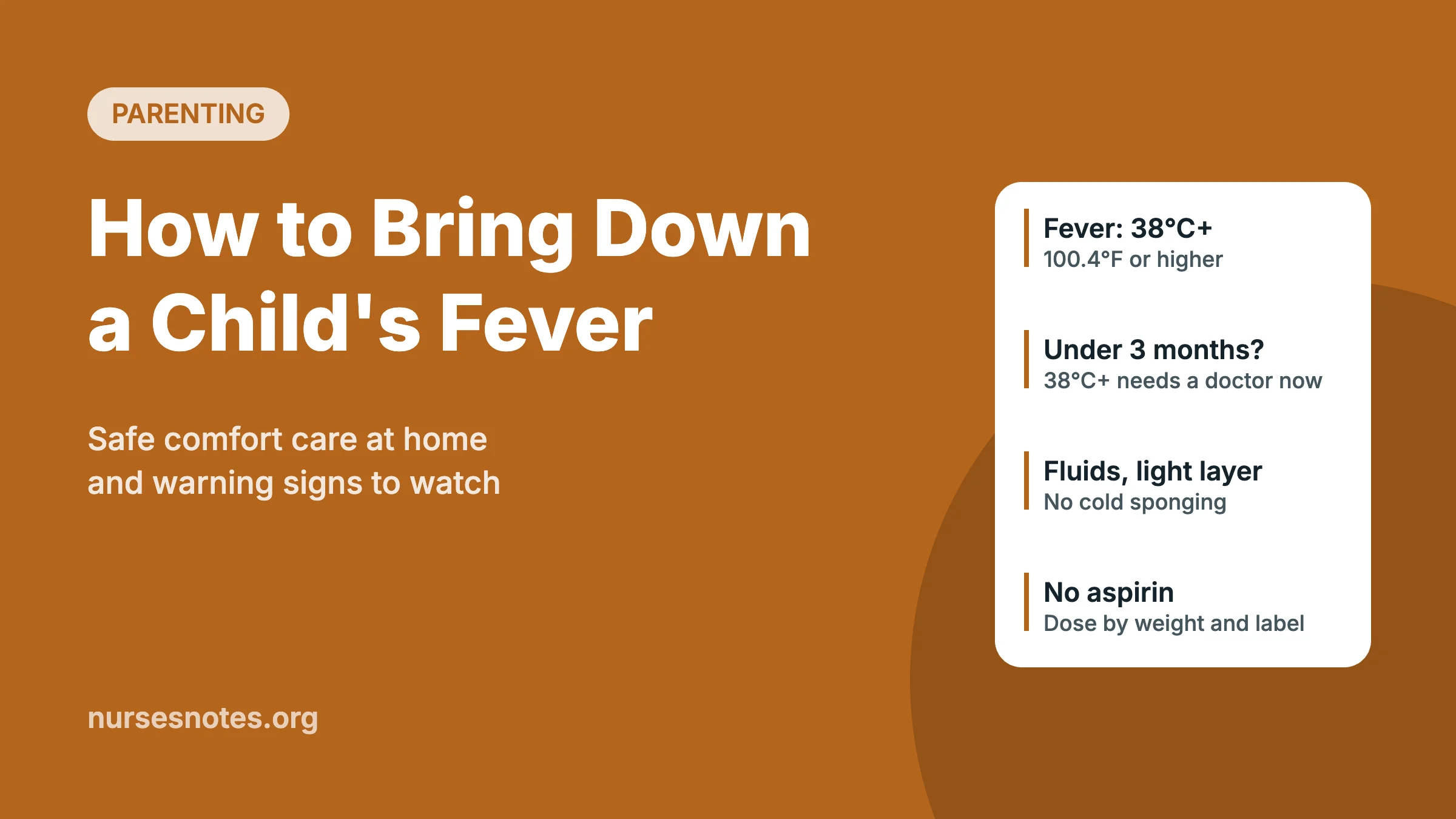
- A fever is a temperature of 38°C (100.4°F) or higher.
- Any baby under 3 months with a temperature of 38°C or more needs to be checked by a doctor urgently.
- The goal is to make your child comfortable, not to bring the number down to normal.
- Never give aspirin to children, and do not sponge with cold water or alcohol.
What counts as a fever in a child?
A normal body temperature is around 37°C (98.6°F). A temperature of 38°C (100.4°F) or higher is a fever. Feeling the forehead is not reliable, so use a digital thermometer.
The NHS suggests placing a digital thermometer in the armpit for young children, while the American Academy of Pediatrics (AAP) notes that a rectal reading is the most accurate for babies. If your child has just had a bath or been wrapped up, wait a few minutes before checking.
Fever is very common in young children and usually settles within 1 to 4 days. Common causes include colds, tonsillitis and chickenpox, and a mild fever can also follow vaccinations.
How to bring down a child’s fever at home
- Offer fluids often. Fever increases fluid loss. Keep breastfeeding as normal, and offer water or other drinks to older children. Watch for signs of dehydration.
- Dress them lightly. One light layer is enough. Add a light blanket if they are shivering, but do not bundle them up.
- Do not sponge or use cold baths. Sponging, ice packs and alcohol rubs are no longer recommended and can be harmful.
- Let them rest and offer food if they want it.
- Check on them regularly, including at night, and keep them home from school or daycare while unwell.
- Consider a fever medicine only if your child is uncomfortable. See the next section.
Fever medicines for children: what to know
Paracetamol (acetaminophen) or ibuprofen can make a child more comfortable. The right dose depends on your child’s weight and age and on the exact product, so always follow the label or ask your doctor or pharmacist. For children under 2, check the dose with your doctor or pharmacist first.
| Do not give… | Why or when |
|---|---|
| Aspirin | Not for children under 16 (NHS) |
| Paracetamol | To babies under 2 months |
| Ibuprofen | To babies under 3 months or under 5 kg, children with chickenpox, or a child who is dehydrated |
| Ibuprofen to a child with asthma | Unless a doctor has said it is suitable |
| Paracetamol and ibuprofen alternately | Unless a health professional advises it |
A good sign is a child who plays and interacts normally once the medicine has made them comfortable. If your child still seems very unwell after the fever comes down, contact a doctor.
When to get medical help
Call a doctor or get urgent advice if:
- Your baby is under 3 months old with a temperature of 38°C (100.4°F) or higher.
- Your baby is 3 to 6 months old with a temperature of 39°C or higher.
- The fever lasts more than 24 hours in a child under 2, or more than 3 days in a child 2 or older.
- The temperature repeatedly goes above 40°C (104°F).
- Your child has a rash, is not feeding or drinking well, or does not seem like themselves.
- There are signs of dehydration: very few wet nappies, no tears when crying, sunken eyes or a sunken soft spot.
- Your child has a long-term condition that affects immunity, such as sickle cell disease or cancer, takes steroids, or has a heart problem.
Call your local emergency number or go to the emergency department now if your child:
- Has a stiff neck, sensitivity to light or a severe headache.
- Has a rash that does not fade when you press a glass against it.
- Has a seizure (fit) for the first time.
- Is drowsy and hard to wake, extremely agitated or confused, or not responding normally.
- Has difficulty breathing or very fast breathing.
- Has blue, grey, very pale or blotchy skin, lips or tongue, or unusually cold hands and feet.
- Has been in a very hot place, such as a closed car.
Frequently asked questions
What temperature is too high for a child?
Any fever of 38°C (100.4°F) or more in a baby under 3 months needs urgent medical review. In older children, how they look and act matters more than the exact number. A temperature that repeatedly goes above 40°C (104°F), or any red-flag sign such as a stiff neck or a rash that does not fade, needs medical help.
Should I wake my child to give fever medicine?
Fever medicine is for comfort: the NHS advises it when a child is distressed or uncomfortable, not simply to lower the number. A child sleeping peacefully does not need it, but keep checking on them through the night, and ask a pharmacist if unsure. Wake them and seek help if they are hard to rouse, breathing fast or have any warning signs.
Is it safe to bathe a child with a fever?
Cold baths, ice packs, sponging and alcohol rubs are no longer recommended because they can be harmful. Keep the room comfortable, dress your child in one light layer, and offer plenty of fluids instead.
Related on Nurses Notes
- Signs of dehydration and how to rehydrate safely
- More parenting and child health guides
- Newborn jaundice: signs and when to worry
Sources
- NHS. High temperature (fever) in children. NHS (UK), reviewed January 2024.
- American Academy of Pediatrics. Fever without fear: information for parents. HealthyChildren.org, updated September 2025.
- American Academy of Pediatrics. Fever and your child: when to call the pediatrician. HealthyChildren.org, updated December 2022.
This article is for education only and does not replace advice from your own doctor, nurse or other qualified health professional.