On this page
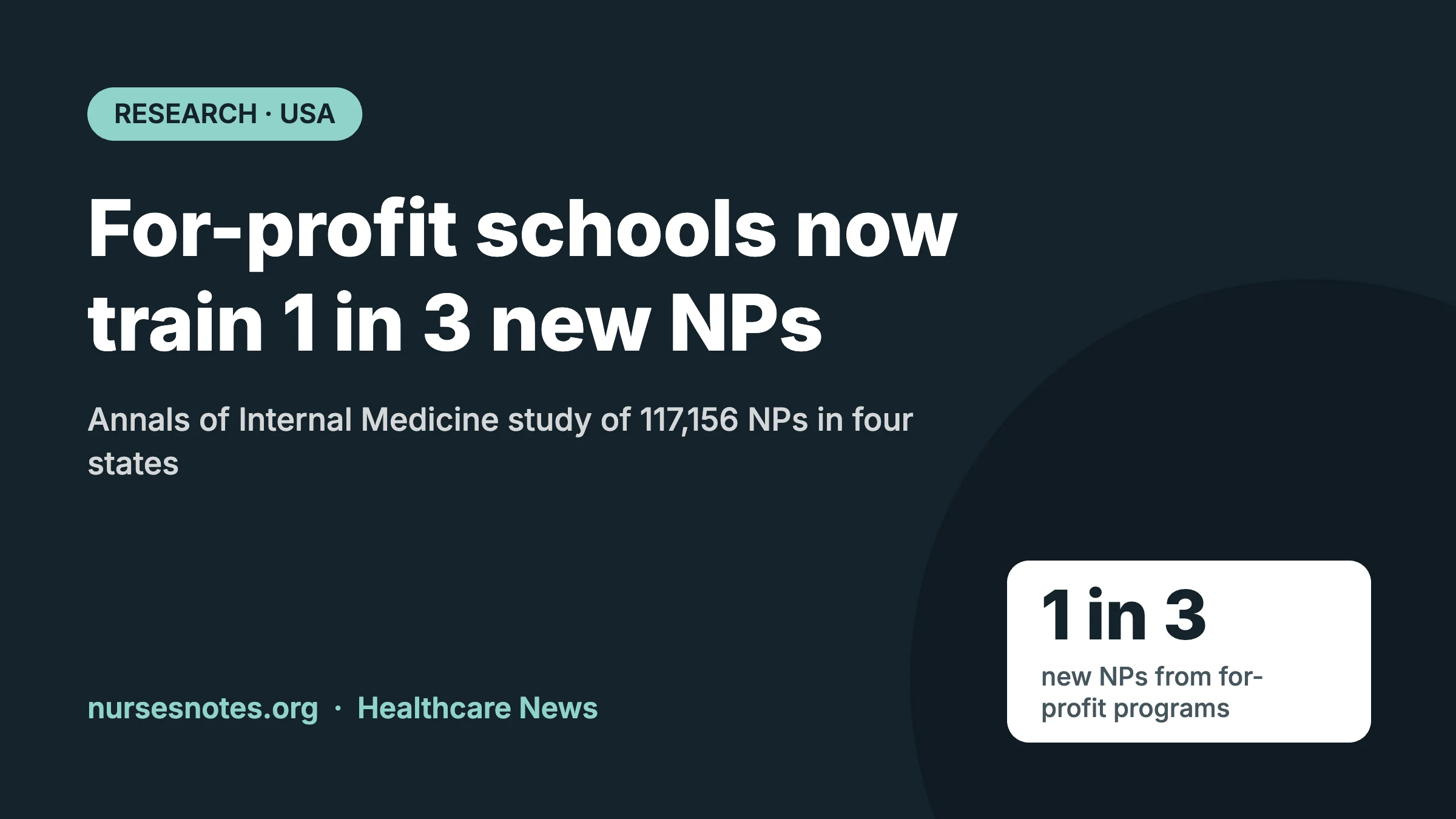
For-profit nurse practitioner schools now educate nearly one in three newly licensed NPs in four large US states, up from 2.4% in 2010, according to a study in Annals of Internal Medicine. The analysis covered 117,156 nurse practitioners licensed in California, Florida, Iowa, and Texas between 2010 and 2024.
Key points
- Nearly one-third of new nurse practitioners in the four states trained at for-profit programs in 2024, compared with 2.4% in 2010.
- California had the highest share at 40.9%, followed by Florida (35.1%), Texas (21.1%), and Iowa (14.8%).
- The study did not measure patient outcomes, so it cannot show whether for-profit training affects quality of care.
What the for-profit nurse practitioner schools study found
Researchers led by senior author Dr. Michael Barnett of the Brown University School of Public Health tracked where newly licensed nurse practitioners were educated over 15 years. The paper, “Growth in the Share of Advanced Practice Registered Nurses Educated at For-Profit Programs in Four U.S. States,” was published on 6 October 2026.
The headline finding is a steep rise. In 2010, only 2.4% of new NPs in these states came from for-profit programs; by 2024, the share was close to one-third. Barnett told Brown University News: “There has been an explosion in the nurse practitioner workforce.”
| State | Share of new NPs from for-profit programs (2024) |
|---|---|
| California | 40.9% |
| Florida | 35.1% |
| Texas | 21.1% |
| Iowa | 14.8% |
| All four states (2010) | 2.4% |
| All four states (2024) | Nearly one-third |
Why the growth in for-profit NP programs matters
Demand for nurse practitioners is rising fast. The US Bureau of Labor Statistics projects NP jobs to grow 35% over 10 years, compared with 3% for physicians, the study release noted.
Many for-profit programs are online and flexible, which can help working RNs, career changers, and students far from a university. The researchers point out, however, that there is little public data on how these programs perform.
The release also cites earlier evidence linking for-profit nursing education to lower NCLEX pass rates. That earlier evidence comes from separate research, not from this study.
Limitations
- Only four states. California, Florida, Iowa, and Texas may not reflect the whole US.
- No patient outcomes. The study describes where NPs trained; it does not show whether for-profit graduates give better or worse care.
- Descriptive, not causal. It tracks trends over time and cannot explain why the shift happened.
- Limited transparency. The authors note that hard data on program quality, clinical placements, and graduate performance are scarce.
What it means for nurses
- Check accreditation before you enrol. Confirm the program is accredited by CCNE or ACEN and that graduates can sit for national NP certification.
- Ask for outcome data. Request certification pass rates, completion rates, and how the school arranges clinical placements; programs that make you find your own preceptors can delay graduation.
- Compare total cost. Look at full tuition and fees, not just the per-credit price, and weigh it against expected NP pay in your state.
- International nurses: if you plan to work in the US, check that the program meets the licensing rules of the state where you want to practise. Our nursing study guides can help you prepare for exams along the way.
Frequently asked questions
How many nurse practitioners go to for-profit schools?
In California, Florida, Iowa, and Texas, nearly one in three newly licensed nurse practitioners in 2024 trained at a for-profit program, up from 2.4% in 2010. California had the highest share at 40.9%. National figures were not part of this study, which looked at 117,156 NPs in those four states.
Are for-profit nurse practitioner programs bad?
This study does not answer that. It shows rapid growth but did not measure patient outcomes or graduate skills. Earlier separate research has linked for-profit nursing education to lower NCLEX pass rates. Before enrolling, check accreditation, certification pass rates, and how the program arranges clinical placements.
How do I check if an NP program is accredited?
Look up the program on the websites of the Commission on Collegiate Nursing Education (CCNE) or the Accreditation Commission for Education in Nursing (ACEN). Also ask the school for its national certification pass rates and confirm that graduates are eligible for licensure in the state where you plan to work.
Related on Nurses Notes
- CMS Nurses for Nursing Homes loan repayment program
- Nurse understaffing and patient mortality study
- Latest healthcare news for nurses
Sources
- Growth in the Share of Advanced Practice Registered Nurses Educated at For-Profit Programs in Four U.S. States – Annals of Internal Medicine, 6 October 2026
- Nearly one in three new nurse practitioners educated at for-profit schools, study finds – Brown University News, 8 October 2026
- Nearly 1 in 3 new nurse practitioners educated at for-profit schools, study finds – EurekAlert!, 8 October 2026
This summary is for information only and does not replace official guidance or advice from a qualified professional.