
On this page
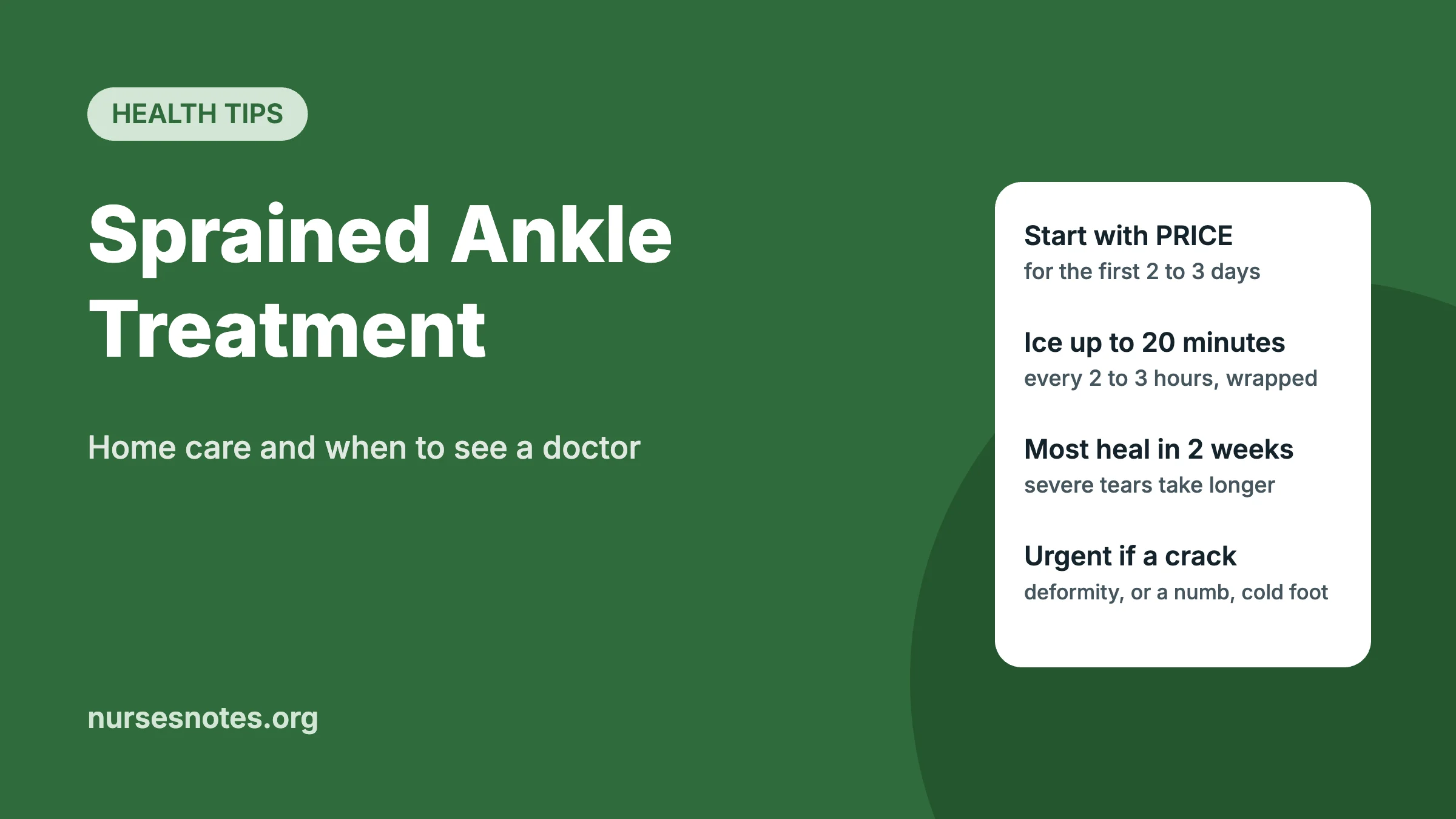
Sprained ankle treatment at home usually means PRICE for the first 2 to 3 days: protection, rest, ice, compression, and elevation, followed by gentle movement as the pain allows. Most mild sprains improve within about 2 weeks, but some signs, such as being unable to stand on the foot, mean you should get it checked for a fracture.
Key points
- A sprain is a stretched or torn ligament; most ankle sprains happen when the foot rolls inward.
- Use PRICE for the first 2 to 3 days and avoid heat, alcohol, and massage, which can increase swelling.
- Mild sprains often settle in 1 to 2 weeks; complete tears can take several months.
- Get urgent help if you heard a crack, the ankle looks deformed, or the foot is numb, cold, or blue.
What is a sprained ankle?
Ligaments are tough bands of tissue that hold the ankle bones together and keep the joint stable. A sprain happens when one or more of these ligaments is stretched or torn, most often on the outer side of the ankle.
Common causes include rolling the foot inward during a fall, landing awkwardly after a jump, walking on uneven ground, and someone stepping on your foot. A previous sprain, weak ankles, poor balance, and unsuitable shoes, including high heels, raise the risk.
Sprained ankle symptoms
- Pain, especially when you put weight on the foot
- Tenderness, swelling, and bruising
- Less movement in the ankle
- A feeling that the ankle may give way
- A pop felt or heard at the moment of injury
| Grade | What has happened | Typical signs |
|---|---|---|
| Grade 1 (mild) | Ligament stretched, with tiny tears | Mild tenderness and swelling; the ankle feels stable |
| Grade 2 (moderate) | Ligament partly torn | Moderate swelling and pain when standing; slight looseness |
| Grade 3 (severe) | Ligament completely torn | Significant swelling, severe pain when standing, and an unstable ankle |
How to treat a sprained ankle at home
For the first 2 to 3 days, follow PRICE:
- Protect the ankle with a support or sturdy, supportive shoes.
- Rest it: stop the activity and keep weight off it as much as you can.
- Ice it with an ice pack or frozen peas wrapped in a thin towel for up to 20 minutes every 2 to 3 hours. Never put ice directly on the skin.
- Compress it with an elastic bandage during the day, starting at the end farthest from the heart (the toes) and wrapping up toward the leg. It should feel snug, not tight; loosen it if your toes tingle, go numb, or change colour.
- Elevate it on a pillow, ideally above the level of your heart, especially at night.
If you have diabetes, vascular disease, or reduced feeling in your skin, check with a doctor before using ice. For other first aid basics, see our guide on how to treat a burn at home.
What to avoid in the first few days
The NHS advises avoiding heat (such as hot baths or heat packs), alcohol, and massage for the first couple of days, because they can increase swelling. Avoid strenuous exercise such as running for up to 8 weeks to lower the risk of injuring it again.
Pain relief
Over-the-counter pain relievers such as paracetamol (acetaminophen) or ibuprofen can help. Follow the label, and ask a pharmacist or doctor first if you have heart, kidney, liver, or stomach problems, or if you need them for more than 10 days.
When to start moving
Once the pain no longer stops you, start moving the ankle gently so it does not become stiff. Pain and swelling usually improve within about 48 hours, after which you can slowly put more weight on the foot. Stop if it hurts.
How long does a sprained ankle take to heal?
Most sprains improve within about 2 weeks, and bruising usually fades within that time. More severe sprains, such as complete tears, can take several weeks to months, and rehabilitation for these often takes 6 to 12 weeks. Balance and strengthening exercises help prevent the ankle from giving way again.
When to get medical help
Go to the emergency department or call your local emergency number if:
- You heard a crack when you were injured
- The ankle has changed shape or points at an odd angle
- The foot is numb, tingling, or has pins and needles
- The skin looks blue or grey, or feels cold
Do not drive yourself; ask someone to take you.
See a doctor or urgent care the same day if:
- The pain is severe or getting worse
- Swelling or bruising is large or spreading
- You cannot put any weight on the foot or walk more than a few steps
- The ankle is very stiff or hard to move
- You have a fever or feel hot, cold, or shivery
Also see a doctor if the ankle is not improving after 5 to 7 days of self-care, or if it keeps feeling weak or giving way. A doctor may order an X-ray if you have trouble bearing weight or tenderness over the bones.
How to prevent ankle sprains
- Warm up before sport or exercise.
- Do balance and strengthening exercises.
- Take care on uneven ground.
- Wear shoes that fit well and suit the activity, and limit high heels.
- Consider a brace or tape if your ankle has been injured before.
Frequently asked questions
Should I walk on a sprained ankle?
Rest it and keep weight off it for the first couple of days. Once pain and swelling start to ease, usually after about 48 hours, gradually put weight on the foot and move it gently so it does not stiffen. If you cannot put any weight on it or walk more than a few steps, see a doctor.
Should I use ice or heat on a sprained ankle?
Use ice, not heat, in the first few days. Wrap an ice pack in a thin towel and apply it for up to 20 minutes every 2 to 3 hours. Heat, such as hot baths or heat packs, can increase swelling early on, so the NHS advises avoiding it for the first couple of days.
How do I know if my ankle is broken or sprained?
You cannot always tell at home, because a severe sprain can look like a fracture. Signs that need urgent care include hearing a crack, an ankle that looks deformed, numbness, a cold or blue foot, and being unable to bear weight. A doctor can examine you and may order an X-ray.
Related on Nurses Notes
- How to treat a burn at home: first aid steps
- How to stop a nosebleed: first aid steps
- More health tips
Sources
- Sprains and strains, NHS, reviewed 2024
- Sprained ankle – Symptoms and causes, Mayo Clinic, 2026
- Sprained ankle – Diagnosis and treatment, Mayo Clinic, 2026
- Ankle sprain – aftercare, MedlinePlus (NIH), 2024
- Sprained Ankle, Cleveland Clinic, 2026
- Sprained Ankle, OrthoInfo (American Academy of Orthopaedic Surgeons), accessed November 2026
This article is for education only and does not replace advice from your own doctor, nurse, or other qualified health professional.