On this page
- What is appendicitis?
- Early signs of appendicitis
- Other symptoms of appendicitis
- Appendicitis in children, pregnancy, and older adults
- Why a burst appendix is an emergency
- How appendicitis is diagnosed and treated
- What to do if you think it is appendicitis
- When to get medical help
- Frequently asked questions
The classic appendicitis symptoms are pain that starts around the belly button and then moves to the lower right side of the abdomen, getting steadily worse, often with nausea, vomiting, loss of appetite, and a mild fever. Appendicitis needs urgent medical care, so anyone with worsening belly pain like this should be seen by a doctor the same day.
Key points
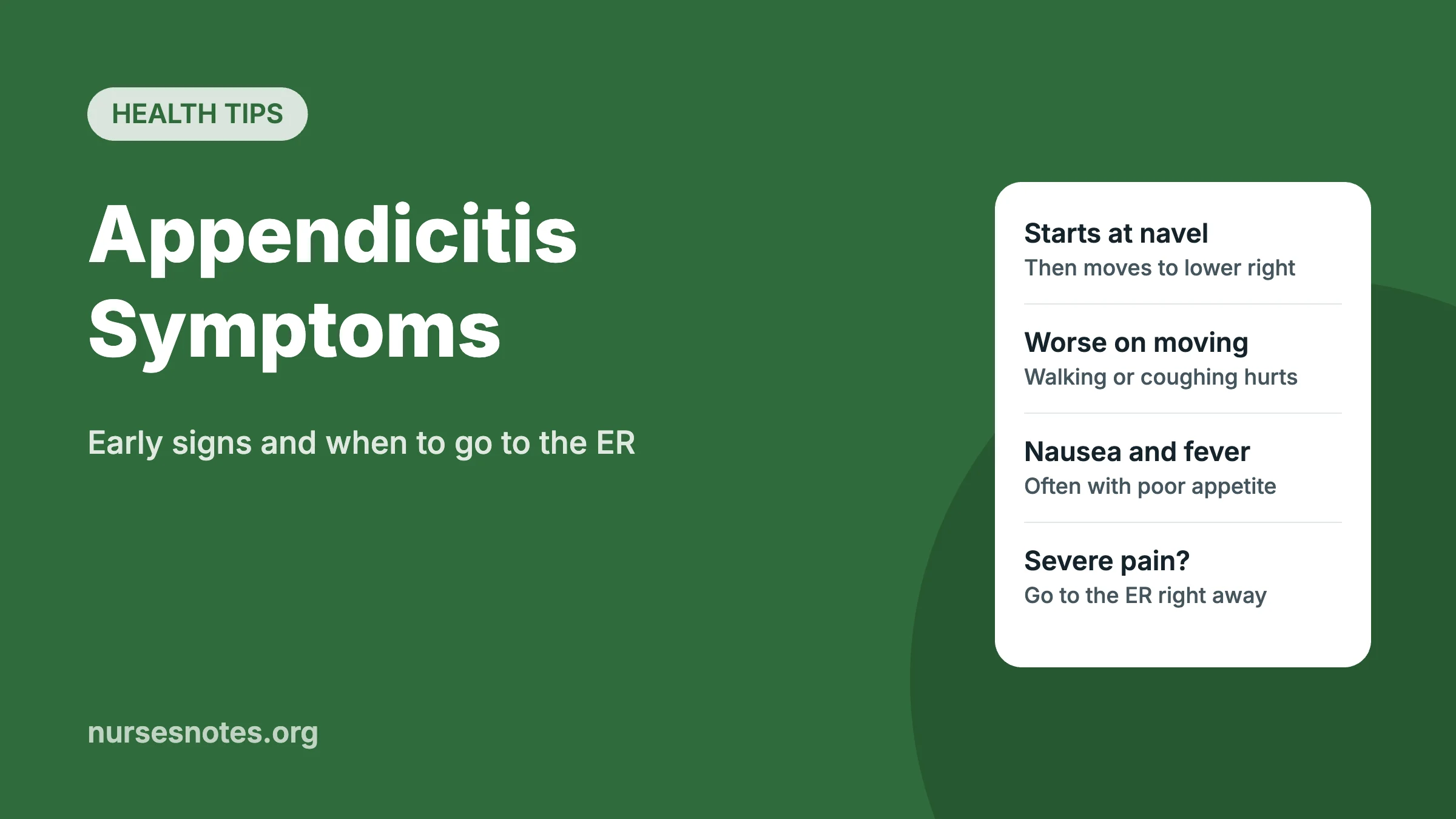
- Pain usually begins near the belly button and moves to the lower right abdomen over several hours.
- The pain often gets worse when you walk, cough, or press on the area.
- Children, pregnant women, and older adults may not have the typical pattern.
- Severe pain that spreads across the whole belly can mean the appendix has burst. Go to the emergency room straight away.
What is appendicitis?
Appendicitis is swelling and infection of the appendix, a small finger-shaped pouch attached to the large intestine on the lower right side of the abdomen. It usually happens when the inside of the appendix becomes blocked, for example by hard stool, and bacteria then multiply inside it.
It is one of the most common reasons for emergency surgery. Anyone can get it, but it is most common between the ages of 10 and 30, according to Mayo Clinic, and it is rare in babies under 12 months.
Early signs of appendicitis
Symptoms often develop in a recognizable order, although only about half of people have this classic pattern, according to Cleveland Clinic.
- Pain around the belly button that may come and go at first.
- Pain moving to the lower right abdomen, usually after a few hours (MedlinePlus says this most often happens 12 to 24 hours after the illness starts).
- Pain that becomes sharper and more constant, and worse with movement, coughing, or pressing on the area.
- Nausea, vomiting, and loss of appetite.
- A low-grade fever that may rise as the illness worsens.
Other symptoms of appendicitis
- Constipation, diarrhea, or being unable to pass gas.
- A swollen or bloated belly.
- Needing to pee more often or more urgently.
- Sudden confusion in older people.
Many other problems can cause similar pain, including a urinary tract infection, kidney stones, gallstones, ovarian cysts, and ectopic pregnancy. Do not try to work out the cause yourself; let a doctor examine you.
Appendicitis in children, pregnancy, and older adults
Appendicitis can be harder to spot in young children, older adults, and women of childbearing age. Pain may be milder, start more slowly, or appear in a different place.
- Children: young children may not be able to say where it hurts. Watch for belly pain that keeps getting worse, loss of appetite, vomiting, fever, or pain that is worse when they move or cough.
- Pregnancy: the appendix sits higher as the womb grows, so pain may seem to come from the upper abdomen.
- Older adults: symptoms may be vague, and sudden confusion can be a sign of serious infection.
Why a burst appendix is an emergency
If appendicitis is not treated, the appendix can burst. Cleveland Clinic notes this can happen within 36 hours of the first symptoms. Infection can then spread through the abdomen (peritonitis), form a pocket of pus (abscess), or lead to sepsis.
A warning sign is pain that eases suddenly for a short time and then becomes severe and spreads across the whole belly.
How appendicitis is diagnosed and treated
There is no single test that always confirms appendicitis. A doctor will usually examine your abdomen and may order blood tests, a urine test, a pregnancy test, and an ultrasound or CT scan.
- Surgery (appendectomy) is the usual treatment, most often by keyhole (laparoscopic) surgery. You can live normally without your appendix.
- Antibiotics are given in almost all cases. Antibiotics alone are sometimes used in selected cases, but appendicitis can come back.
- If an abscess has formed, it may be drained and treated with antibiotics first, with surgery later.
Most people recover from a simple appendectomy within 1 to 2 weeks, although full recovery can take longer, especially if the appendix burst.
What to do if you think it is appendicitis
- Go to a doctor or emergency room the same day. Do not wait to see if the pain settles.
- Ask someone to drive you, or call an ambulance. Do not drive yourself if you are in severe pain.
- Bring a list of any medicines you take.
- Note when the pain started and how it has changed. This helps the doctor.
When to get medical help
See a doctor urgently if you or your child has belly pain that is gradually getting worse, does not go away, or moves to the lower right side.
Go to the emergency room or call your local emergency number if there is:
- Severe abdominal pain, or pain spreading across the whole belly.
- Lower right belly pain with fever, nausea, or vomiting.
- A belly that is very tender to touch.
- Confusion, difficulty breathing, or skin that looks blotchy or paler than usual (possible signs of sepsis).
Frequently asked questions
Which side is appendicitis pain on?
Appendicitis pain usually ends up on the lower right side of the abdomen, roughly between the belly button and the right hip bone. It often starts in the middle, around the belly button, before moving there. In pregnancy, or if the appendix lies in an unusual position, the pain may be felt higher up or elsewhere.
Can appendicitis go away on its own?
It is possible but unlikely, and waiting is risky because the appendix can burst and cause a life-threatening infection. Appendicitis is treated as an emergency. If you have symptoms, get medical care the same day rather than hoping the pain will pass. A doctor will decide whether you need surgery or antibiotics.
How long can you have appendicitis before it bursts?
It varies from person to person. Cleveland Clinic notes the appendix can rupture within 36 hours of the first symptoms, which is why doctors usually operate soon after diagnosis. Because there is no way to know how quickly your own appendix might burst, you should never wait at home with worsening belly pain.
Related on Nurses Notes
- Kidney stone symptoms: signs, causes, and when to see a doctor
- UTI symptoms: signs of a urinary tract infection
- Food poisoning symptoms: home care and when to get help
- All health tips
Sources
- Appendicitis, NHS, reviewed 2024.
- Appendicitis: Symptoms and causes, Mayo Clinic, 2025.
- Appendicitis, MedlinePlus Medical Encyclopedia, US National Library of Medicine, reviewed 2025.
- Appendicitis: Signs & Symptoms, Causes, Diagnosis & Treatment, Cleveland Clinic, 2023.
This article is for education only and does not replace advice from your own doctor, nurse, or other qualified health professional.