On this page
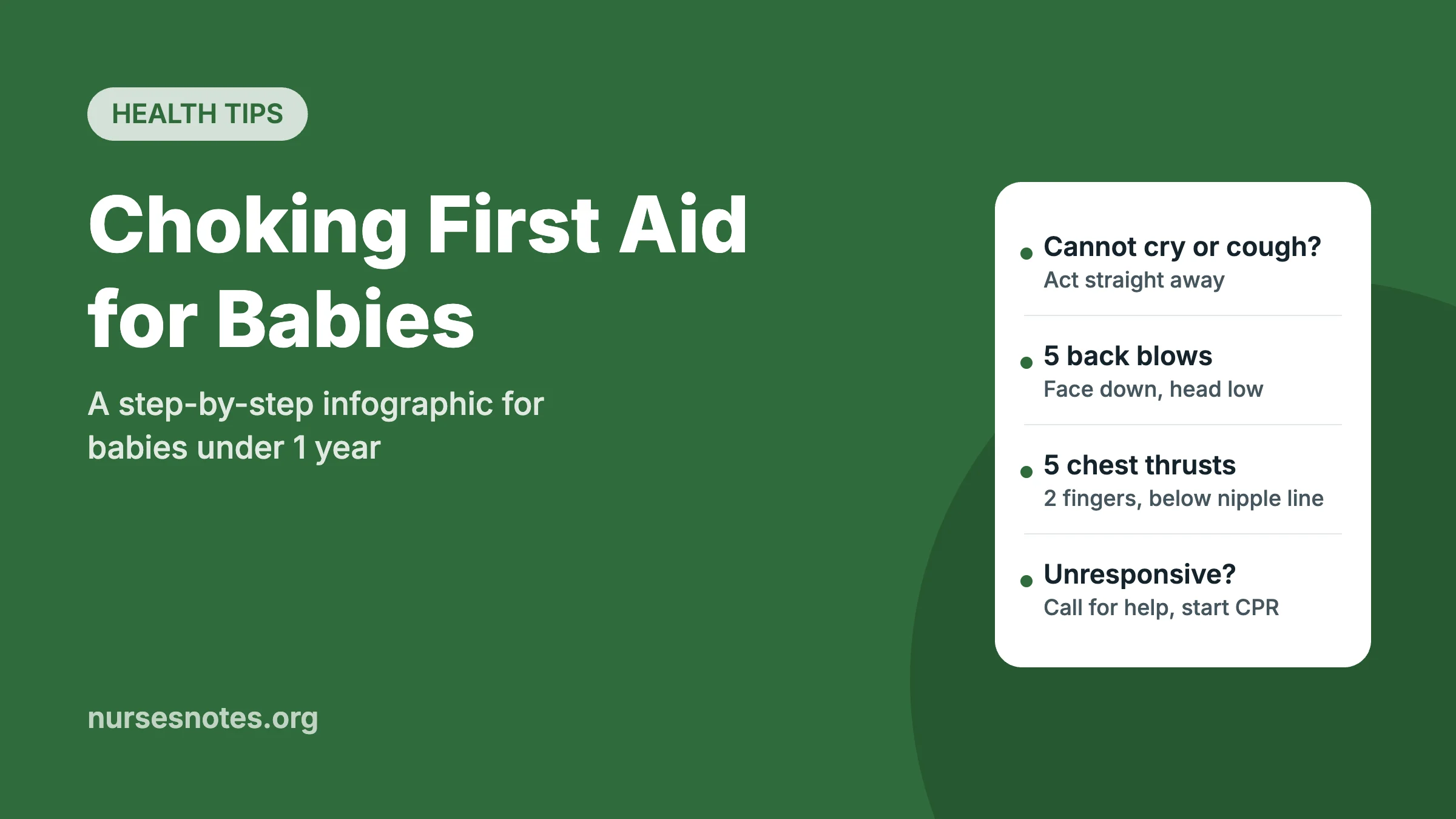
Choking first aid for babies under 1 year uses up to 5 back blows followed by up to 5 chest thrusts, repeated until the object comes out or help arrives. Save or print the infographic below so you and anyone caring for your baby can act quickly in an emergency.
Key points
- If the baby is coughing hard or crying, let them cough and stay with them.
- If they cannot cry, cough, or breathe, shout for help and start back blows straight away.
- Babies under 1 get chest thrusts, not abdominal thrusts.
- Always get the baby checked by a doctor afterwards, even if the object came out.
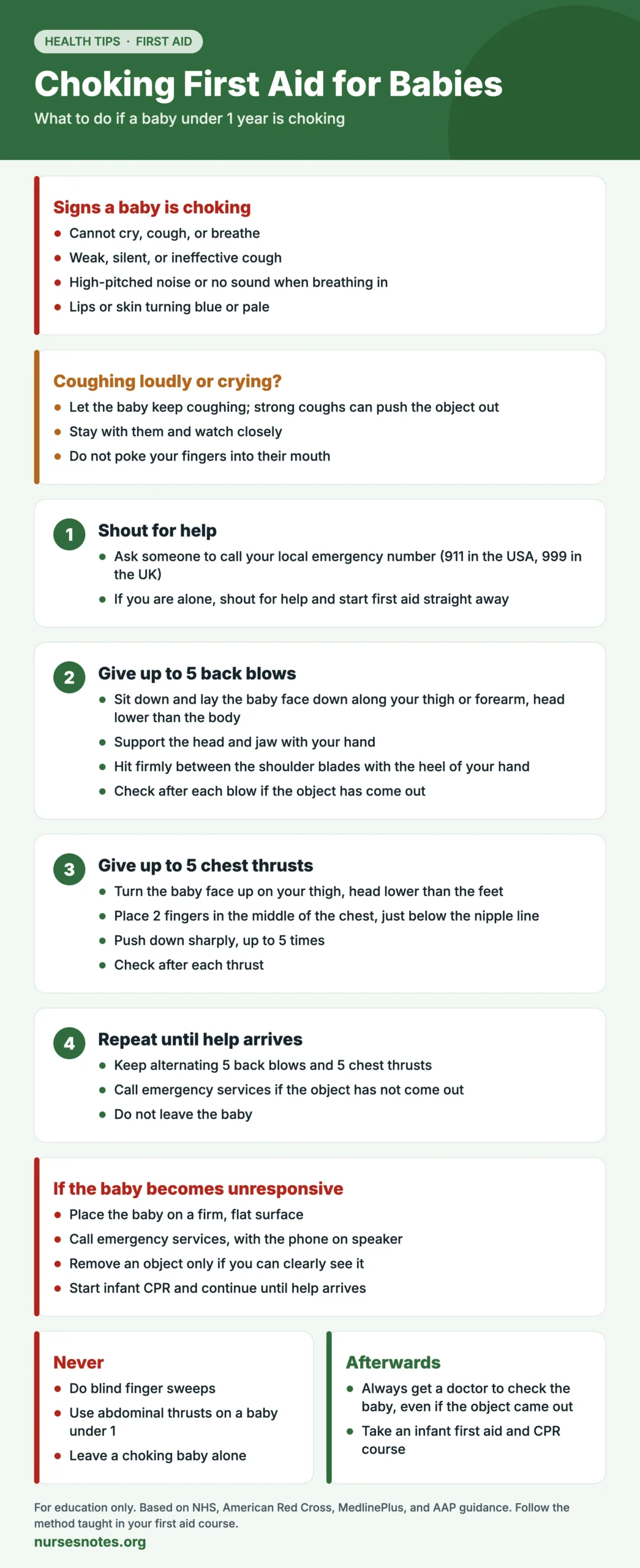
Signs a baby is choking
Choking often happens suddenly while a baby is eating or playing with small objects. Watch for:
- Being unable to cry, cough, or make much sound
- A weak, silent, or ineffective cough
- High-pitched noises, or no sound, when breathing in
- Lips or skin turning blue or pale
- A panicked or surprised look, or the chest pulling inward with each breath
If your baby is coughing loudly or crying, their airway is only partly blocked. Encourage them to keep coughing, because strong coughs can push the object out, and stay with them in case things change.
Step-by-step choking first aid for babies
Use these steps if your baby is awake but cannot cough effectively, cry, or breathe.
Step 1: Shout for help
Ask someone to call your local emergency number (911 in the USA, 999 in the UK) while you start first aid. If you are alone, shout for help and begin straight away.
Step 2: Give up to 5 back blows
- Sit down and lay your baby face down along your thigh or forearm, with their head lower than their body.
- Support their head and jaw with your hand.
- Give up to 5 firm blows between the shoulder blades with the heel of your other hand.
- Check after each blow whether the object has come out. You may not need all 5.
Step 3: Give up to 5 chest thrusts
- If back blows have not worked, turn your baby face up along your thigh, with their head lower than their feet and supported.
- Place 2 fingers in the middle of the chest, just below the nipple line.
- Push down sharply up to 5 times, checking after each thrust.
The NHS and the American Red Cross describe a two-finger technique, while MedlinePlus describes using the heel of one hand. Use the method taught in your own infant first aid course.
Step 4: Repeat until the object is out or help arrives
Keep alternating 5 back blows and 5 chest thrusts. If the blockage has not cleared, call emergency services if no one has yet, and do not leave your baby.
If the baby becomes unresponsive
- Place your baby on a firm, flat surface and shout for help.
- Call emergency services, putting the phone on speaker so your hands are free.
- Open the mouth, and remove the object only if you can clearly see it and grasp it easily.
- Start infant CPR and continue until help arrives or your baby starts breathing.
What not to do
- Do not do blind finger sweeps or poke around in the mouth; this can push the object further in.
- Do not give abdominal thrusts (the Heimlich maneuver) to a baby under 1. For older children and adults, see our choking first aid guide for adults.
- Do not leave a choking baby alone.
When to get medical help
Call your local emergency number straight away if your baby cannot breathe, cry, or cough, turns blue, or becomes floppy or unresponsive.
Even if the object comes out and your baby seems well, see a doctor. Part of the object may still be in the airway, and back blows or chest thrusts can sometimes cause injury.
How to prevent choking in babies
- Cut food into small pieces, no larger than about half an inch (about 1 cm), and serve soft textures as your baby starts solids. Our guide on when to start solid foods has more tips.
- Avoid or modify high-risk foods for young children, such as whole grapes, nuts, popcorn, hard candy, and chunks of hot dog, meat, or cheese.
- Keep small items out of reach, including coins, marbles, small toy parts, balloons, pen caps, and button batteries.
- Always supervise meals, and keep your baby sitting upright while eating.
- Check floors, under furniture, and between cushions for small objects.
- Take an infant first aid and CPR course, and ask grandparents, carers, and helpers to do the same.
Frequently asked questions
What is the first thing to do when a baby is choking?
First check whether your baby can cough or cry. If they are coughing hard, let them keep coughing and watch closely. If they cannot cough, cry, or breathe, shout for help, have someone call emergency services, and start up to 5 back blows with your baby face down and head lower than the body.
Can you do the Heimlich maneuver on a baby?
No. Abdominal thrusts are not used for babies under 1 year old because of the risk of injury. Instead, alternate up to 5 back blows with up to 5 chest thrusts in the middle of the chest, just below the nipple line. Abdominal thrusts are used for children over 1 and adults.
Should I take my baby to the doctor after choking?
Yes. Always contact a doctor after a choking episode, even if the object came out and your baby seems fine. Part of the object could remain in the airway, and the first aid itself can sometimes cause injury. Go to emergency care right away if your baby has any breathing difficulty.
Related on Nurses Notes
- Choking first aid: what to do when an adult is choking
- When to start solid foods for your baby
- Safe sleep for babies
- More health tips
Sources
- How to stop a child from choking. NHS, 2024.
- Infant Choking: How To Help. American Red Cross.
- Choking – infant under 1 year. MedlinePlus, US National Library of Medicine, 2026.
- Choking Prevention for Babies & Children: What Every Parent Needs to Know. American Academy of Pediatrics, HealthyChildren.org, 2026.
This article is for education only and does not replace advice from your own doctor, nurse, or other qualified health professional.