
On this page
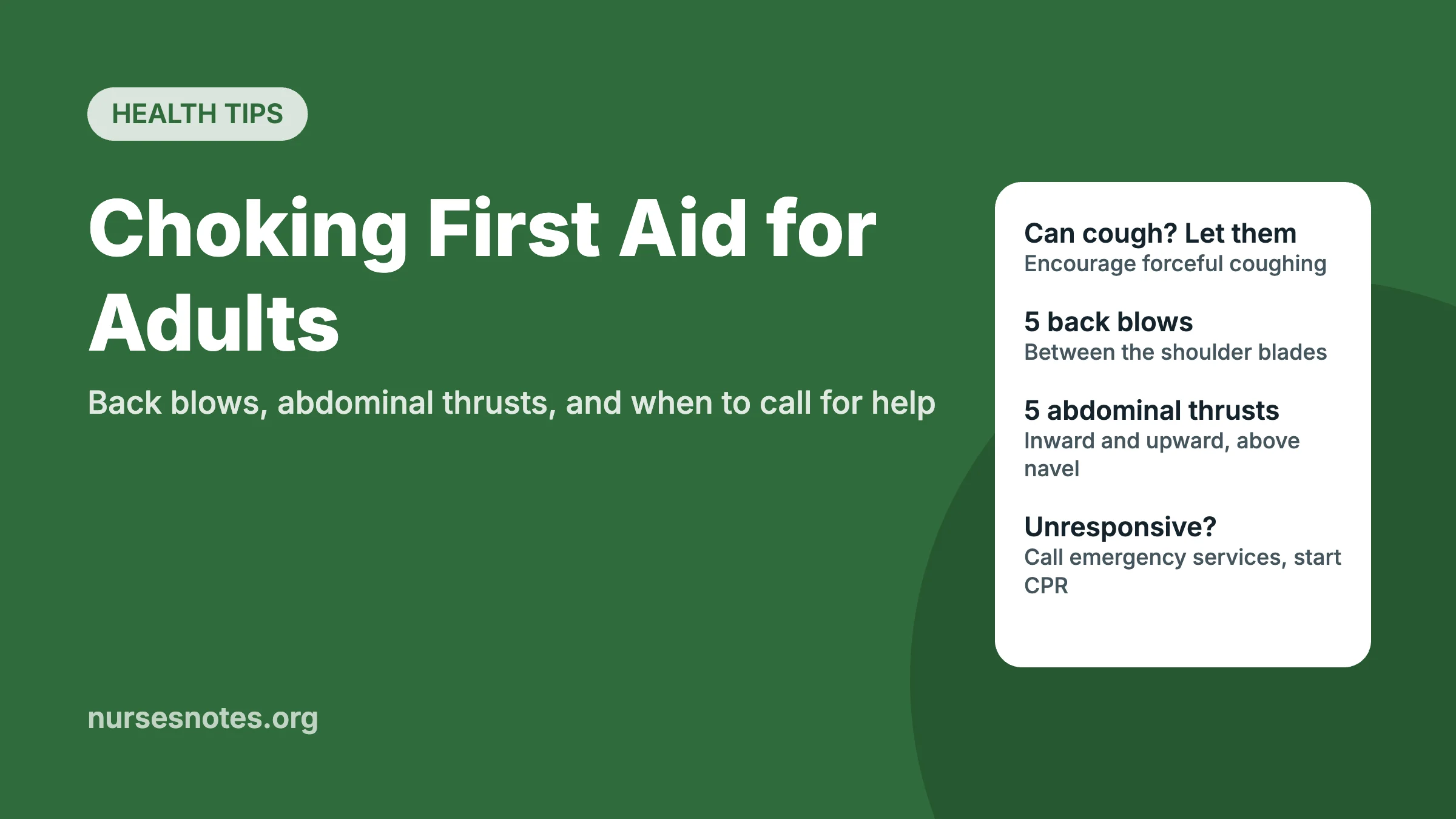
Choking first aid for an adult who cannot cough, speak, or breathe is to give 5 firm back blows followed by 5 abdominal thrusts, and to repeat the cycle until the object comes out. If the person becomes unresponsive, call your local emergency number and start CPR.
Key points
- If the person can cough forcefully or speak, let them keep coughing and stay with them.
- If they cannot cough, speak, or breathe, alternate 5 back blows and 5 abdominal thrusts (the Heimlich maneuver).
- Use chest thrusts instead for a pregnant person or someone you cannot wrap your arms around.
- Everyone who has needed abdominal thrusts should be checked by a doctor afterwards.
Signs that someone is choking
Choking happens when food or an object blocks the throat or windpipe. Many people instinctively clutch their throat with one or both hands. Other signs include:
- Not being able to talk
- Noisy, squeaky, or strained breathing
- A weak cough, or no cough at all
- Lips, skin, or nails turning blue or grey
- Panic, confusion, or loss of consciousness
Mild versus severe choking
If the person can cough forcefully and speak, the airway is only partly blocked. Do not slap their back or give thrusts; encourage them to keep coughing and be ready to act if things get worse. If they cannot cough, speak, cry, or breathe, the blockage is severe and they need your help right away.
How to help an adult who is choking
If other people are around, ask someone to call your local emergency number while you start first aid. If you are alone, shout for help and begin the steps below.
Step 1: Give 5 back blows
- Stand to the side and slightly behind the person.
- Support their chest with one arm and lean them forward.
- Strike firmly between the shoulder blades with the heel of your other hand, up to 5 times.
Step 2: Give 5 abdominal thrusts (Heimlich maneuver)
- Stand behind the person, wrap your arms around their waist, and tip them slightly forward.
- Make a fist and place it just above the navel, below the breastbone.
- Grasp your fist with your other hand.
- Press sharply inward and upward, up to 5 times.
Step 3: Repeat
Keep alternating 5 back blows and 5 abdominal thrusts until the object comes out or the person becomes unresponsive. Mayo Clinic notes that using abdominal thrusts alone is also acceptable if you have not been taught back blows.
Special situations
- Pregnant or larger person: place your hands at the base of the breastbone, just above the lowest ribs, and give quick chest thrusts instead of abdominal thrusts.
- Young children: kneel behind the child and use gentler thrusts.
- Babies under 1 year: do not give abdominal thrusts. Lay the baby face down along your forearm with the head lower than the body, give 5 back blows, then turn the baby face up and give 5 gentle chest thrusts with two fingers on the breastbone, just below the nipple line. Call for emergency help, and start infant CPR if the baby stops breathing.
How to help yourself if you are choking alone
- Call your local emergency number right away if you can.
- Place a fist slightly above your navel and grasp it with your other hand.
- Bend over a hard surface, such as a countertop or the back of a chair.
- Thrust your fist inward and upward, or press your upper abdomen sharply against the edge.
If the person becomes unresponsive
- Call your local emergency number, or have someone else call.
- Lower the person gently onto their back on a firm, flat surface.
- Start CPR with chest compressions.
- Before giving rescue breaths, look in the mouth. Remove an object only if you can see it and it is loose; never sweep blindly with your finger, as this can push it deeper.
When to get medical help
Call your local emergency number immediately if:
- The person cannot cough, speak, or breathe and the object does not come out
- The person becomes unresponsive or stops breathing
- Their lips or face turn blue or grey
Even when choking is relieved, abdominal thrusts can cause injuries such as broken ribs or, rarely, damage inside the abdomen. Everyone who has choked badly enough to need help should see a doctor. Get medical advice promptly if any of these appear afterwards, as they can mean something entered the lungs or the voice box was hurt:
- A cough that will not go away
- Fever
- Trouble swallowing or speaking
- Shortness of breath or wheezing
How to prevent choking
- Cut food into small pieces, eat slowly, and chew well.
- Avoid talking or laughing with food in your mouth.
- Make sure dentures fit properly.
- Limit alcohol before and during meals.
- Keep small objects out of reach of young children.
Knowing first aid steps helps in other emergencies too. See our guides to the signs of a heart attack and how to treat a burn. A hands-on first aid and CPR course is the best way to build confidence.
Frequently asked questions
What is the first thing to do when someone is choking?
First, check whether they can cough or speak. If they can, encourage them to keep coughing and stay close. If they cannot cough, speak, or breathe, ask someone to call emergency services and start 5 back blows followed by 5 abdominal thrusts, repeating until the object comes out.
Is the Heimlich maneuver safe?
Abdominal thrusts can save a life, but they can also cause injuries, most often broken ribs and, rarely, damage to the digestive tract. That is why they are only used when a person truly cannot breathe, cough, or speak. Anyone who has received abdominal thrusts should be checked by a doctor afterwards.
Can you do the Heimlich maneuver on yourself?
Yes. If you are alone, call emergency services if you can, then place a fist just above your navel, grasp it with your other hand, and thrust inward and upward. You can also lean over a firm edge, such as a chair back or countertop, and press your upper abdomen sharply against it.
Related on Nurses Notes
- Signs of a heart attack and what to do
- How to treat a burn at home
- How to stop a nosebleed: first aid steps
- All Health Tips on Nurses Notes
Sources
- Choking: First aid. Mayo Clinic. 25 August 2025.
- Choking – adult or child over 1 year. MedlinePlus Medical Encyclopedia, U.S. National Library of Medicine. Reviewed 10 February 2026.
- How To Do the Heimlich Maneuver. Cleveland Clinic. Updated 13 February 2024.
This article is for education only and does not replace advice from your own doctor, nurse, or other qualified health professional.