On this page
Colic in babies means long bouts of intense crying, often in the late afternoon or evening, in a baby who is otherwise healthy and feeding and growing well. It usually starts in the first few weeks of life and settles by 3 to 4 months, though this can feel like a very long time for tired parents.
Key points
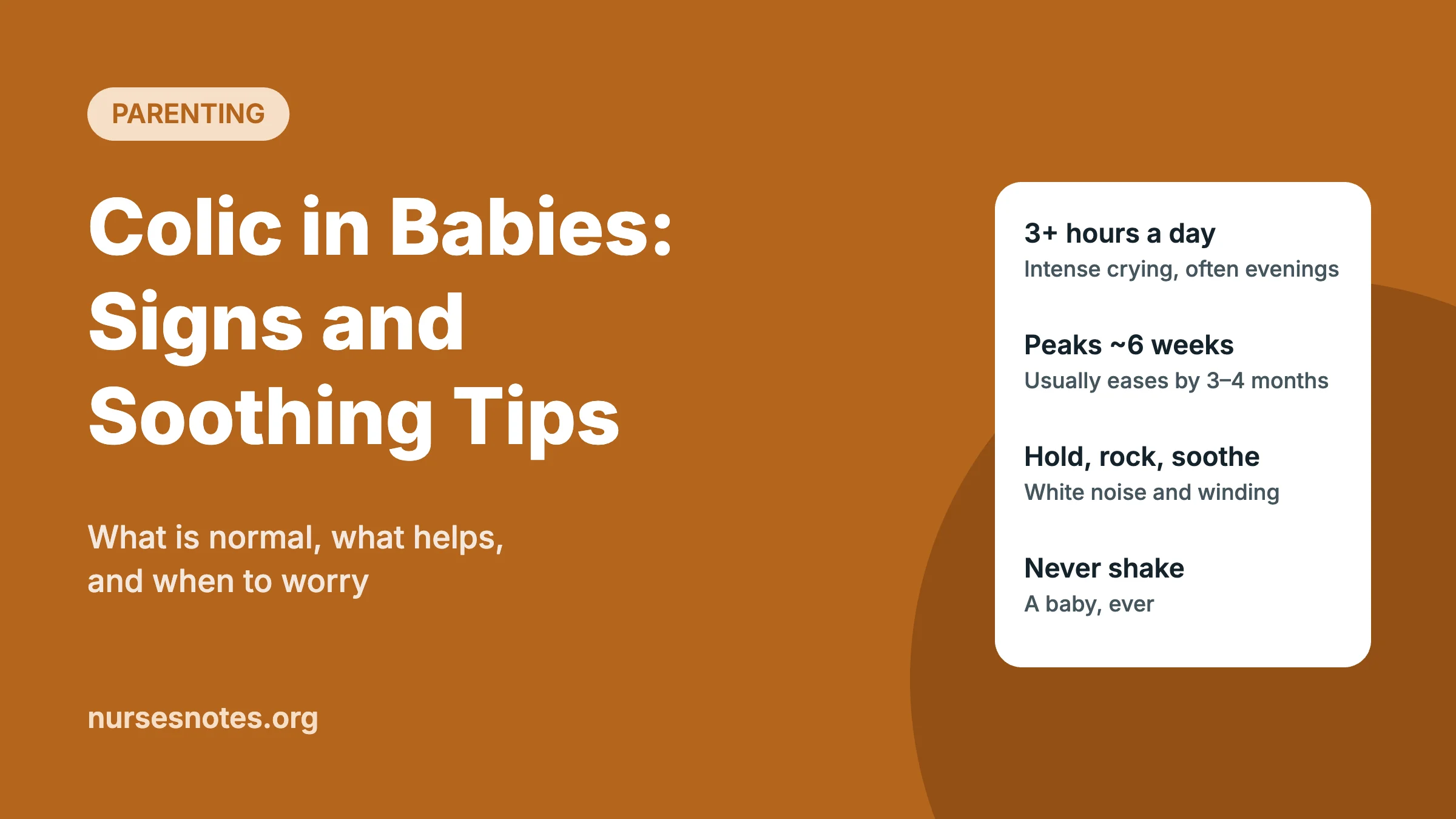
- A common guide is crying for more than 3 hours a day, on 3 or more days a week, in an otherwise healthy baby.
- Colic often peaks at about 6 weeks and usually eases by 3 to 4 months.
- Holding, rocking, gentle white noise, and winding after feeds can help; anti-colic drops and supplements are not recommended by the NHS.
- Never shake a baby. A weak, high-pitched, or unusual cry, or fever in a young baby, needs urgent medical care.
What is colic?
Colic is frequent, prolonged crying with no obvious cause. The NHS says a baby may have colic if they cry more than 3 hours a day, 3 days a week, for at least 1 week, while Mayo Clinic uses a stricter “3 weeks” version of the same rule. You do not need to wait that long to ask for help.
The American Academy of Pediatrics (AAP) says about one in five babies develop colic, usually between the second and fourth weeks. It is not caused by anything a parent did wrong.
Signs of colic in babies
- Loud, intense crying that can sound like screaming or pain, and is hard to settle.
- Crying at a predictable time of day, often in the evening.
- A red or flushed face.
- Clenched fists, knees pulled up, an arched back, or a tense tummy.
- A rumbling or very windy tummy.
Before deciding it is colic, check for simple causes such as hunger, a dirty nappy (diaper), wind, reflux, or constipation.
What causes colic?
No one knows exactly. Experts think it may be linked to a young baby’s developing digestive system, gut bacteria, sensitivity to stimulation, or an immature nervous system that cannot yet self-soothe.
In a small number of babies, a food sensitivity plays a part, such as cow’s milk protein. Mayo Clinic notes that colic is not linked to the baby’s sex, birth order, or whether they are breastfed or formula-fed, but smoking during or after pregnancy may raise the risk.
How to soothe a colicky baby
- Hold and cuddle your baby, or walk with them in a baby carrier.
- Rock them gently over your shoulder, in your arms, or in a pram.
- Try gentle white noise, such as a fan, a white-noise machine, or a vacuum running in another room.
- Give a warm bath or a gentle baby massage.
- Swaddle them in a large, thin blanket, and offer a pacifier (dummy).
- Lay them tummy-down across your knees and rub their back while they are awake, then always put them on their back to sleep. Read more on safe sleep for babies.
Feeding tips
- Hold your baby upright during feeds and wind (burp) them afterwards.
- Keep feeding as usual. The NHS says breastfeeding mothers do not usually need to change their diet.
- If your doctor suspects a food sensitivity, they may suggest removing one food from a breastfeeding parent’s diet at a time, or trying a different formula. Do not change formula without medical advice.
- Avoid overfeeding. The AAP suggests waiting at least 2 to 2½ hours from the start of one feed to the start of the next.
The NHS says anti-colic drops and herbal or probiotic supplements are not recommended, as there is no evidence they help. Ask your doctor or pharmacist before giving your baby any remedy, and never give medicine without checking the dose for your baby’s weight and the product.
Looking after yourself
Constant crying is exhausting. If you feel angry or overwhelmed, it is okay to put your baby on their back in a safe cot or crib and leave the room for 10 to 15 minutes. Take deep breaths, call someone, and go back when you feel calmer.
Never shake a baby. The AAP warns that shaking can cause blindness, brain damage, or death. Make sure everyone who cares for your baby knows this. Ask family or friends to give you a break, and tell your own doctor if you feel low; Mayo Clinic notes colic is linked to postpartum depression.
When to get medical help
Call your local emergency number or go to the emergency room now if your baby:
- Has a weak, high-pitched, or unusual cry that does not sound like their normal cry.
- Has difficulty breathing, grunting, or breathes very fast.
- Has blue, grey, pale, or blotchy skin, lips, or tongue.
- Is floppy, drowsy, or hard to wake, or is not interested in feeding.
- Has a rash that does not fade when you press a glass against it, or has a fit (seizure).
- May have been shaken or hurt, especially if they have vomiting, seizures, or unusual sleepiness.
Contact a doctor urgently the same day if your baby:
- Is under 3 months old and has a temperature of 38°C or higher.
- Is 3 to 6 months old and has a temperature of 39°C or higher.
- Is not feeding well, seems unwell, or has signs of dehydration such as fewer wet nappies.
Also see your doctor if you are worried, nothing seems to help, your baby is not gaining weight, the crying continues past 4 months, or you are struggling to cope. For fever care, read how to bring down a child’s fever.
Frequently asked questions
How long does colic last in babies?
Colic usually starts when a baby is a few weeks old, often peaks at around 6 weeks, and settles by 3 to 4 months. The AAP notes that some babies continue until about 6 months. If crying carries on beyond 4 months, or your baby seems unwell, ask your doctor to check for another cause.
Is colic dangerous for my baby?
Colic itself does not cause lasting harm, and Mayo Clinic says colic that settles before 6 months has no short- or long-term medical effects. The main risks are to the family: stress, exhaustion, and in some cases shaking. Get help early, and see a doctor to rule out illness if the crying is new or unusual.
Do anti-colic drops work?
The NHS says anti-colic drops and herbal or probiotic supplements are not recommended because there is no evidence they help colic. Before giving any product, talk to your doctor or pharmacist, who can check whether it is safe for your baby. Comfort measures like holding, rocking, and white noise are the first steps.
Related on Nurses Notes
- How to bring down a child’s fever
- Safe sleep for babies
- Teething symptoms and how to help
- All Parenting articles on Nurses Notes
Sources
- Colic. NHS, reviewed April 2022.
- Colic Relief Tips for Parents. American Academy of Pediatrics (HealthyChildren.org), April 2024.
- Colic – Symptoms and causes. Mayo Clinic, December 2025.
- Shaken Baby Syndrome: Protect Your Infant from Abusive Head Trauma. American Academy of Pediatrics (HealthyChildren.org), February 2025.
- High temperature (fever) in children. NHS, reviewed January 2024.
This article is for education only and does not replace advice from your own doctor, nurse, or other qualified health professional.