On this page
Compassion fatigue in nurses is the physical and emotional exhaustion that can build up from caring for people who are suffering or have been through trauma. It is a recognised occupational hazard, not a personal weakness, and with early support most nurses recover their energy and their sense of purpose.
Key points
- Compassion fatigue combines burnout with secondary traumatic stress, which comes from absorbing other people’s trauma.
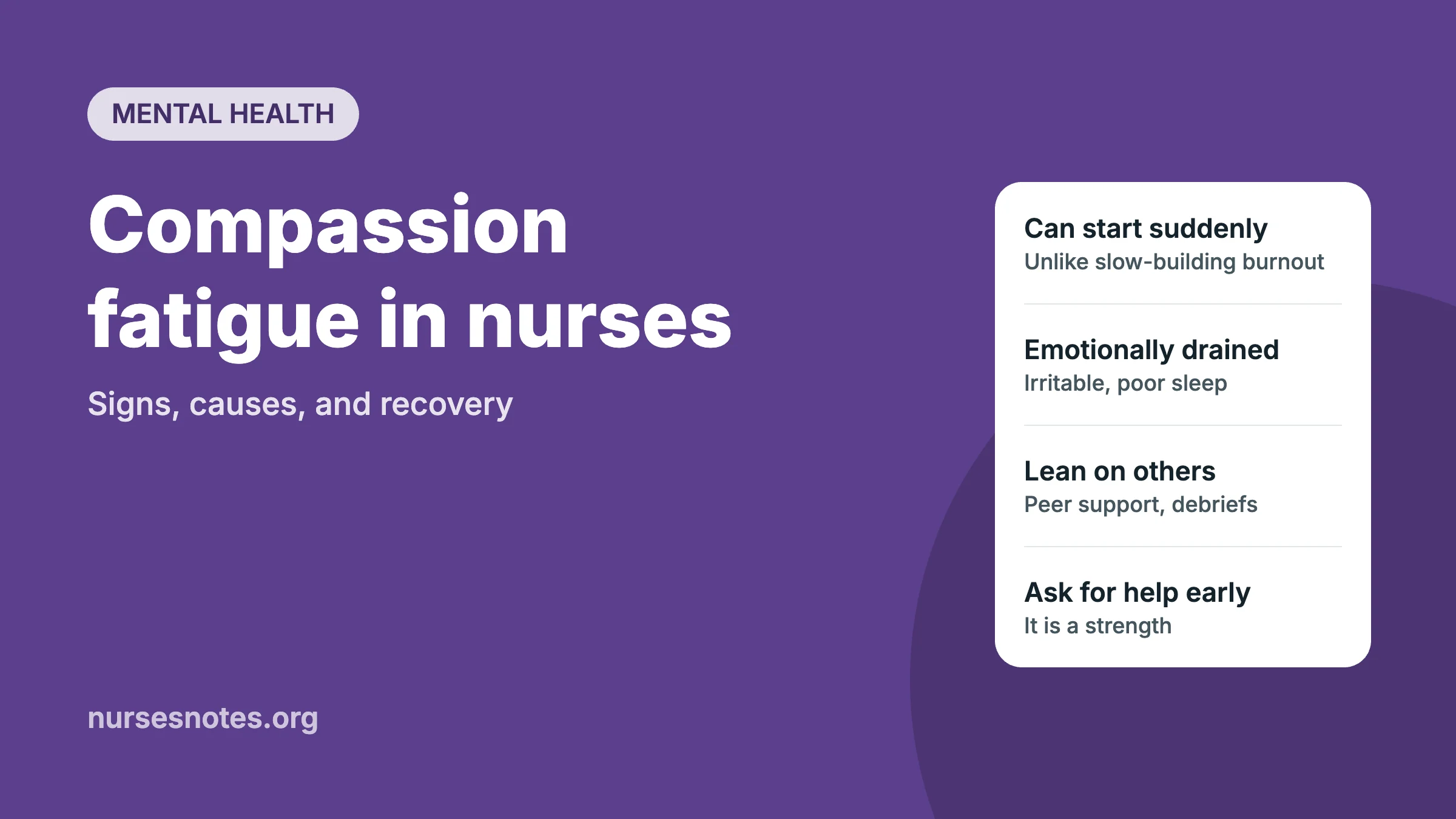
- Unlike burnout, which builds slowly, compassion fatigue can come on quickly, sometimes after one very hard case.
- Common signs include feeling emotionally drained, irritability, poor sleep, dreading certain patients, and pulling away from people you love.
- Self-care helps, but peer support, debriefing, and good management matter just as much.
What is compassion fatigue?
Trauma researcher Charles Figley, who first wrote about the idea in the late 1980s, described compassion fatigue as a state of exhaustion and dysfunction that affects the body, mind, and social life. The Royal College of Nursing (RCN) calls it the physical and emotional reaction to the trauma you witness.
The American Psychological Association (APA) describes it as having two parts: burnout from heavy workloads and limited resources, and secondary traumatic stress, or “empathy overload”, from repeated indirect exposure to trauma.
Compassion fatigue vs burnout
| Burnout | Compassion fatigue | |
|---|---|---|
| Main cause | Workload, low control, and feeling unable to reach your goals | Absorbing patients’ suffering and trauma |
| How it starts | Gradually, over a long period | Can start suddenly |
| Typical pattern | Withdrawal and indifference | Over-involvement, then emotional numbness |
| Related feelings | Frustration and low morale | Guilt, distress, and intrusive thoughts |
The two often overlap, and burnout can make compassion fatigue more likely. If burnout sounds more like you, read our guide to the signs of nurse burnout.
Signs of compassion fatigue in nurses
- Emotional: feeling emotionally spent, irritable, anxious, or low; trouble concentrating; self-doubt; and feeling you have nothing left to give.
- Physical: headaches, stomach problems, muscle tension, poor sleep, and frequent minor illnesses.
- Behavioural: withdrawing from colleagues, friends, and family; finding it hard to switch off; or feeling on edge.
- At work: dreading or avoiding certain patients, feeling less empathy, more mistakes, and losing the joy you once felt in nursing.
Most nurses show more than one sign before they notice something is wrong. Seeing these signs in yourself is a reason for kindness and support, not blame.
What causes it?
- Repeated exposure to suffering, death, or traumatic events
- Heavy workloads, long shifts, and too little rest between them
- Short staffing and limited resources
- Low control over your work and little recognition
- Poor support from managers
- Putting patients first while neglecting your own needs
Research also points to protective factors: feeling satisfied by the good you do, resilience, social connection, and regular self-care.
How to recover from compassion fatigue
Look after the basics
- Protect your sleep after shifts. Our sleep hygiene tips include ideas for shift workers.
- Eat regularly, drink water, and move your body, even a short walk.
- Do something you enjoy every day. The RCN suggests at least 10 minutes a day.
- Practise calming skills such as slow breathing or mindfulness when you are calm, so they are easier to use under stress.
Set gentle boundaries
- Notice when you are taking work home in your head, and create a small ritual to mark the end of a shift.
- Accept that you cannot fix every outcome.
- Challenge guilt about resting; rest helps you care well.
- Check in with yourself: the APA mentions the free Professional Quality of Life (ProQOL) self-check.
Lean on others
- Talk with a trusted colleague or a “self-care buddy”.
- Join debriefs after difficult cases or deaths, or ask your manager to arrange one.
- Ask whether your hospital has an employee assistance programme, staff counselling, or reflective forums such as Schwartz Rounds.
- Managers can help with fair rotas, less overtime, quiet rooms, and support for new nurses.
An NHS England evaluation found that among staff who regularly attended Schwartz Rounds, the share reporting poor psychological wellbeing fell from 25% to 12%. For more everyday strategies, see how to manage stress.
When to get help
Reach out to your doctor, a counsellor, or your occupational health service if:
- Signs last more than a couple of weeks or keep getting worse
- You feel hopeless, numb, or unable to enjoy anything
- Sleep, eating, or drinking habits have changed a lot
- Memories of patients or events keep intruding or upsetting you
- You are thinking about leaving nursing because you feel empty
Asking for help early is a professional strength. If you ever have thoughts of harming yourself, contact a crisis line or emergency services straight away.
Where to get help
If you are struggling, you do not have to cope alone. These services are free and confidential:
- Philippines: NCMH Crisis Hotline 1553, 0917-899-8727, or (02) 7-989-8727
- USA: 988 Suicide & Crisis Lifeline: call or text 988 (24/7)
- UK: Samaritans: call 116 123 for free (24/7)
- Anywhere: if you or someone else is in immediate danger, call your local emergency number
Frequently asked questions
What is the difference between compassion fatigue and burnout?
Burnout comes mainly from workload and the work environment, and it usually builds slowly. Compassion fatigue comes from absorbing the suffering of the people you care for, and it can start suddenly. Many nurses experience both together, and support for one usually helps the other too.
How long does it take to recover from compassion fatigue?
There is no fixed timeline, and it differs from person to person. Recovery is helped by rest, talking about what you have seen, and real support at work, such as debriefing and fair workloads. Because signs tend to deepen when ignored, it is best to seek help early rather than waiting.
Can compassion fatigue make you quit nursing?
It can, because exhaustion and numbness make the job feel empty. But compassion fatigue is treatable. Rest, peer support, debriefing, counselling, and changes at work can bring back your energy and meaning. Talk to someone you trust before making a big decision about your career.
Related on Nurses Notes
- Signs of nurse burnout and what to do
- How to manage stress
- Sleep hygiene tips
- More mental health articles
Sources
- Compassion Fatigue in Palliative Care Nursing: A Concept Analysis, Cross LA, Journal of Hospice & Palliative Nursing, 2019
- Compassion Fatigue among Healthcare, Emergency and Community Service Workers: A Systematic Review, Cocker F and Joss N, International Journal of Environmental Research and Public Health, 2016
- Compassion Fatigue: A Nurse’s Primer, Lombardo B and Eyre C, OJIN (American Nurses Association), 2011
- Are you experiencing compassion fatigue?, American Psychological Association, 2020 (updated 2022)
- Five ways to combat compassion fatigue, Royal College of Nursing, 2022
- A realist informed mixed-methods evaluation of Schwartz Center Rounds® in England, Maben J et al., NIHR Journals Library, 2018
- World Suicide Prevention Day, National Center for Mental Health (Philippines)
- 988 Suicide & Crisis Lifeline, accessed November 2026
- Samaritans, accessed November 2026
This article is for education only and does not replace advice from your own doctor, nurse, or other qualified health professional.