
On this page
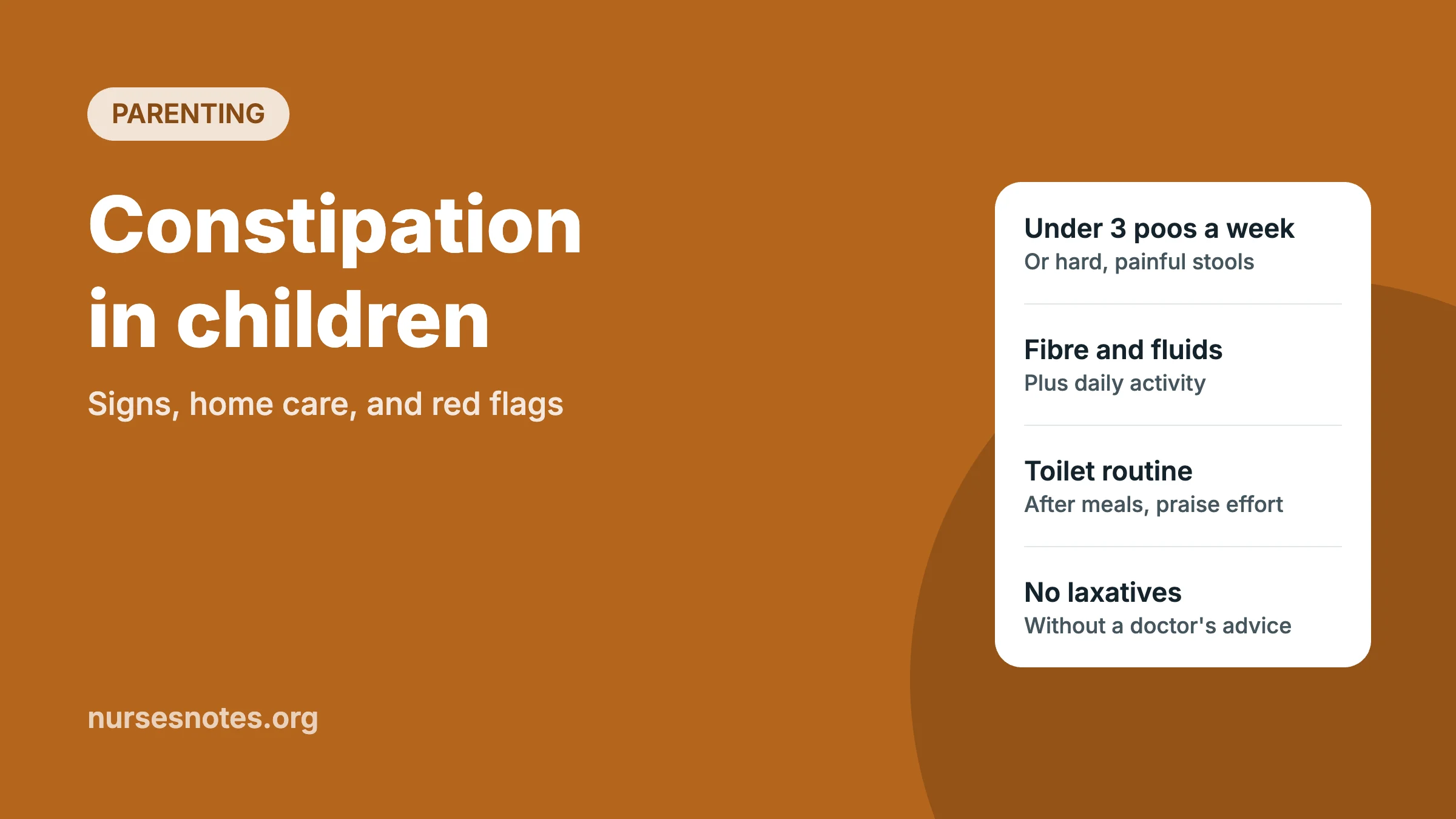
Constipation in children usually means fewer than three poos a week, or stools that are hard, large, or painful to pass. It is very common, often linked to diet, fluids, or holding in stools, and most children improve with simple changes at home and, when needed, treatment from a doctor.
Key points
- How soft the stool is matters more than how often; healthy breastfed babies can sometimes go several days without a poo.
- Holding in stools is the most common cause in toddlers and school-age children, and it can turn into a cycle of pain and more holding.
- Fibre, fluids, activity, and a calm toilet routine help most children.
- Never give laxatives, suppositories, or enemas to a child without first asking the doctor.
What counts as constipation in children?
The NHS lists these common signs of constipation in children:
- Fewer than three poos in a week
- Large, hard poos, or small pellets like rabbit droppings
- Straining or pain when pooing, sometimes with a little blood on the paper
- Poor appetite or tummy pain that gets better after a poo
- In children over 1, runny poo leaking around a hard poo (overflow soiling)
Babies are different. The American Academy of Pediatrics (AAP) explains that breastfed babies may go several days or even a week between poos once feeding is well established, and that straining or going red in the face does not always mean constipation. Soft stools usually mean there is no problem.
Common causes
- Not enough fibre or fluids in the diet
- Holding in poo because of fear of pain, not wanting to stop playing, or avoiding school toilets
- Pressure during potty training, or starting it too early
- Changes such as starting solids, switching from breast milk to formula, travel, hot weather, or a new school
- Illness, some medicines, or, rarely, an underlying medical condition
The NHS puts it simply: the more a child holds back, the more constipated they get. Hard poo hurts, so the child holds on again, and the cycle continues.
How to help constipation at home
Babies not yet on solids
- Offer plenty of breastfeeds.
- For formula-fed babies, always make up formula exactly as the instructions say. The NHS warns that adding extra powder can make a baby constipated or dehydrated.
- The NHS says formula-fed babies can have extra sips of water between feeds; under 6 months, use cooled boiled water.
- Gentle tummy massage and moving the legs in a bicycling motion may help.
- Speak to your doctor before trying fruit juice; the AAP generally does not recommend juice before age 1, so ask what is right for your baby.
Babies on solids
Offer fibre-rich purees such as pears, prunes, peas, and beans, along with water. Our guide on when to start solid foods explains how to introduce new foods safely.
Toddlers and older children
- Add fibre gradually: fruit, vegetables, beans, and wholegrains.
- Offer plenty of fluids, ideally water, through the day.
- Keep them active with daily play and movement.
- Build a toilet routine: sit on the toilet for a few minutes after meals or before bed.
- Support their feet flat on the floor or a small step so they can push comfortably.
- Praise effort, not results, and never punish accidents or soiling.
- Pause potty training while your child is constipated, then restart gently.
Medicines for constipation
Many children need a laxative prescribed by a doctor, sometimes for weeks or months. The right medicine and dose depend on the child’s age, weight, and the product, so follow the doctor’s plan and the label, or ask the doctor or pharmacist. MedlinePlus advises not giving laxatives or enemas to children without asking their provider first.
When to get medical help
See your doctor if constipation lasts more than two weeks, keeps coming back, or your child has soiling, pain, or is withholding during potty training. MedlinePlus advises calling the doctor for any baby under 2 months who seems constipated.
Get urgent medical help the same day if your child has:
- A newborn who has not passed their first poo (meconium) within 48 hours of birth
- A swollen or very hard tummy, especially with vomiting
- Blood in the stool
- Fever, refusing to eat, unusual sleepiness, or weight loss
- Constipation since birth or the first few weeks of life
- New weakness in the legs or delays in walking
Frequently asked questions
How many days can a baby go without pooping?
It depends on age and feeding. The AAP says breastfed babies past the first month may go several days or even a week without a poo, while formula-fed babies usually go most days. In the first month, fewer than one poo a day can mean a baby is not feeding enough, so check with your doctor.
What foods help a constipated child poop?
Fibre-rich foods help most, such as pears, prunes, peas, beans, other fruit and vegetables, and wholegrains. Increase fibre slowly and give plenty of water at the same time; the AAP notes that fibre supplements without enough water can make constipation worse. Unprocessed bran is not recommended for children by NICE.
Is it safe to give my child a laxative?
Only with your doctor’s advice. Laxatives are a common and effective treatment for childhood constipation, but the type and dose must suit your child’s age and weight. Do not use adult products, enemas, or suppositories at home without guidance, and keep giving the medicine for as long as the doctor recommends.
Related on Nurses Notes
- When to start solid foods for babies
- Colic in babies: signs and soothing tips
- Diarrhea in children: care and warning signs
- More parenting guides
Sources
- Constipation in children, NHS, 2023
- How to make up baby formula, NHS, 2023
- How Can I Tell If My Baby is Constipated?, American Academy of Pediatrics (HealthyChildren.org), 2022
- Constipation in Children, American Academy of Pediatrics (HealthyChildren.org), 2024
- Constipation in children and young people: diagnosis and management (CG99), NICE, updated 2017
- Constipation in children – Symptoms and causes, Mayo Clinic, 2025
- Constipation in infants and children, MedlinePlus, 2024
This article is for education only and does not replace advice from your own doctor, nurse, or other qualified health professional.