
On this page
An ear infection in children is usually a middle ear infection (acute otitis media) that follows a cold and causes ear pain, fever, fussiness, and tugging at the ear. Many clear up on their own within a few days, but some need antibiotics, and certain warning signs mean your child should be seen quickly.
Key points
- Ear infections are very common: about five in six children have at least one by age 3.
- Signs in babies include ear tugging, crying, poor sleep, poor feeding, and fever.
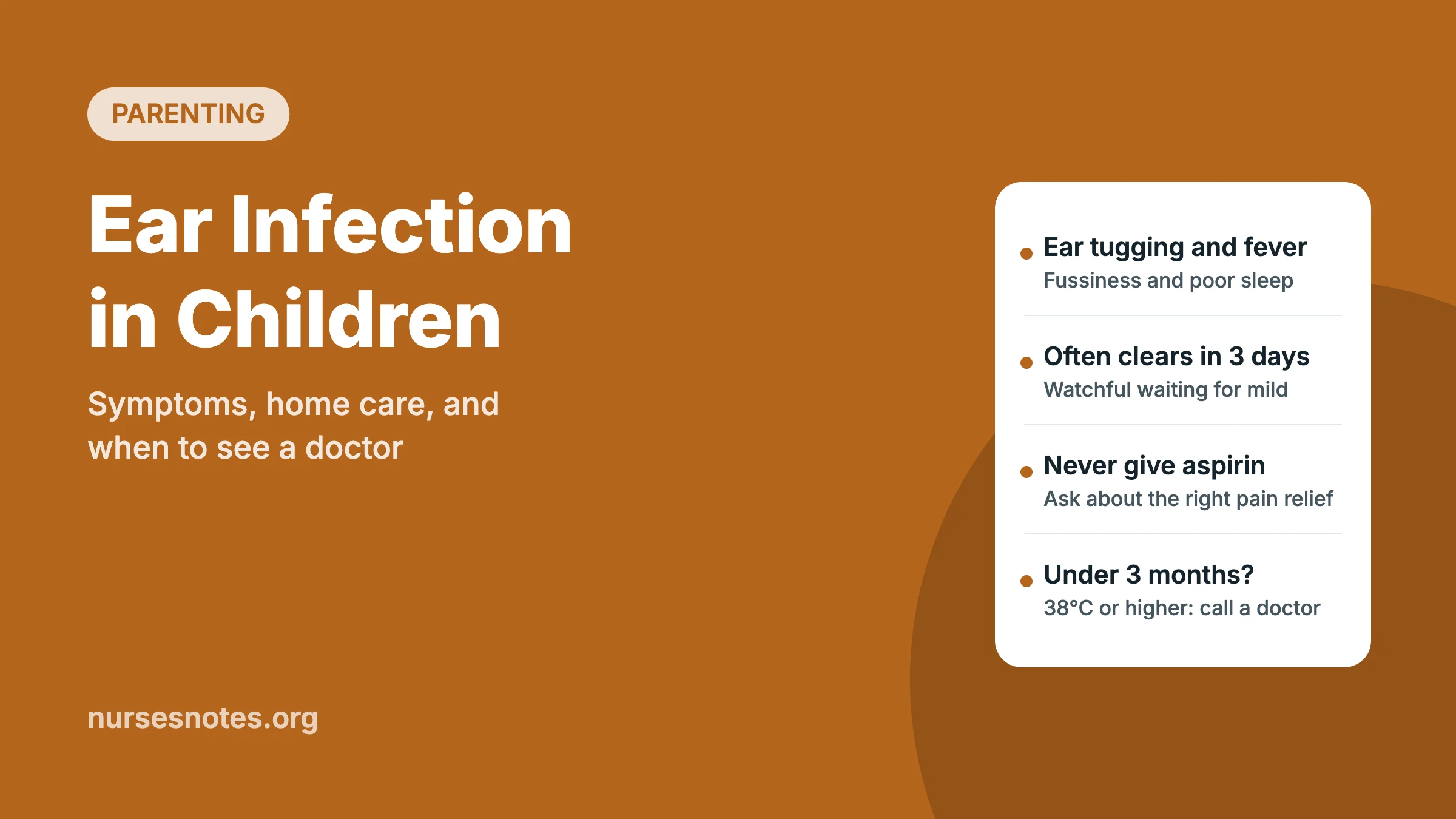
- Most clear within about 3 days, and doctors often suggest watchful waiting for mild cases.
- Call a doctor right away for a baby under 3 months with a temperature of 38°C (100.4°F) or higher.
What is an ear infection in children?
The middle ear is the small, air-filled space behind the eardrum. It is linked to the back of the nose by a narrow channel called the eustachian tube, which drains fluid away.
In young children this tube is shorter and more level, so it blocks easily when a cold causes swelling and mucus. Fluid builds up behind the eardrum, and viruses or bacteria (most often Streptococcus pneumoniae and Haemophilus influenzae) can then cause an infection. This is different from swimmer’s ear, which affects the outer ear canal.
Symptoms of an ear infection in babies and toddlers
Babies cannot tell you their ear hurts, so watch for these signs, especially during or after a cold:
- Tugging, pulling, or rubbing at one or both ears
- Fussiness and crying, sometimes worse during feeds
- Trouble sleeping
- Poor feeding or loss of appetite
- Fever, often between 37.8°C and 40°C (100°F and 104°F)
- Yellow or white fluid draining from the ear, sometimes blood-tinged
- Not reacting to quiet sounds, clumsiness, or problems with balance
Older children may say their ear hurts, feels full, or sounds muffled. Other things can cause ear pain too, such as teething, a sore throat, or swimmer’s ear, so only a doctor who looks at the eardrum can confirm an ear infection.
How to care for your child at home
- Ease pain and fever: paracetamol (acetaminophen) can be used, and ibuprofen is an option for babies 6 months and older. The CDC advises acetaminophen only for babies under 6 months. Doses depend on your child’s weight and the product, so follow the label or ask your doctor or pharmacist.
- Never give aspirin to children under 16, because of the risk of Reye’s syndrome.
- Offer rest and plenty of fluids. Breast milk or formula is fine for babies.
- Clean gently: wipe any discharge from the outer ear with cotton wool, but do not push cotton buds, fingers, or anything else into the ear.
- Skip decongestants and antihistamines: the NHS says there is no evidence they help ear infections.
For more on safe temperature care, see our guide on how to bring down a child’s fever.
Does my child need antibiotics for an ear infection?
Not always. The CDC explains that the body often fights off a middle ear infection without help, and many do not need antibiotics.
For mild cases, the doctor may suggest watchful waiting for 2 to 3 days, or give a delayed prescription to use only if your child is not improving. Severe infections, or those lasting more than 2 to 3 days, usually need antibiotics. If antibiotics are prescribed, give the full course even if your child seems better.
How long does an ear infection last?
The NHS says most ear infections clear up within 3 days, although symptoms can last up to a week. Fluid can stay behind the eardrum for 3 to 6 weeks afterwards, and hearing may seem muffled during that time.
How to lower the risk of ear infections
- Keep your child’s vaccines up to date, including pneumococcal and yearly flu vaccines.
- Keep your child away from cigarette and other smoke.
- Breastfeed if you can; the CDC suggests exclusive breastfeeding for about 6 months and continuing for at least 12 months.
- Do not put your baby down to sleep with a bottle.
- Wash hands often and limit contact with people who are sick.
- Try not to use a pacifier (dummy) after 6 months of age.
When to get medical help
Call your doctor right away or get same-day care if:
- Your baby is under 3 months old and has a temperature of 38°C (100.4°F) or higher
- Your child has a fever of 39°C (102.2°F) or higher
- There is swelling around the ear, or fluid or pus coming from it
- Your child seems generally unwell, very hot or shivery, is vomiting, or is dizzy
- A baby under 12 months has earache in both ears
- You notice new hearing loss
- Symptoms are getting worse or have lasted more than 2 to 3 days
Go to the nearest emergency department if your child is floppy, very drowsy, hard to wake, has a seizure, or you feel they are seriously ill.
Also see a doctor if ear infections keep coming back. Some children with frequent infections are referred to an ear, nose, and throat specialist.
Frequently asked questions
Can an ear infection in a child go away on its own?
Yes, many do. The CDC says the body often clears a middle ear infection without antibiotics, and the NHS says most get better within 3 days. Your doctor may suggest watching for 2 to 3 days while you manage pain. See a doctor sooner if your child is very young, very unwell, or not improving.
How can I tell if my baby has an ear infection?
Look for ear tugging or rubbing, more crying than usual, trouble sleeping, poor feeding, fever, or fluid from the ear, often after a cold. These signs can have other causes such as teething, so a doctor needs to look at the eardrum with an otoscope to confirm it. An ear infection cannot be diagnosed over the phone.
How long does fluid stay in the ear after an ear infection?
Fluid can remain behind the eardrum for 3 to 6 weeks after the infection itself has cleared, according to the NIDCD. During this time your child may not hear as clearly. This usually settles on its own, but tell your doctor if hearing problems last longer or your child seems to have speech or balance concerns.
Related on Nurses Notes
- How to bring down a child’s fever safely at home
- Croup in children: barking cough symptoms and home care
- RSV in babies: symptoms, warning signs, and care
- More parenting and child health guides
Sources
- Ear Infection Symptoms. American Academy of Pediatrics, HealthyChildren.org, 2025.
- Ear Infection Basics. Centers for Disease Control and Prevention (CDC), 2024.
- Ear infections. NHS, 2025.
- Ear Infections in Children. National Institute on Deafness and Other Communication Disorders (NIDCD), 2022.
This article is for education only and does not replace advice from your own doctor, nurse, or other qualified health professional.