On this page
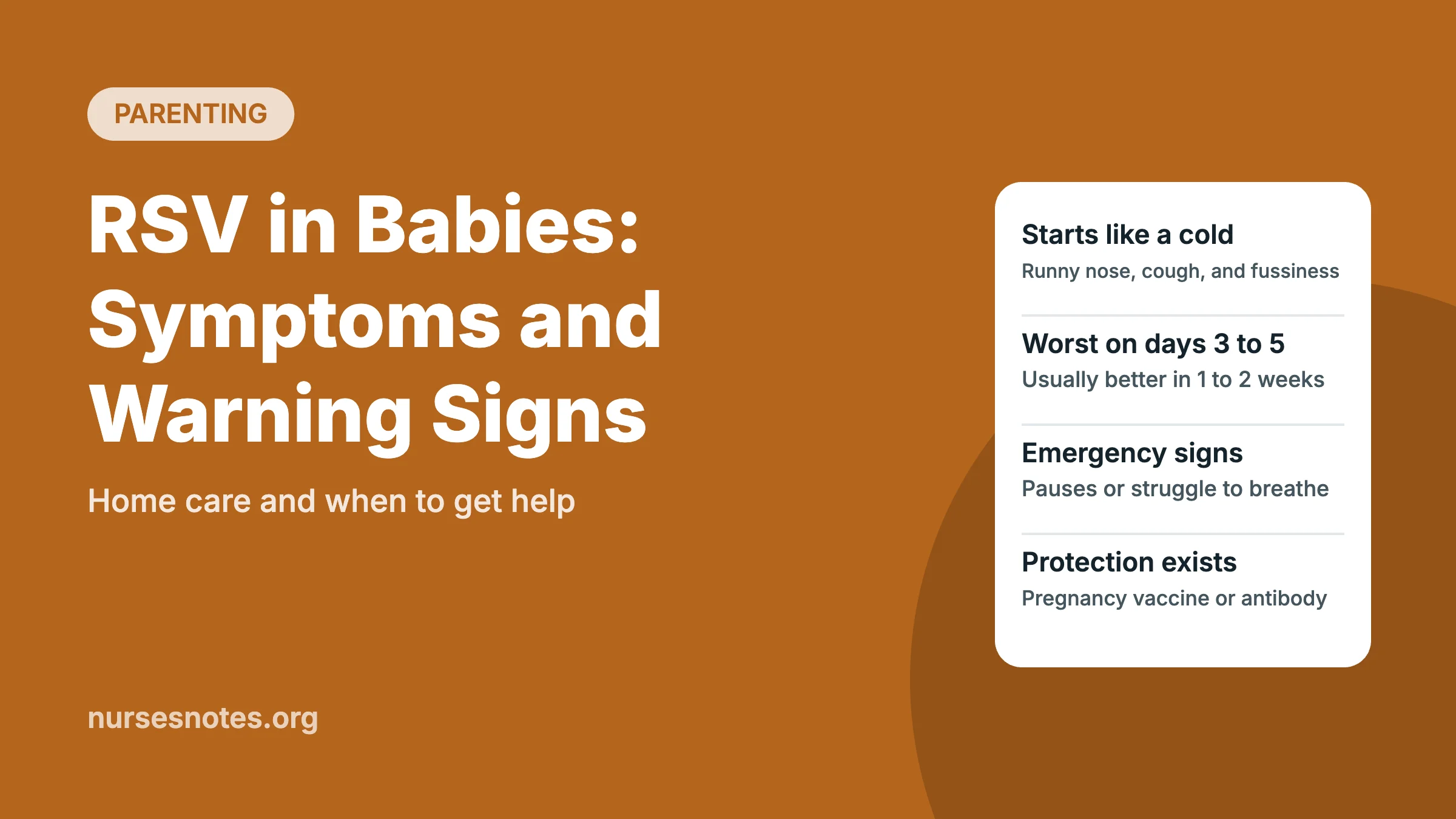
RSV in babies usually starts like a cold, with a runny nose, cough, sneezing, and fussiness, but in young infants it can spread to the small airways and make breathing hard. Most babies get better at home within 1 to 2 weeks, so the most important thing parents can learn is which breathing and feeding signs mean the baby needs a doctor or emergency care.
Key points
- RSV (respiratory syncytial virus) is very common: nearly all children catch it before age 2.
- Babies under 6 months may show only irritability, low activity, poor feeding, or pauses in breathing, often without fever.
- Go to emergency care for struggling to breathe, pauses in breathing, or blue or gray lips.
- Protection is available in many countries: an RSV vaccine in pregnancy or an antibody injection for the baby.
What is RSV?
RSV is a respiratory virus that spreads through droplets from coughs and sneezes, direct contact, and contaminated surfaces. In older children and adults it usually causes a mild cold. In babies it can cause bronchiolitis (swelling of the small airways in the lungs) or pneumonia.
The WHO estimates that RSV causes about 3.6 million hospital admissions and around 100,000 deaths in children under 5 each year, mostly in low- and middle-income countries. In many tropical countries, including those in Southeast Asia, RSV can circulate for months at a time without a clear season.
Signs and symptoms of RSV in babies
Early symptoms look like a cold:
- Runny or stuffy nose and sneezing
- Cough, which may be wet or dry
- Fever (though many young babies with RSV have no fever)
- Fussiness, a hoarse cry, and feeding less than usual
If RSV reaches the lungs (bronchiolitis), you may see:
- Fast breathing or wheezing
- Nostrils flaring with each breath
- Grunting, head bobbing, or belly breathing
- Skin pulling in between or under the ribs with each breath (retractions)
The CDC notes that babies younger than 6 months may show only irritability, less activity, or apnea, which means pauses in breathing lasting more than 10 seconds. Symptoms are usually worst around days 3 to 5 of the illness.
Which babies are at higher risk?
- Babies 6 months old or younger, especially the youngest infants
- Babies born prematurely
- Children with congenital heart disease or chronic lung disease
- Children with a weakened immune system or a neuromuscular condition that makes it hard to swallow or clear mucus
How to care for a baby with RSV at home
There is no medicine that cures RSV, and antibiotics do not help because it is a virus. Care at home focuses on comfort, breathing, and fluids:
- Clear the nose before feeds and sleep. Use saline drops and gentle suction with a bulb syringe or nasal aspirator.
- Offer frequent, smaller feeds. A blocked nose makes feeding tiring, so breastfeed or bottle-feed more often.
- Watch wet diapers. Fewer than one wet diaper every 8 hours can be a sign of dehydration.
- Use a cool-mist humidifier if you have one, and keep the baby away from cigarette smoke.
- Ask before giving medicine. Do not give cough and cold medicines or aspirin. Fever medicine is not suitable for every age, and doses depend on the baby’s weight and the product, so follow the label or ask your doctor or pharmacist first. Our guide on how to bring down a child’s fever explains safe comfort measures.
- Keep sleep safe. Even when your baby is congested, place them on their back on a flat, firm surface. See safe sleep for babies.
When to get medical help
Call your doctor or go to a clinic if your baby:
- Is under 3 months old and has a temperature of 38 °C (100.4 °F) or higher
- Has a fever that keeps going above 40 °C (104 °F) at any age
- Is not drinking or feeding enough
- Has symptoms that get worse, or do not improve after 7 days
- Has ear pain or ear drainage, or is unusually fussy
Go to the nearest emergency department or call your local emergency number right away if your baby has:
- Trouble breathing or is struggling to breathe
- Pauses in breathing
- Very fast, shallow, or noisy breathing
- Nostril flaring, grunting, or the chest or ribs pulling in with each breath
- Blue, gray, or pale lips, mouth, fingernails, or skin
- Signs of dehydration, such as fewer than one wet diaper every 8 hours
- Much less activity or alertness than usual
How to protect your baby from RSV
- RSV vaccine in pregnancy: antibodies pass to the baby and protect them for about the first 6 months. The WHO recommends it in the third trimester; exact timing depends on your country’s guidance.
- RSV antibody injection for the baby: a long-acting monoclonal antibody (such as nirsevimab) can be given to infants before or during their first RSV season. Most babies need either the pregnancy vaccine or the infant antibody, not both.
- Everyday steps: wash hands before holding the baby, keep the baby away from people who are sick, avoid crowds when RSV is spreading, avoid smoke, and breastfeed if you can.
Ask your obstetrician, pediatrician, or local health center which of these options are available where you live.
Frequently asked questions
How long does RSV last in babies?
Most babies with RSV feel better within 1 to 2 weeks. Symptoms are usually worst around days 3 to 5, and a cough can linger longer. If your baby is getting worse instead of better after the first few days, or still has symptoms after 7 days, check in with your doctor.
Can a baby with RSV be treated at home?
Yes, most babies recover at home with nose suctioning, frequent feeds, and close watching. A baby may need hospital care if they struggle to breathe, have pauses in breathing, need oxygen, or cannot feed enough to stay hydrated. Hospitals give supportive care such as oxygen and fluids.
Is RSV the same as a cold?
RSV is one of the viruses that can cause cold symptoms, and in older children and adults it usually stays mild. The difference is that in young babies RSV is more likely to spread to the small airways and cause bronchiolitis or pneumonia, so breathing needs closer attention.
Related on Nurses Notes
- Croup in children: barking cough symptoms and when to worry
- How to bring down a child’s fever safely
- Safe sleep for babies: how to lower the risk of SIDS
- More parenting and child health articles
Sources
- RSV in Infants and Young Children. Centers for Disease Control and Prevention (CDC), updated February 2026.
- RSV: When It’s More Than Just a Cold. American Academy of Pediatrics, HealthyChildren.org, updated September 2026.
- Respiratory syncytial virus (RSV). World Health Organization fact sheet, December 2025.
- RSV in Babies & Children. Cleveland Clinic, January 2024.
This article is for education only and does not replace advice from your own doctor, nurse, or other qualified health professional.