On this page
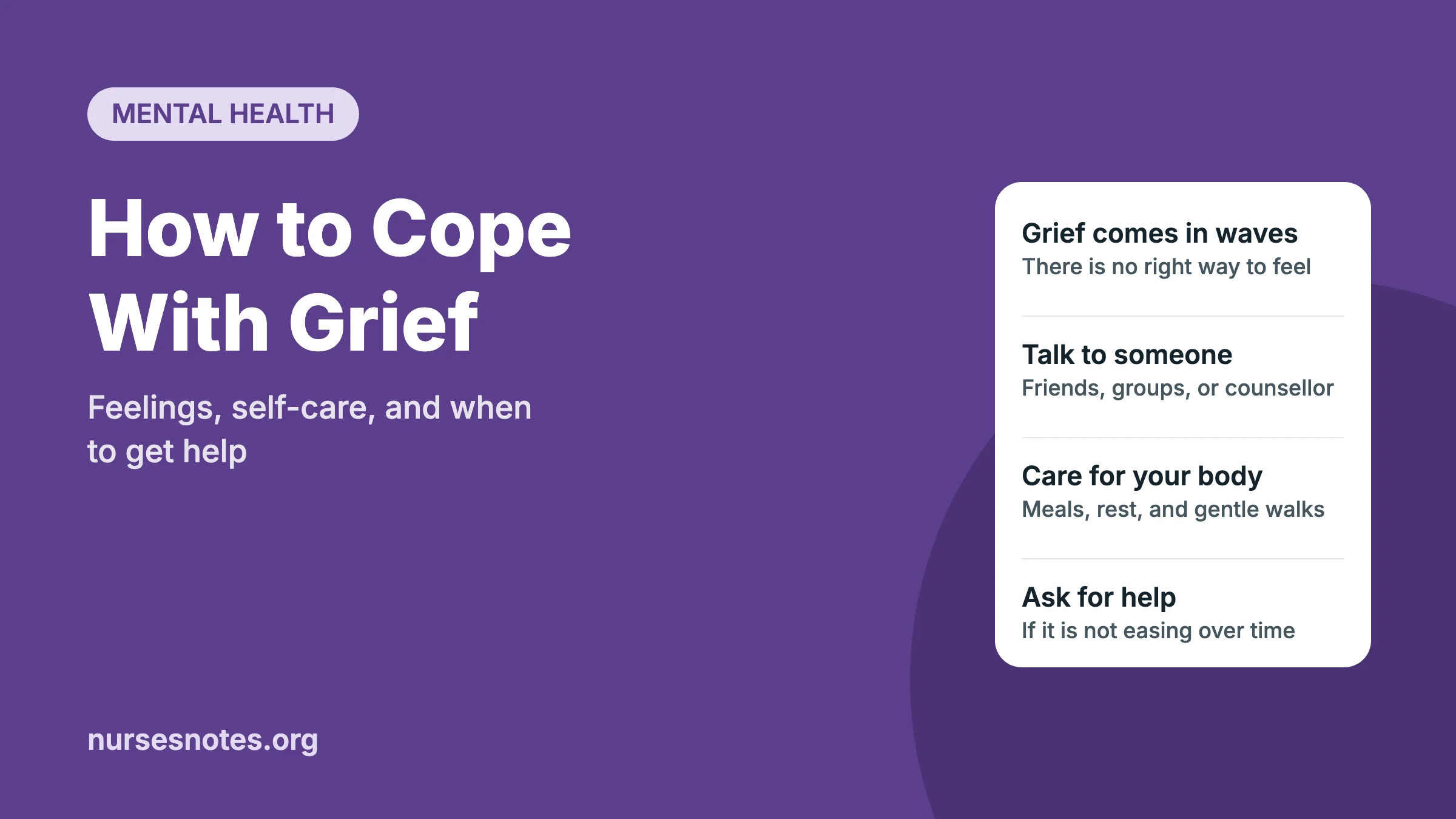
To cope with grief, give yourself permission to feel whatever comes, lean on people you trust, keep up basic routines like eating, sleeping, and moving, and reach out for professional support if the pain stops you from functioning. There is no right or wrong way to grieve, and for most people the intensity eases with time.
Key points
- Grief can bring shock, sadness, anger, guilt, and tiredness, often in waves rather than in a neat order.
- Talking, small daily goals, regular meals, and gentle exercise all help; alcohol and drugs usually make things harder.
- Grief can follow many losses, not only a death: a relationship, a job, a home, or a loved one’s health.
- If grief feels unbearable or does not ease over months, talk to a doctor or mental health professional.
What is grief?
Grief is the natural response to losing someone or something important to you. Mind describes bereavement as the experience of losing someone close, and grief as the process and range of feelings that follow.
Grief does not only follow a death. The NHS notes it can come after a breakup, losing a job, moving away from home, or when someone you love becomes seriously ill. Nurses and caregivers may also grieve patients they have cared for.
Common feelings of grief
Everyone grieves differently, and feelings can arrive without warning. You might notice:
- Shock or numbness, especially in the early days
- Deep sadness and crying
- Anger at the situation, at others, or at yourself
- Guilt about things said or left unsaid
- Exhaustion and trouble sleeping or concentrating
- Longing for the person, or feeling their absence everywhere
These reactions are normal. Grief often comes in waves, and a song, a smell, or an anniversary can bring strong feelings back.
Are there stages of grief?
You may have heard of five stages: denial, anger, bargaining, depression, and acceptance. The NHS points out that not everyone goes through all of them, and they rarely happen in order.
Acceptance does not mean you are fine with the loss. It means slowly coming to terms with it and finding a way to carry it as life goes on.
How to cope with grief: practical steps
There is no fixed timeline for grief. These steps, drawn from NHS and Mind guidance, can make each day a little more manageable.
- Talk about it. Share memories and feelings with a friend, relative, faith leader, or counsellor. Bottling things up can make you feel more alone.
- Join a support group. Meeting others who have had a similar loss can be a comfort and reduce isolation.
- Look after your body. Try to eat regular meals, drink water, rest, and move a little each day, even a short walk.
- Set small goals. Grief is tiring. Focus on one or two manageable tasks a day instead of trying to do everything at once.
- Go easy on yourself. Avoid dwelling on what you cannot change, and remember that grief is a common human experience.
- Limit alcohol and avoid drugs. They may numb the pain briefly but often make low mood and sleep worse.
- Plan for hard days. Birthdays, holidays, and anniversaries can be painful. Decide ahead how you want to spend them and who you want with you.
If you are supporting someone else who is struggling, our guide on how to help someone with depression has tips that also apply to grief.
Grief for nurses and caregivers
Health workers often move straight from one patient to the next after a death, with little time to process it. Repeated losses without support can add to stress and exhaustion.
Simple steps help: take a short pause after a death if you can, talk with trusted colleagues, and use any staff support or debriefing your workplace offers. If grief starts to wear you down, read our guide to the signs of nurse burnout.
When grief needs extra help
For most people, grief slowly becomes easier to live with. For some, it stays intense and gets in the way of daily life. This is sometimes called prolonged or complicated grief.
Talk to a doctor or mental health professional if:
- Low mood lasts more than 2 weeks, or self-help is not working
- You are struggling to cope with stress, anxiety, or sleep
- Intense grief is not easing after many months, or you find it very hard to accept the loss or return to daily life
- You feel life has no meaning, or you are withdrawing from everyone
- You are having thoughts that life is not worth living
The risk of prolonged grief is higher after a sudden, unexpected, or traumatic death, or the death of a child. Bereavement counselling and talking therapies can help, and asking for help is a sign of strength, not weakness.
Where to get help
If you or the person you are supporting is in danger or may not be safe, call your local emergency number now or go to the nearest emergency department. You can also contact these free crisis lines:
- Philippines: NCMH Crisis Hotline – 1553 (landline, nationwide), 0919-057-1553, 0966-351-4518, or 0917-899-8727
- USA: 988 Suicide & Crisis Lifeline – call or text 988, or chat at 988lifeline.org
- UK and Ireland: Samaritans – call 116 123, free, day or night
- Anywhere else: your local emergency number, or a doctor, nurse, or mental health service near you
Crisis numbers were checked on official sources on 25 October 2026.
Frequently asked questions
How long does grief last?
There is no set time limit. Grief depends on your relationship with the person, how they died, and your past experiences of loss. Many people find the pain becomes less intense over months, though feelings can return around anniversaries. If grief stays overwhelming for a long time and affects daily life, talk to a health professional.
Is it normal to feel angry or guilty when grieving?
Yes. Anger and guilt are common parts of grief. You may feel angry at the situation, at others, or at the person who died, or guilty about things you did or did not do. These feelings usually soften over time. Talking about them with someone you trust or a counsellor can help.
What is the difference between grief and depression?
Grief is a natural response to loss that usually eases with time, even though feelings come and go. Depression is a health condition that may need treatment. The two can overlap, and long, intense grief can lead to depression. If low mood lasts more than 2 weeks or self-help is not working, see a doctor.
Related on Nurses Notes
- How to help someone with depression: a practical guide
- Signs of nurse burnout and how to recover
- Panic attack symptoms: what they feel like and what to do
- All mental health articles
Sources
- Grief after bereavement or loss – NHS, reviewed July 2026
- What is bereavement? – Mind, 2023
- Complicated grief: Symptoms and causes – Mayo Clinic, 2022
- DOH: Mental health programs, crisis hotlines available this Undas – Philippine Information Agency, October 2025
- 988 Suicide & Crisis Lifeline – 988 Lifeline, 2026
- Contact Samaritans – Samaritans, 2026
This article is for education only and does not replace advice from your own doctor, nurse, or other qualified health professional.