On this page
IV drip rate calculation tells you how fast a fluid should run, either in millilitres per hour (mL/hr) for an infusion pump or in drops per minute (gtt/min) for gravity tubing. To get it right you need three things from the order and the tubing package: the total volume, the time, and the drop factor.
Key points
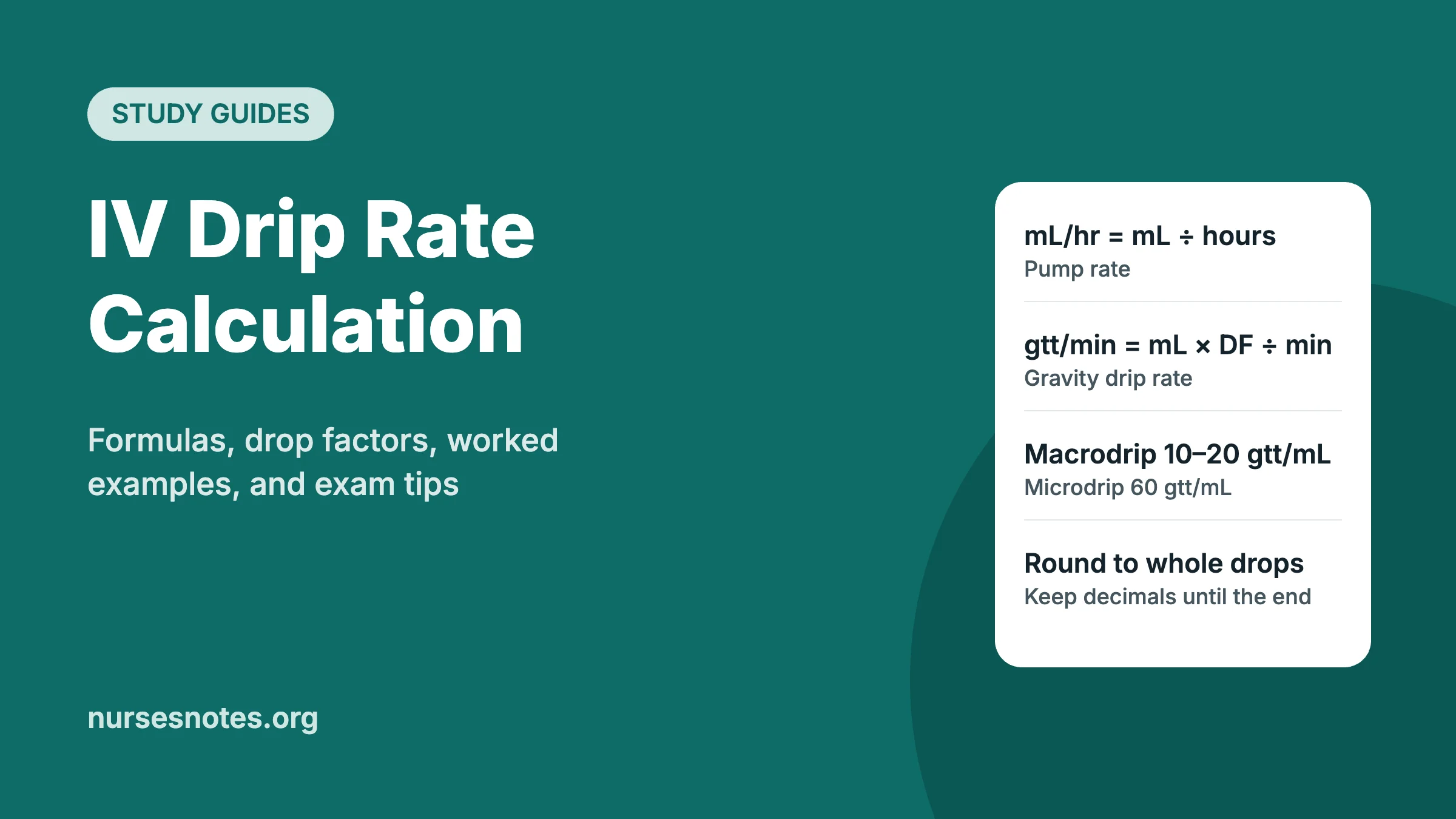
- For a pump: mL/hr = total volume (mL) ÷ time (hours).
- For gravity tubing: gtt/min = (volume in mL × drop factor) ÷ time in minutes.
- The drop factor is printed on the tubing package: macrodrip sets are 10 to 20 gtt/mL, and microdrip sets are 60 gtt/mL.
- Round drops to the nearest whole number, because you cannot give part of a drop.
What is an IV drip rate?
The drip rate (also called the flow rate or infusion rate) is the speed at which an intravenous fluid enters the patient. When an electronic infusion pump is used, you program the rate in mL/hr. When fluid runs by gravity, you adjust the roller clamp until the drops falling in the drip chamber match the calculated drops per minute.
Both methods start from the same prescriber order, for example “1,000 mL 0.9% sodium chloride over 8 hours.” The maths differs only in the final unit you need.
What is a drop factor?
The drop factor is the number of drops that make up 1 mL in a particular gravity IV set. It is written on the tubing package, so always check the package rather than assuming a value. Open RN describes two broad types:
| Tubing type | Drop factor | Typical use | Quick shortcut from mL/hr |
|---|---|---|---|
| Macrodrip | 10 gtt/mL | General adult IV fluids | Divide mL/hr by 6 |
| Macrodrip | 15 gtt/mL | General adult IV fluids | Divide mL/hr by 4 |
| Macrodrip | 20 gtt/mL | General adult IV fluids | Divide mL/hr by 3 |
| Microdrip | 60 gtt/mL | Small, precise volumes (infants and children) | gtt/min equals mL/hr |
IV drip rate formulas
Learn these three formulas and you can solve almost every IV question on a nursing exam:
- Infusion rate (mL/hr) = total volume (mL) ÷ time (hours)
- Drip rate (gtt/min) = (total volume (mL) × drop factor (gtt/mL)) ÷ time (minutes)
- Infusion time (hours) = total volume (mL) ÷ rate (mL/hr)
A useful variation, when you already know the mL/hr, is gtt/min = (mL/hr × drop factor) ÷ 60. This is the same formula with the time already converted to minutes.
How to calculate drops per minute: step by step
- Read the order: total volume and time. Convert litres to millilitres (1 L = 1,000 mL).
- Find the drop factor on the tubing package.
- Convert the time to minutes (hours × 60).
- Multiply the volume by the drop factor.
- Divide by the time in minutes.
- Round to the nearest whole drop, then ask yourself whether the answer makes sense.
Worked examples
Example 1: Macrodrip, adult maintenance fluid
Order: 1,000 mL over 8 hours. Tubing: 15 gtt/mL.
- Rate: 1,000 ÷ 8 = 125 mL/hr
- Drops: (125 × 15) ÷ 60 = 31.25, so set 31 gtt/min
Example 2: Microdrip
Order: 500 mL over 4 hours. Tubing: 60 gtt/mL.
- Drops: (500 × 60) ÷ 240 minutes = 125 gtt/min
- Notice that 500 ÷ 4 is also 125 mL/hr. With 60 gtt/mL tubing, gtt/min always equals mL/hr.
Example 3: Rounding
Order: 250 mL over 2 hours. Tubing: 10 gtt/mL.
- Drops: (250 × 10) ÷ 120 = 20.83, so set 21 gtt/min
Example 4: Pump rate for a short infusion
Order: 100 mL over 30 minutes on a pump.
- Convert time: 30 minutes = 0.5 hour
- Rate: 100 ÷ 0.5 = 200 mL/hr
Example 5: When will the bag finish?
Order: 500 mL at 75 mL/hr, started at 0800.
- Time: 500 ÷ 75 = 6.67 hours
- Convert the decimal: 0.67 × 60 ≈ 40 minutes, so 6 hours 40 minutes
- Finish time: 0800 + 6 h 40 min = 1440
Nursing assessment before you start
- Check the order for the fluid, volume, rate or time, and route, and clarify anything unclear with the prescriber.
- Assess the IV site for patency, swelling, redness, or pain.
- Note baseline vital signs, intake and output, and any risk of fluid overload, such as heart or kidney problems or older age.
- Review relevant labs, such as electrolytes (see our electrolytes guide for nurses).
Nursing considerations
- Use an infusion pump when precision matters, for example for medicines or for patients at risk of fluid overload. Gravity rates can drift.
- A pump adds safety, but Open RN reminds nurses that they remain responsible for setting it up correctly. Ask for help with unfamiliar equipment.
- For gravity infusions, count the drops in the drip chamber while adjusting the roller clamp, then recheck regularly, because bag height and patient position can change the flow.
- Double-check your calculation, and follow facility policy on independent double checks for high-alert infusions.
- Monitor the site, fluid balance, and the patient’s response throughout the infusion, and document the rate, volume infused, and site condition.
- Always perform hand hygiene before handling IV lines (the 5 moments for hand hygiene).
Exam tips and common traps
- Units first. Convert litres to mL and hours to minutes before you multiply. Most wrong answers come from skipping this step.
- Do not round early. Keep decimals until the final answer, then round drops to a whole number.
- Microdrip shortcut: 60 gtt/mL tubing means gtt/min = mL/hr.
- Macrodrip shortcuts: divide mL/hr by 6 (10 gtt/mL), 4 (15 gtt/mL), or 3 (20 gtt/mL).
- Sense check: an adult maintenance rate of several hundred drops per minute on macrodrip tubing is almost certainly a calculation error.
- Read the question: does it ask for mL/hr, gtt/min, or a finish time? Answer in the unit asked.
Frequently asked questions
What is the formula for IV drip rate?
The standard formula is drops per minute = (total volume in mL × drop factor in gtt/mL) ÷ time in minutes. If you already know the hourly rate, use (mL/hr × drop factor) ÷ 60. For an infusion pump, you only need mL/hr, which is the total volume divided by the time in hours.
How do I know the drop factor?
The drop factor is printed on the IV tubing package, so check it each time you prime a new set. Macrodrip sets usually deliver 10, 15, or 20 drops per mL, and microdrip sets deliver 60 drops per mL. In exam questions, the drop factor is always given in the question.
Should I round drops per minute up or down?
Round to the nearest whole number, because a fraction of a drop cannot be counted or given. Keep all decimals until the last step so the error stays small. If even a small difference matters, for example with medicines or a patient at risk of fluid overload, use an infusion pump instead.
Related on Nurses Notes
- Electrolytes made simple: what nurses need to know
- Types of insulin chart for nursing students
- 5 moments for hand hygiene: a nursing study guide
- All Study Guides on Nurses Notes
Sources
- Chapter 5 Math Calculations, in Nursing Skills [Internet], Open RN, Chippewa Valley Technical College (NCBI Bookshelf), 2021
- 5.14 IV Infusion by Gravity, Nursing Skills, Open Resources for Nursing (Open RN), accessed October 2026
- Pharmacy Calculations, StatPearls (NCBI Bookshelf), updated June 2023
- IV Flow Rates, Math for Medication Administration, BCcampus Open Education, accessed October 2026
This article is for education only and does not replace advice from your own doctor, nurse, or other qualified health professional. Always follow your facility’s policies and reference ranges.