On this page
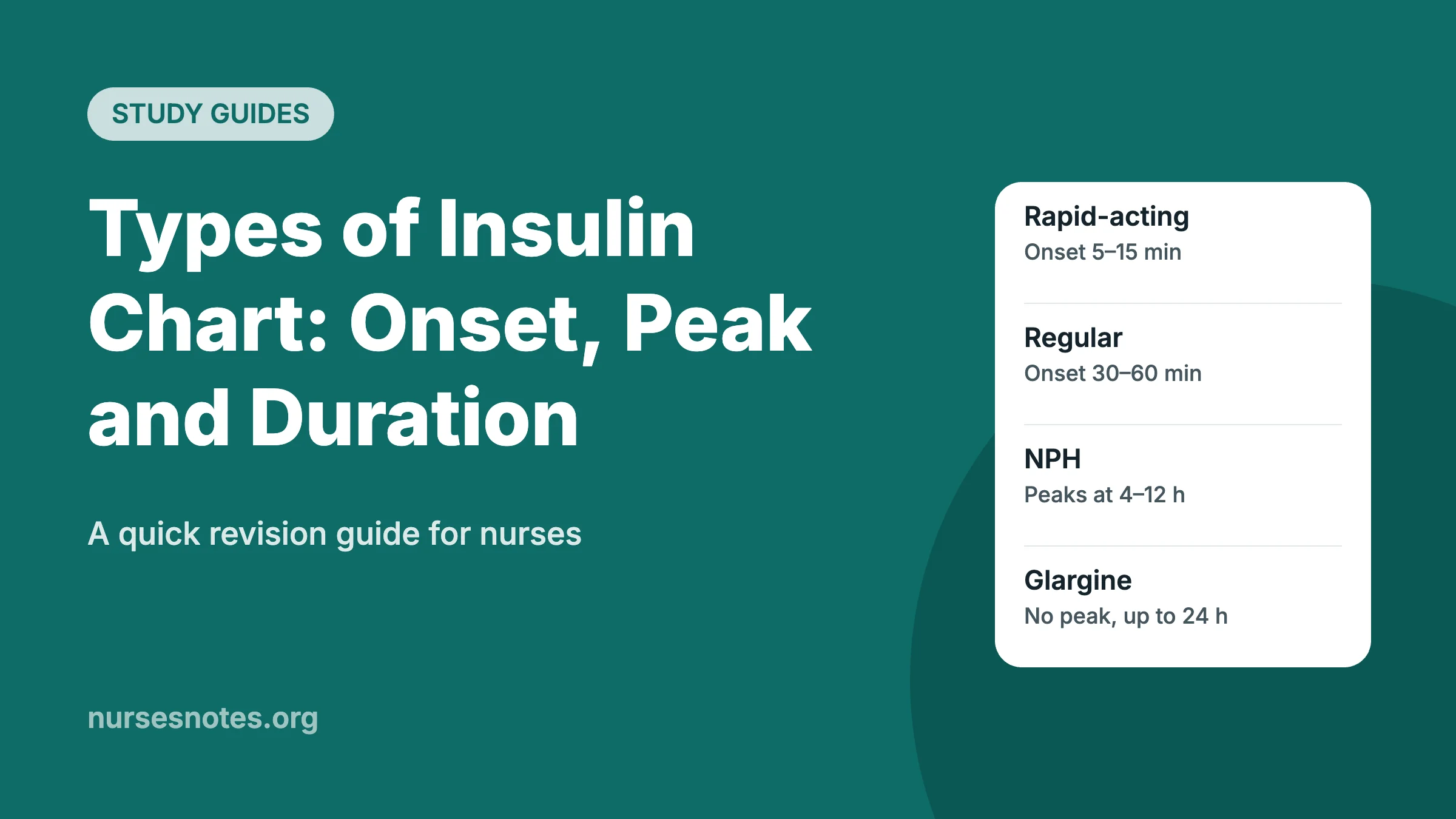
A types of insulin chart groups insulins by how fast they start working (onset), when they work hardest (peak) and how long they last (duration): rapid-acting, short-acting (regular), intermediate-acting (NPH), long-acting and premixed. Knowing these times helps you match each dose to meals, predict when hypoglycaemia is most likely and answer NCLEX and board exam questions with confidence.
Key points
- Rapid-acting insulins (lispro, aspart, glulisine) start in about 5 to 15 minutes, so food must be ready when you give them.
- Regular insulin starts in about 30 to 60 minutes; NPH starts in 1 to 2 hours and peaks at 4 to 12 hours.
- Long-acting insulins such as glargine and degludec have no pronounced peak and cover about a day or longer.
- Hypoglycaemia (blood glucose below 70 mg/dL) is the most common adverse effect; the risk is highest around the peak.
What onset, peak and duration mean
Onset is the time from injection until insulin starts lowering blood glucose. Peak is when the effect is strongest. Duration is how long it keeps working.
These three numbers explain most insulin exam questions. If you know when a dose peaks, you know when to watch most closely for low blood sugar and when a meal or snack matters most.
Types of insulin chart (subcutaneous)
The table below uses the timings published by Cleveland Clinic for common products. Figures are approximate; other references (for example the CDC) give slightly different ranges, and the CDC notes that brands of the same type can differ. Always check the product information and your facility’s references.
| Type | Examples (generic) | Onset | Peak | Duration |
|---|---|---|---|---|
| Rapid-acting | Glulisine | 5–15 min | 1–3 h | 3–5 h |
| Rapid-acting | Aspart, lispro | 10–15 min | 1–3 h | 3–5 h |
| Short-acting | Regular (human) insulin | 30–60 min | 2–4 h | 5–8 h |
| Intermediate-acting | NPH (isophane) | 1–2 h | 4–12 h | 14–24 h |
| Long-acting | Detemir | 1 h | 3–14 h | Up to 24 h |
| Long-acting | Glargine U-100 | 3–4 h | No peak | Up to 24 h |
| Long-acting | Glargine U-300 | 6 h | No peak | Up to 36 h |
| Ultra-long-acting | Degludec | 1 h | No peak | Up to 42 h |
| Premixed (human) | NPH/regular 70/30, 50/50 | 30–60 min | 2–12 h | 10–16 h |
| Premixed (analogue) | Lispro or aspart mixes | 5–20 min | 1–2 h | 10–16 h |
How each insulin type is used
- Rapid-acting: covers the rise in glucose from a meal. Cleveland Clinic notes these may be taken up to 15 minutes before eating; StatPearls describes aspart as given 5 to 10 minutes before a meal.
- Short-acting (regular): also a mealtime insulin, but slower. Cleveland Clinic says it is taken about 30 minutes before eating, and the CDC gives 30 to 60 minutes.
- Intermediate-acting (NPH): covers about half a day or overnight and is often combined with a rapid- or short-acting insulin.
- Long-acting and ultra-long-acting: provide steady background (basal) insulin for about a day or longer, with mealtime insulin added as needed.
- Premixed: combine a fast and an intermediate insulin in one injection, usually given before breakfast and dinner.
Nursing assessment before giving insulin
- Check the blood glucose result and the time of the patient’s next meal. Do not give a rapid-acting dose if the tray is not coming or the patient is nil by mouth without a clear order.
- Assess for signs of hypoglycaemia: dizziness, sweating, confusion, tremor, fast heart rate and hunger.
- Review potassium. Insulin moves potassium into cells, so it can cause hypokalaemia and, if untreated, dangerous arrhythmias (see our electrolytes guide for nurses).
- Inspect injection sites for lumps or skin changes (lipodystrophy).
- Confirm the insulin name, concentration and dose against the order. StatPearls advises verifying the label before every injection to reduce medication errors.
Nursing interventions and considerations
- Rotate sites among the abdomen, thighs, upper arms and buttocks to reduce lipodystrophy. StatPearls advises avoiding the area within 2 inches (about 5 cm) of the navel.
- Time the dose with food: have a meal or a glucose source ready, especially with rapid-acting insulin.
- Monitor glucose as ordered. StatPearls describes checks before meals or 2 hours after for non-critically ill patients, and every 1 to 2 hours in critically ill patients.
- Mixing: rapid-acting and regular insulins may be mixed with NPH, but Cleveland Clinic advises against mixing insulins from different manufacturers. A mixture of aspart and NPH is given subcutaneously only. Follow your facility’s procedure.
- IV insulin is used only in specific settings and needs close monitoring of glucose and serum potassium.
- Never share insulin pens, needles or syringes between patients.
- Teach patients how to recognise and treat low blood sugar and to follow the information that comes with their own insulin.
Recognising and treating hypoglycaemia
The CDC defines low blood sugar as below 70 mg/dL (about 3.9 mmol/L) and severely low as below 55 mg/dL (about 3.1 mmol/L). Thresholds and protocols vary by facility, so follow your hypoglycaemia policy.
- Conscious and able to swallow: the CDC “15-15 rule” is to give 15 g of fast-acting carbohydrate, wait 15 minutes and recheck. Repeat if still below 70 mg/dL, then give a snack or meal with carbohydrate and protein.
- Unable to swallow or unconscious: do not give anything by mouth. Glucagon or IV dextrose is used according to orders and protocol, and medical help is needed straight away.
- Afterwards: report the event so the insulin plan can be reviewed, and look for the cause (missed meal, wrong timing, extra activity, dose error).
Exam tips
- Peak equals danger: if NPH is given at 0700, hypoglycaemia is most likely in the late morning to evening (4 to 12 hours later). Many questions test this timing.
- Rapid-acting means food now: the safest answer usually links rapid-acting insulin with the meal tray being present.
- No peak for glargine or degludec: these are basal insulins, not for correcting a high reading before a meal.
- Watch potassium: in questions about insulin infusions (for example in DKA), low potassium is a key risk. Review acid-base basics in our ABG interpretation steps.
- Concentration traps: Cleveland Clinic lists different concentrations (U-100, U-200, U-300) with different action times, so read the name and concentration on the label every time.
Frequently asked questions
Which insulin has the fastest onset?
Rapid-acting analogues have the fastest onset. Cleveland Clinic lists glulisine at 5 to 15 minutes and aspart and lispro at 10 to 15 minutes. Because they act so quickly, the patient should be ready to eat soon after the injection, and the nurse should confirm the meal is available before giving the dose.
Which insulin has no peak?
Long-acting basal insulins such as glargine and the ultra-long-acting degludec are described as having no pronounced peak. They give a steady level of insulin for about 24 hours or more. Detemir is also long-acting, but Cleveland Clinic lists a broad peak of 3 to 14 hours, so watch for lows during that window.
When is a patient most at risk of hypoglycaemia?
The risk is highest when the insulin is at its peak, especially if a meal is late, missed or small, or the patient is more active than usual. For NPH this is about 4 to 12 hours after injection, and for rapid-acting insulin about 1 to 3 hours. Check glucose if any symptoms appear.
Related on Nurses Notes
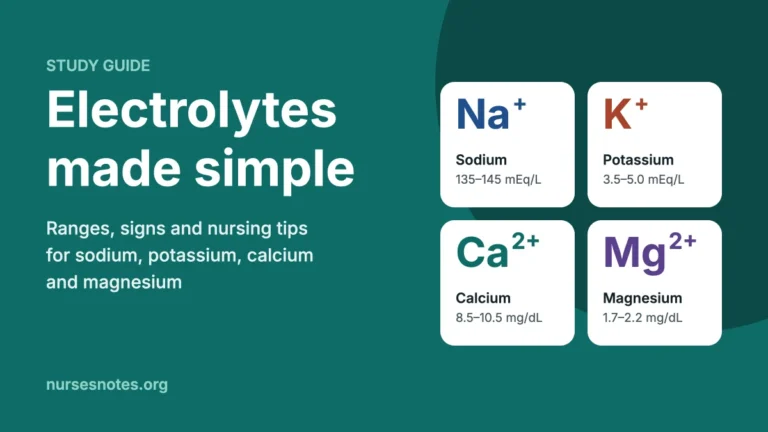
- Electrolytes made simple: sodium, potassium, calcium and magnesium
- ABG interpretation steps: a simple guide for nurses
- Signs of dehydration in adults and when to worry
- More nursing study guides
Sources
- Injectable Insulin Medications – Cleveland Clinic (medically reviewed 2018)
- How to Use Insulin – Centers for Disease Control and Prevention (2024)
- Treatment of Low Blood Sugar (Hypoglycemia) – Centers for Disease Control and Prevention (2024)
- Aspart Insulin – StatPearls, NCBI Bookshelf, National Library of Medicine (2024)
This article is for education only and does not replace advice from your own doctor, nurse or other qualified health professional. Always follow your facility’s policies and reference ranges.