On this page
Nasogastric tube insertion is the passing of a flexible tube through the nose, down the oesophagus, and into the stomach to drain stomach contents or to give feeds, fluids, and medicines. The most important nursing responsibility is not the insertion itself but proving the tip is in the stomach before anything goes down the tube.
Key points
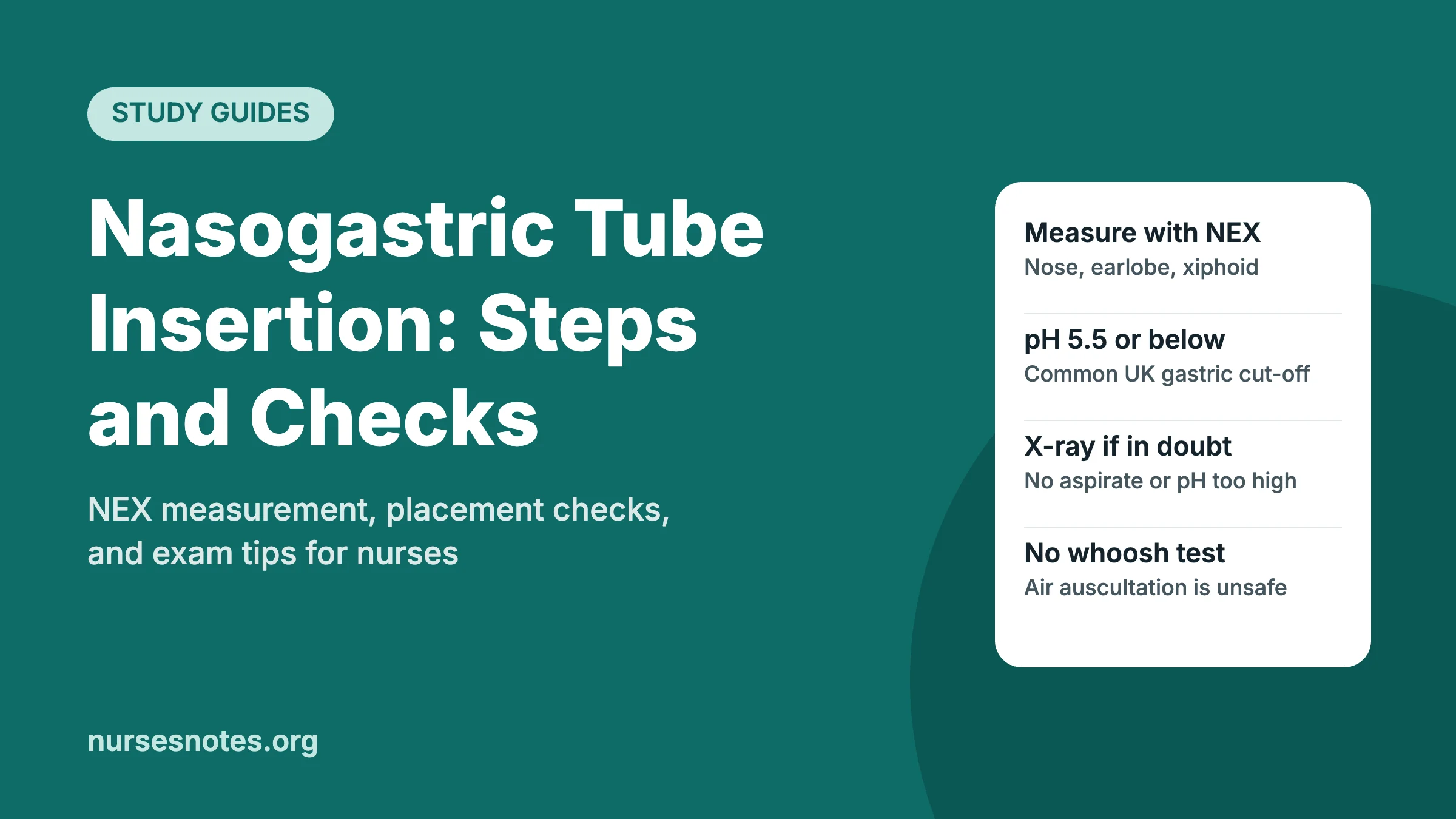
- Measure the length using the nose-ear-xiphoid (NEX) method; StatPearls notes about 55 cm reaches the stomach in an average adult, but every estimate has some error.
- Never use the “whoosh” (air auscultation) test; StatPearls calls it of dubious value and says it should not be used.
- In UK practice, an aspirate pH of 5.5 or below is commonly accepted as gastric; if no aspirate or a higher pH, get an X-ray.
- Feeding into a tube placed in the lung is a recognised “Never Event”, so check placement before every use.
What is a nasogastric (NG) tube?
An NG tube is a soft tube that runs from the nostril to the stomach. Wide-bore tubes are mainly used for drainage and decompression, while fine-bore tubes are used for feeding and medicines.
Because it is placed “blind”, the tube can end up in the wrong place, including the airway. That is why placement checks are tested so often in NCLEX and Philippine nursing board questions.
Indications
- Decompression of the stomach in ileus or small bowel obstruction
- Nutrition or medicines when the gut works but the patient cannot swallow safely
- Removal of poison after some oral overdoses
- Diagnosis in suspected upper gastrointestinal bleeding
StatPearls adds that routine NG tubes after abdominal surgery are not recommended.
Contraindications
| Type | Examples |
|---|---|
| Absolute | Severe craniofacial trauma (risk of the tube entering the skull), patient refusal or no valid consent, and a blocked gut when the aim is feeding |
| Relative | Uncorrected bleeding problems or anticoagulant use, oesophageal varices or recent banding, oesophageal injury such as caustic ingestion, bariatric surgery, severe gastroparesis, and unstable vital signs |
Equipment
- Correct NG tube as ordered, with a guidewire if it is a fine-bore feeding tube
- Water-soluble lubricant (some guidelines use 2% lidocaine gel)
- Enteral (ENFit) syringe, usually 60 mL, and CE-marked pH indicator strips
- Glass of water and straw (if the patient is allowed to swallow)
- Tape or a fixation device, gloves, apron, tissues, and a vomit bowl
How to measure NG tube length (NEX)
Hold the tip of the tube at the nostril, run it to the earlobe, and then down to the xiphoid process. Note the mark on the tube; this is the length to insert.
StatPearls notes that about 55 cm from the nostril reaches the stomach in an adult, but all estimation methods carry some margin of error. Placement still has to be confirmed after insertion.
Nasogastric tube insertion steps
- Check the order, identify the patient, explain the procedure, and agree on a stop signal (such as raising a hand).
- Perform hand hygiene and put on gloves and an apron.
- Position the patient upright with the neck slightly flexed, if possible. StatPearls also describes a left lateral position for some patients.
- Check that the nostrils are clear and choose the more open side.
- Measure the tube using NEX and mark the length.
- Lubricate the tip and pass it gently along the floor of the nose, aiming back rather than up.
- When the tube reaches the throat, ask the patient to sip water through a straw and swallow as you advance the tube.
- Stop and pull back if there is resistance, or if the patient becomes breathless, distressed, or unable to speak.
- Advance to the marked length, then hold the tube in place.
- Confirm placement (see below) before using the tube, and only then remove any guidewire as per the manufacturer and policy.
- Secure the tube to the nose without pressure on the nostril, record the external length, and document the procedure.
How to confirm NG tube placement
StatPearls explains that a tube can enter the airway without any symptoms, especially in intubated patients or those without a gag reflex. The absence of coughing or distress does not prove the tube is in the stomach.
| Method | Use it? | Notes |
|---|---|---|
| pH of aspirate using CE-marked strips | Yes (first-line in many UK hospitals) | A pH of 5.5 or below is commonly accepted as gastric; cut-offs vary between guidelines |
| Chest or upper abdominal X-ray | Yes | Needed when no aspirate is obtained or the pH is outside the safe range; StatPearls says thin, flexible tubes should always be X-ray confirmed |
| Air auscultation (“whoosh test”) | No | A tube in the lung or small bowel can sound similar |
| Appearance of aspirate alone | No | Colour is supportive only; StatPearls describes bilious (yellow or green) fluid but you still confirm |
| No coughing or breathlessness | No | Airway placement can be silent |
The UK Healthcare Safety Investigation Branch (HSSIB) found that incorrect reading of X-rays is the most common cause of NG tube incidents. Only competent staff should confirm placement from an X-ray.
Nursing considerations after insertion
- Check placement before every feed, every medicine, and after vomiting, coughing fits, or signs the tube has moved.
- Check the external length mark at the nostril each shift and compare it with the documented length.
- Flush the tube with water before and after feeds and medicines, as MedlinePlus advises after each feeding or as your nurse recommends.
- If the tube blocks, flush gently; MedlinePlus advises not to push the plunger hard or fast.
- Re-tape regularly and inspect the nostril, as constant pressure can cause pressure ulcers (see pressure ulcer stages).
- Give mouth care, since patients who are nil by mouth get a dry mouth quickly.
- Monitor fluid balance and electrolytes, especially potassium, when there is heavy drainage or irrigation.
Complications to watch for
- Nosebleed and pain during insertion
- Placement in the airway, leading to aspiration pneumonia, pneumothorax, or death if feeds are given
- Pressure injury or necrosis of the nostril
- Sinusitis and irritation or bleeding of the stomach lining with long-term use
- Electrolyte losses such as hypokalaemia with extensive irrigation (review electrolytes for nurses)
Exam tips
- NEX = Nose, Ear, Xiphoid. Measure before you insert.
- “Swallow to follow.” Swallowing closes the airway and helps the tube enter the oesophagus.
- The whoosh test is always wrong. If an answer option says “inject air and listen”, it is a distractor.
- X-ray is the most accurate check, but pH testing of aspirate is the usual bedside first step in many guidelines.
- Facial trauma or basal skull fracture? Suspect a contraindication to nasal insertion and expect an order for the oral route instead.
- Check before every use, not only after insertion.
Frequently asked questions
What pH confirms NG tube placement?
In UK guidance, an aspirate pH of 5.5 or below on CE-marked pH strips is commonly accepted as gastric placement. HSSIB notes that research does not agree on the best cut-off, and some guidelines use 4.0 or 5.0. Always follow your facility’s approved cut-off.
What is the most accurate way to check NG tube placement?
An X-ray, read by a competent practitioner, is regarded as the most accurate method. However, HSSIB found that misreading X-rays is the most common cause of NG tube incidents. At the bedside, pH testing of aspirate is often used first, with X-ray when no aspirate is obtained or the pH is not in range.
Why is the whoosh test no longer used?
Injecting air and listening over the stomach cannot tell a tube in the stomach from one in the lung or small bowel, because they can sound the same. StatPearls says this method is of dubious value and should not be used. Exam questions often include it as a tempting but wrong answer.
Related on Nurses Notes
- Pressure ulcer stages: nursing study guide
- Electrolytes made simple: what nurses need to know
- PPE donning and doffing sequence
- All Study Guides on Nurses Notes
Sources
- Goosenberg E, An J. Nasogastric Tube Insertion. StatPearls Publishing, NCBI Bookshelf; last updated 29 March 2026.
- Investigation report: Placement of nasogastric tubes. Healthcare Safety Investigation Branch (HSSIB), UK; 2021.
- Nasogastric feeding tube. MedlinePlus, U.S. National Library of Medicine; reviewed 2024.
This article is for education only and does not replace advice from your own doctor, nurse, or other qualified health professional. Always follow your facility’s policies and reference ranges.