On this page
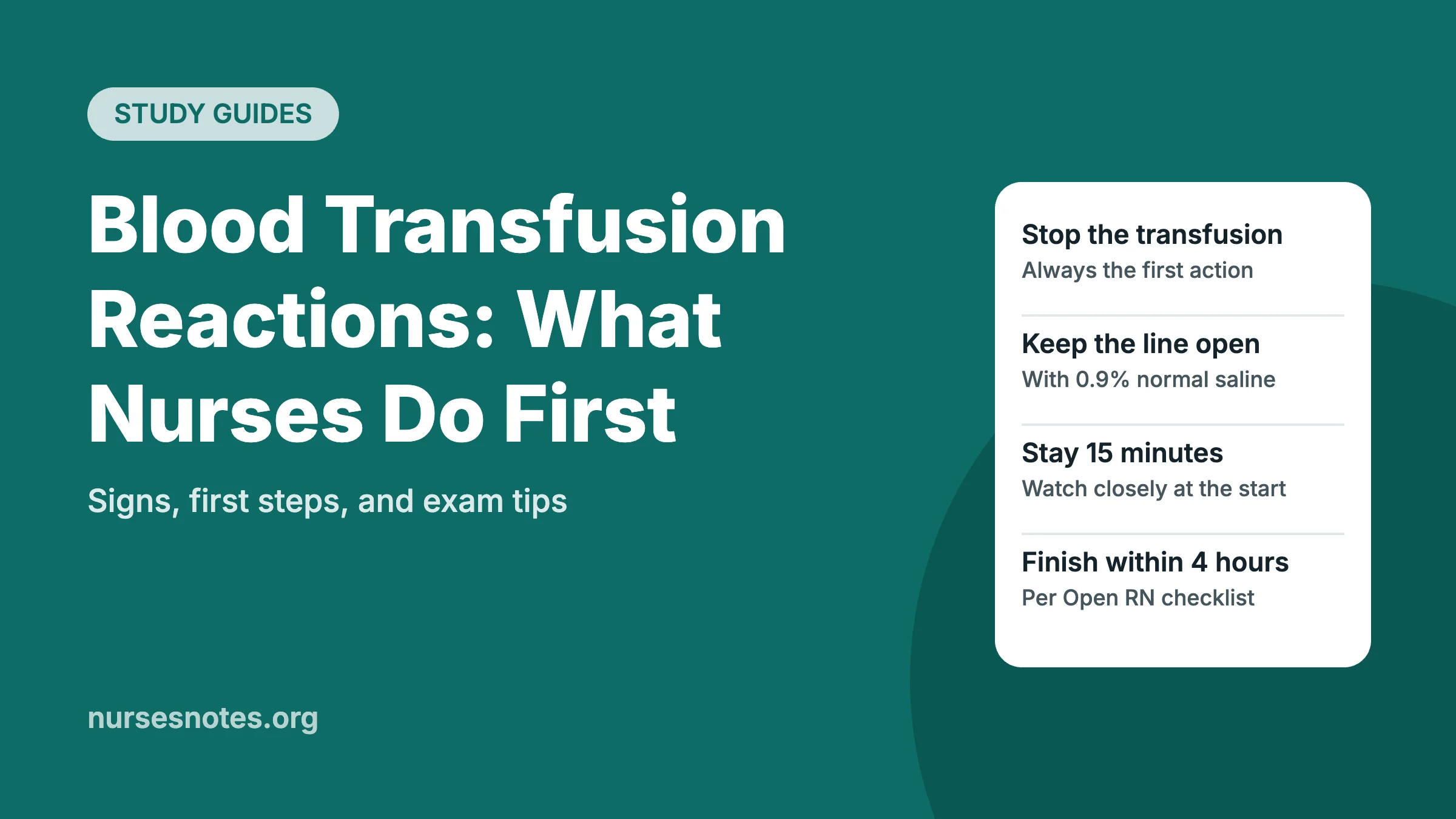
Blood transfusion reaction nursing interventions start with one rule: if you suspect a reaction, stop the transfusion immediately and keep the IV line open with 0.9% normal saline. After that, you check the patient and the blood product, monitor vital signs closely, notify the provider and blood bank, and send samples as your facility requires.
Key points
- Stopping the transfusion is always the first action when a reaction is suspected.
- Most serious reactions are linked to identification or clerical errors, so the two-person bedside check matters.
- Stay with the patient for the first 15 minutes; acute reactions usually show up within the first hour.
- Know how to tell TACO (fluid overload, often hypertension) from TRALI (acute lung injury, often hypotension and fever).
What is a blood transfusion reaction?
A transfusion reaction is any unwanted response to a blood product. StatPearls groups them into acute reactions, which happen during the transfusion or within 24 hours, and delayed reactions, which appear days to weeks later.
Acute reactions include febrile non-hemolytic, mild allergic, anaphylactic, septic, acute hemolytic, transfusion-associated circulatory overload (TACO), and transfusion-related acute lung injury (TRALI). Delayed reactions include delayed hemolytic reactions and transfusion-associated graft-versus-host disease.
StatPearls authors note that most transfusion reactions stem from clerical or nursing errors, and that nurse vigilance is the key to reducing harm. This is why the checks before and during the transfusion are tested so often in NCLEX and board exams.
Types of transfusion reactions: signs and timing
| Reaction | Usual timing | Key signs and symptoms | Typical management (as ordered) |
|---|---|---|---|
| Acute hemolytic (AHTR) | During the transfusion, often early | Fever, chills, flank or back pain, burning or oozing at the IV site, hypotension, red or dark urine, low urine output, unusual bleeding | Stop transfusion, IV fluids to support urine output, oxygen if needed, labs for hemolysis |
| Febrile non-hemolytic (FNHTR) | During or within 4 hours | Temperature above 38 °C with a rise of at least 1 °C from baseline, chills, rigors | Stop transfusion, antipyretic, rule out hemolysis and sepsis |
| Mild allergic | During or within 4 hours | Hives, itching, rash, swelling | Stop transfusion, antihistamine; may restart only if the provider decides it is safe |
| Anaphylaxis | Within minutes of starting | Hypotension, bronchospasm, wheezing, respiratory distress | Stop transfusion and start emergency treatment |
| TACO | Within 12 hours | Dyspnea, hypoxia, hypertension, tachycardia, crackles, distended neck veins, edema | Diuretics and ventilatory support as needed |
| TRALI | Within 6 hours, often within 1 to 2 hours | Sudden hypoxemia, bilateral infiltrates, pink frothy secretions, hypotension, fever | Stop transfusion, oxygen, ventilatory support; diuretics used cautiously |
| Delayed hemolytic | More than 24 hours, usually 1 to 2 weeks | Low-grade fever, jaundice, unexplained fall in hemoglobin | Monitor hemoglobin, hydration, record the antibody for future transfusions |
Fever during a transfusion can also be a sign of bacterial contamination of the unit (a septic reaction), so the provider may order blood cultures from the patient and from the product.
Before the transfusion: nursing assessment and checks
Most prevention happens before the first drop runs in. Based on the Open RN blood administration checklist and StatPearls, key steps are:
- Ask about previous transfusions and any past reactions.
- Confirm the patient’s identity using at least two identifiers, and complete a two-person check of the blood product against the order and the patient.
- Take baseline vital signs within 15 minutes before starting, so later changes can be compared.
- Use a blood administration set with a standard blood filter, primed with preservative-free normal saline.
- Start the transfusion within 30 minutes of collecting the unit from the blood bank, or follow your facility’s time limit.
If you need to work out a gravity flow rate for the infusion, see our guide to IV drip rate calculation.
During the transfusion: monitoring
- Start slowly, typically about 2 mL per minute (120 mL per hour) or as your policy states, and stay with the patient for the first 15 minutes.
- Recheck vital signs during the first 15 minutes, then as your agency policy and the patient’s condition require.
- Increase to the prescribed rate so the unit finishes within 4 hours.
- Watch for new symptoms such as chills, itching, back pain, breathlessness, or anxiety, and ask the patient to tell you about them right away.
Small changes can be normal. StatPearls notes that a temperature change of about 0.5 °C may not mean a reaction, but a rise of 1 °C or more from the starting temperature means the transfusion should be stopped. Severe reactions have a median onset of about 20 minutes, which is why the early minutes need close watching.
Nursing interventions for a suspected transfusion reaction
Follow your facility’s protocol. The general sequence described in StatPearls is:
- Stop the transfusion immediately. Do not wait to see if symptoms settle.
- Keep the IV access open with 0.9% normal saline so you can give fluids and medicines.
- Do a clerical check at the bedside: compare the bag label, the compatibility record, and the patient’s identification.
- Assess and monitor vital signs, oxygen saturation, breathing, and urine output; StatPearls suggests recording vital signs every 15 minutes.
- Notify the provider and the blood bank without delay.
- Send samples as ordered: a post-transfusion blood sample, the blood bag and tubing, and urine if requested.
- Give supportive treatment as ordered, such as oxygen, IV fluids, antipyretics, antihistamines, or diuretics depending on the reaction type.
- Document the time, symptoms, vital signs, actions taken, and the patient’s response, and complete an incident report if required.
For an acute hemolytic reaction, StatPearls describes IV normal saline to maintain urine output of about 1 mL/kg/hour, with monitoring of kidney function and labs such as the direct antiglobulin test, LDH, bilirubin, haptoglobin, and coagulation studies. Serial hemoglobin results help track hemolysis; review the CBC normal values if you need a refresher.
Exam tips
- First action = stop the transfusion. Calling the provider, giving medicines, or checking labels comes after.
- TACO vs TRALI: TACO looks like fluid overload (hypertension, distended neck veins, crackles) and responds to diuretics. TRALI is lung injury, often with hypotension and fever, and diuretics are used cautiously.
- Hives only? A mild allergic reaction may be treated and the transfusion restarted, but only on the provider’s order and only if there is no breathing problem or low blood pressure.
- Back pain, fever, and dark urine early in a transfusion point to an acute hemolytic reaction, usually from ABO incompatibility.
- Time limits to remember: start within 30 minutes of pickup, stay for the first 15 minutes, and finish within 4 hours.
- Delayed hemolysis shows up days later as jaundice and a falling hemoglobin, often in patients who were transfused or pregnant before.
Frequently asked questions
What is the first nursing action for a transfusion reaction?
Stop the transfusion immediately. Then keep the IV line open with 0.9% normal saline, check the patient’s identity against the blood product, monitor vital signs, and notify the provider and blood bank. In exams, any answer that delays stopping the transfusion, even to call someone first, is usually wrong.
How long can a unit of blood run?
In the Open RN checklist, a unit should be completed within 4 hours, and the transfusion should start within 30 minutes of collecting the unit from the blood bank. Many facilities have their own limits for different products, so always follow your local transfusion policy and the provider’s order.
What is the difference between TACO and TRALI?
TACO is circulatory overload from too much volume or too fast a rate, often with hypertension, crackles, and distended neck veins. TRALI is acute lung injury within 6 hours of transfusion, often with hypotension, fever, and bilateral infiltrates. Both cause breathlessness, but TACO responds to diuretics while TRALI needs respiratory support.
Related on Nurses Notes
- CBC normal values: hemoglobin, hematocrit, and platelets explained
- IV drip rate calculation: formula and worked examples
- 5 Moments for Hand Hygiene for nursing students
- More nursing study guides
Sources
- Suddock JT, Crookston KP. Transfusion Reactions. StatPearls, NCBI Bookshelf, updated August 2023.
- Khan AI, Goldin J, Gupta G. Noninfectious Complications of Blood Transfusion. StatPearls, NCBI Bookshelf, updated March 2025.
- Rout P, Harewood J, Ramsey A, Master SR. Hemolytic Transfusion Reaction. StatPearls, NCBI Bookshelf, updated September 2023.
- 3.4 Checklist: Administer Blood Products. Nursing Advanced Skills, Open RN / WisTech Open, 2023.
This article is for education only and does not replace advice from your own doctor, nurse, or other qualified health professional. Always follow your facility’s policies and reference ranges.