On this page
Warfarin nursing considerations centre on three things: keeping the INR in the target range, spotting bleeding early, and teaching the patient to take the drug safely every day. This study guide covers how warfarin works, the INR values you need to know, adverse effects, reversal, and the exam traps that catch students.
Key points
- Warfarin is an oral anticoagulant that blocks vitamin K recycling, lowering clotting factors II, VII, IX, and X.
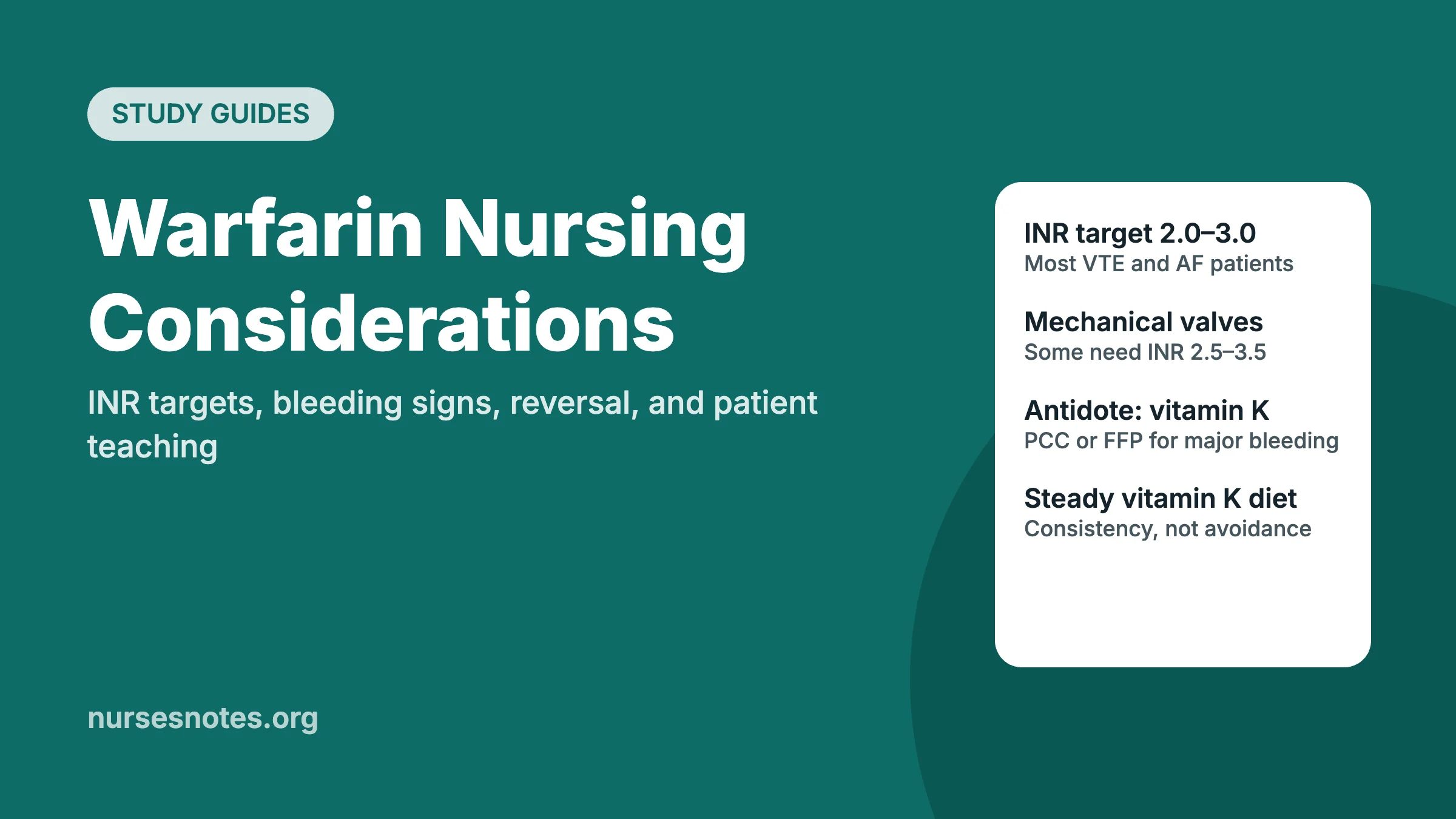
- For most indications, such as VTE and atrial fibrillation, the target INR is 2.0 to 3.0; some mechanical valves need 2.5 to 3.5.
- Bleeding is the main adverse effect. Vitamin K (phytonadione) is the reversal agent, with prothrombin complex concentrate or fresh frozen plasma for significant bleeding.
- Teach a steady vitamin K intake, no new medicines or supplements without advice, and regular INR checks.
What is warfarin?
Warfarin is a vitamin K antagonist, often called a “blood thinner.” It does not dissolve existing clots; it lowers the blood’s ability to form new ones, which helps stop clots from growing or travelling.
It works by inhibiting the enzyme VKORC1, which recycles vitamin K in the liver. Without active vitamin K, the liver makes less of clotting factors II, VII, IX, and X, as well as the natural anticoagulants protein C and protein S.
Common indications
- Prevention and treatment of deep vein thrombosis and pulmonary embolism
- Prevention of stroke and embolism in atrial fibrillation
- Prevention of clots after heart valve replacement, especially mechanical valves
- Reducing the risk of death, repeat heart attack, and embolism after a myocardial infarction
Warfarin INR range: values to know
The INR (international normalised ratio) is calculated from the prothrombin time (PT). It is preferred over the raw PT because it standardises results between laboratories. Reference ranges vary by laboratory and facility, so always check your own lab’s values.
| Situation | Typical value |
|---|---|
| PT, person not on anticoagulants | 11 to 13.5 seconds |
| INR, person not on anticoagulants | 0.8 to 1.1 |
| Target INR: venous thromboembolism (DVT or PE) | 2.0 to 3.0 (goal 2.5) |
| Target INR: non-valvular atrial fibrillation | 2.0 to 3.0 (goal 2.5) |
| Target INR: bioprosthetic mitral valve | 2.0 to 3.0 (goal 2.5) |
| Target INR: mechanical mitral valve, tilting disk, or caged ball/disk valve | 2.5 to 3.5 (goal 3.0) |
A low INR means blood clots too easily, raising the risk of thrombosis. A high INR means blood clots too slowly, raising the risk of bleeding; StatPearls notes that bleeding risk rises substantially as the INR climbs, especially above 5.0.
Adverse effects of warfarin
- Bleeding at any site: the most important and potentially fatal adverse effect. Risk is higher in older adults, with high-intensity or long-term therapy, and with interacting drugs.
- Warfarin-induced skin necrosis: usually in the first week, linked to a temporary drop in protein C; risk is higher with protein C or S deficiency.
- Purple toe syndrome: from cholesterol microemboli, typically 3 to 8 weeks after starting therapy.
- GI effects: nausea, vomiting, abdominal pain, bloating, and taste changes.
Contraindications to remember
- Active bleeding or a high bleeding risk, such as active GI ulceration or recent CNS or eye surgery
- Pregnancy, because warfarin crosses the placenta (except selected patients with mechanical heart valves at high clot risk, after discussing risks and benefits)
- Malignant hypertension
- Patients at high risk of non-adherence who cannot be supervised
Nursing assessment
- Check the latest INR before giving each dose and compare it with the patient’s target range.
- Review baseline haemoglobin and haematocrit (see our guide to CBC normal values), and watch for trends that suggest hidden bleeding.
- Look for bleeding: gum or nose bleeding, bruising or haematoma, blood in urine, black or bloody stools, coffee-ground vomit, and heavy menstrual bleeding.
- Ask about headache, dizziness, or weakness, which may signal internal or intracranial bleeding.
- Inspect the skin and toes for dark or purple areas, sudden pain, or colour and temperature changes.
- Take a full medication and supplement history, including over-the-counter pain relievers and herbal products.
Nursing interventions and considerations
- Give warfarin at about the same time each day. StatPearls notes that afternoon or evening dosing lets the prescriber adjust that day’s dose once lab results are back.
- Monitor INR frequently when therapy starts, daily in hospital, and about every 4 weeks once stable, or as ordered.
- Recheck the INR whenever an interacting drug is started, stopped, or changed.
- Follow your facility’s bleeding-precaution policy, such as gentle handling and firm pressure on puncture sites.
- Report an INR above the target range, or any sign of bleeding, to the prescriber promptly.
- Remind the team that the effect of warfarin can last 2 to 5 days after it is stopped, which matters before surgery or procedures.
Reversal of warfarin
If the INR is high, the prescriber may hold warfarin and order vitamin K (phytonadione). Oral vitamin K is often preferred when there is no significant bleeding, and the INR is expected to fall within about 24 hours; IV vitamin K is an option when needed, while subcutaneous vitamin K is generally not recommended because absorption is erratic. For significant bleeding, prothrombin complex concentrate, fresh frozen plasma, or activated factor VII may be considered.
Patient teaching for warfarin
- Take it once a day at the same time, and do not stop it without talking to the doctor.
- If a dose is missed, take it the same day when remembered, never double the next dose, and call the doctor for advice.
- Keep vitamin K intake consistent week to week rather than avoiding it; avoid sudden large amounts of leafy green vegetables and certain vegetable oils.
- Do not start new medicines or supplements without checking first. Interactions include aspirin, NSAIDs such as ibuprofen and naproxen, garlic, ginkgo, ginseng, and St. John’s wort.
- Ask the doctor about alcohol and grapefruit.
- Tell every dentist, surgeon, and pharmacist that you take warfarin.
- Keep all INR appointments and report bleeding, dark or purple toes, or severe headache right away.
Pregnancy counselling matters too: warfarin can harm an unborn baby, so people who could become pregnant should discuss effective contraception with their doctor.
Exam tips
- “1972” helps you recall the vitamin K-dependent factors warfarin lowers: 10, 9, 7, and 2.
- Monitor INR for warfarin. Do not confuse it with tests used for other anticoagulants.
- Antidote = vitamin K. For major bleeding, think prothrombin complex concentrate or fresh frozen plasma as well.
- Consistency, not avoidance: a “never eat green vegetables” answer is a classic trap. The correct teaching is a steady intake.
- Timing clues: skin necrosis appears early (first week); purple toe syndrome appears later (3 to 8 weeks).
- Compare with other cardiac drugs that need close monitoring in our digoxin nursing considerations guide.
Frequently asked questions
What is the normal INR for a patient on warfarin?
For most patients on warfarin, such as those with a DVT, pulmonary embolism, or atrial fibrillation, the target INR is 2.0 to 3.0. Some mechanical heart valves need a higher range of 2.5 to 3.5. Without an anticoagulant, a typical INR is 0.8 to 1.1. Each patient’s target is set by the prescriber.
What is the antidote for warfarin?
Vitamin K (phytonadione) is the reversal agent for warfarin. Oral vitamin K is often used when the INR is high without major bleeding, and IV vitamin K when needed. For significant bleeding, prothrombin complex concentrate, fresh frozen plasma, or activated factor VII may be given on medical orders.
Can patients on warfarin eat green leafy vegetables?
Yes. Patients do not need to avoid foods containing vitamin K. What matters is keeping the amount steady from week to week, because sudden changes can push the INR up or down. Advise them to avoid sudden large amounts of leafy greens and to tell their care team about major diet changes.
Related on Nurses Notes
- Digoxin nursing considerations and toxicity signs
- CBC normal values for nurses
- How to stop a nosebleed: first aid steps
- All Study Guides on Nurses Notes
Sources
- Patel S, Singh R, Preuss CV, Patel N. Warfarin. StatPearls, NCBI Bookshelf. Updated 5 October 2024.
- Warfarin. MedlinePlus Drug Information, U.S. National Library of Medicine. Revised 15 March 2026.
- Prothrombin Time Test and INR (PT/INR). MedlinePlus, U.S. National Library of Medicine. Updated 15 May 2024.
- What Is a Prothrombin Time (PT/INR) Test? Cleveland Clinic. Reviewed 1 May 2026.
This article is for education only and does not replace advice from your own doctor, nurse, or other qualified health professional. Always follow your facility’s policies and reference ranges.