On this page
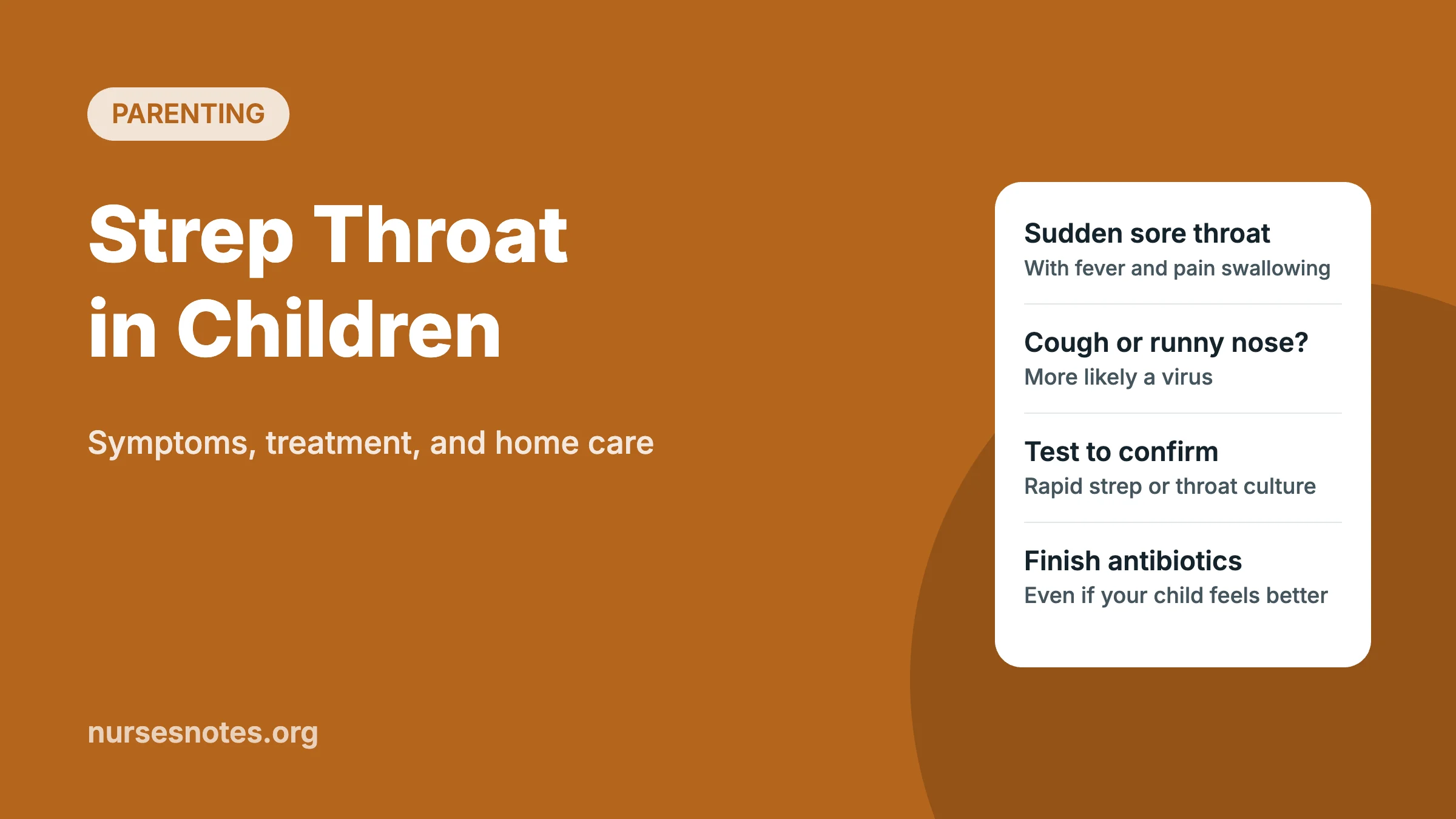
Strep throat in children is a throat and tonsil infection caused by group A streptococcus bacteria, and it usually causes a sudden, very sore throat, fever, painful swallowing, and swollen neck glands. Because it is bacterial, it needs a test and, if positive, antibiotics from a doctor, which help your child recover and prevent rare but serious complications.
Key points
- Most sore throats in children are caused by viruses, not strep.
- A cough, runny nose, hoarse voice, or pink eye point more towards a virus.
- Only a test (a rapid strep test or throat culture) can confirm strep throat.
- If antibiotics are prescribed, your child should finish the full course, even when they feel better.
What is strep throat?
Strep throat is an infection of the throat and tonsils caused by group A Streptococcus bacteria. It is most common in children aged 5 to 15 years and is rare in children younger than 3, according to the CDC.
It spreads easily through close contact, especially within households, schools, and daycare. The germs pass through droplets from coughs and sneezes, saliva, and unwashed hands. Symptoms usually start 2 to 5 days after exposure.
Symptoms of strep throat in children
- A sore throat that starts suddenly and can be very painful.
- Fever, which often starts suddenly.
- Pain when swallowing.
- Red, swollen tonsils, sometimes with white patches or streaks of pus.
- Tiny red spots on the roof of the mouth.
- Swollen, tender glands at the front of the neck.
Younger children may also have a headache, stomach pain, nausea, or vomiting. Some strains cause a rough, sandpaper-like rash that starts on the neck and chest, which is known as scarlet fever.
Strep throat or a viral sore throat?
It is hard to tell the difference just by looking, but some clues help. The American Academy of Pediatrics (AAP) notes that a cough, runny nose, hoarseness, and conjunctivitis are not symptoms of strep, and suggest a virus instead.
| Clue | More likely strep | More likely a virus |
|---|---|---|
| Start | Sudden sore throat and fever | Often comes with a cold |
| Cough or runny nose | Usually absent | Common |
| Tonsils | Very red and swollen, may have white patches | Throat may be red; tonsils often less affected |
| Other signs | Swollen neck glands, headache, stomach ache | Hoarse voice, pink eye |
| Treatment | Antibiotics if the test is positive | Rest and fluids; antibiotics do not help |
How strep throat is diagnosed
A doctor will look at your child’s throat and may do a rapid strep test, which uses a throat swab and gives results within minutes. A negative rapid test does not always rule out strep, so the doctor may also send a throat culture, with results in 1 to 2 days.
Treatment for strep throat
If the test is positive, the doctor will prescribe an antibiotic, given by mouth or sometimes as an injection. The dose depends on your child’s weight and the medicine prescribed, so always follow the doctor’s or pharmacist’s instructions and the label.
- Give the antibiotic for the full course prescribed, even if your child feels better after a few days. Stopping early can allow the infection to return or spread.
- Most children stop being contagious after 24 to 48 hours of antibiotics. Keep your child home from school or daycare until they have been on antibiotics for at least a full day and feel well enough to return.
- Contact the doctor if your child is not improving within 24 to 48 hours of starting treatment.
How to care for a child with strep throat at home
- Offer plenty of fluids, such as water, warm soup, or cold drinks. Ice pops can soothe a sore throat.
- Give soft foods that are easy to swallow.
- Let your child rest.
- For pain or fever, you can use paracetamol (acetaminophen) or ibuprofen made for children. The dose depends on your child’s weight and the product, so follow the label or ask your doctor or pharmacist. Never give aspirin to children under 16. Our guide on how to bring down a child’s fever has more tips.
- Older children may gargle with warm salt water. Do not give hard candies or lozenges to young children, as they are a choking risk.
- Replace your child’s toothbrush after 2 to 3 days of antibiotics, and do not share cups or utensils.
Possible complications
Treating strep throat promptly helps prevent complications, which are uncommon but can be serious. They include an abscess near the tonsils or in the neck, ear and sinus infections, scarlet fever, kidney inflammation (post-streptococcal glomerulonephritis), and rheumatic fever, which can affect the heart, joints, and nervous system.
When to get medical help
See a doctor if your child has a sore throat that does not go away, especially with a fever, headache, stomach ache, or extreme tiredness, or if a sore throat lasts more than a week.
Go to the emergency room or call your local emergency number if your child:
- Has difficulty breathing.
- Cannot swallow, or is drooling because swallowing is too painful.
- Has trouble speaking or opening their mouth, or has swelling inside the mouth or throat.
- Has a severe sore throat that is getting worse quickly.
- Seems extremely ill.
Frequently asked questions
Can babies and toddlers get strep throat?
Strep throat is rare in children under 3 years old. In babies, toddlers, and preschoolers, most sore throats are caused by viruses and get better on their own within about 7 to 10 days. If a young child seems unwell, has a fever, or will not drink, contact your doctor, who can decide whether testing is needed.
When can my child go back to school after strep throat?
Most children are no longer contagious after 24 to 48 hours of antibiotics. MedlinePlus advises keeping children home until they have taken antibiotics for at least a full day. Check your doctor’s advice and your school’s policy, and make sure your child finishes the whole antibiotic course.
Does strep throat go away without antibiotics?
Symptoms may settle, but untreated strep throat can spread to others and can lead to complications such as abscesses, kidney problems, or rheumatic fever. That is why doctors test for strep and treat positive cases with antibiotics. Antibiotics do not help a viral sore throat, which is why testing matters.
Related on Nurses Notes
- How to bring down a child’s fever safely
- Ear infection in children: symptoms, home care, and when to see a doctor
- Hand, foot, and mouth disease in children
- All parenting articles
Sources
- About Strep Throat, Centers for Disease Control and Prevention (CDC), 2026.
- Strep Throat, Sore Throat or Tonsillitis: What’s the Difference?, American Academy of Pediatrics (HealthyChildren.org), 2022.
- Strep throat, MedlinePlus Medical Encyclopedia, US National Library of Medicine, reviewed 2025.
- Tonsillitis, NHS, reviewed 2024.
This article is for education only and does not replace advice from your own doctor, nurse, or other qualified health professional.