On this page
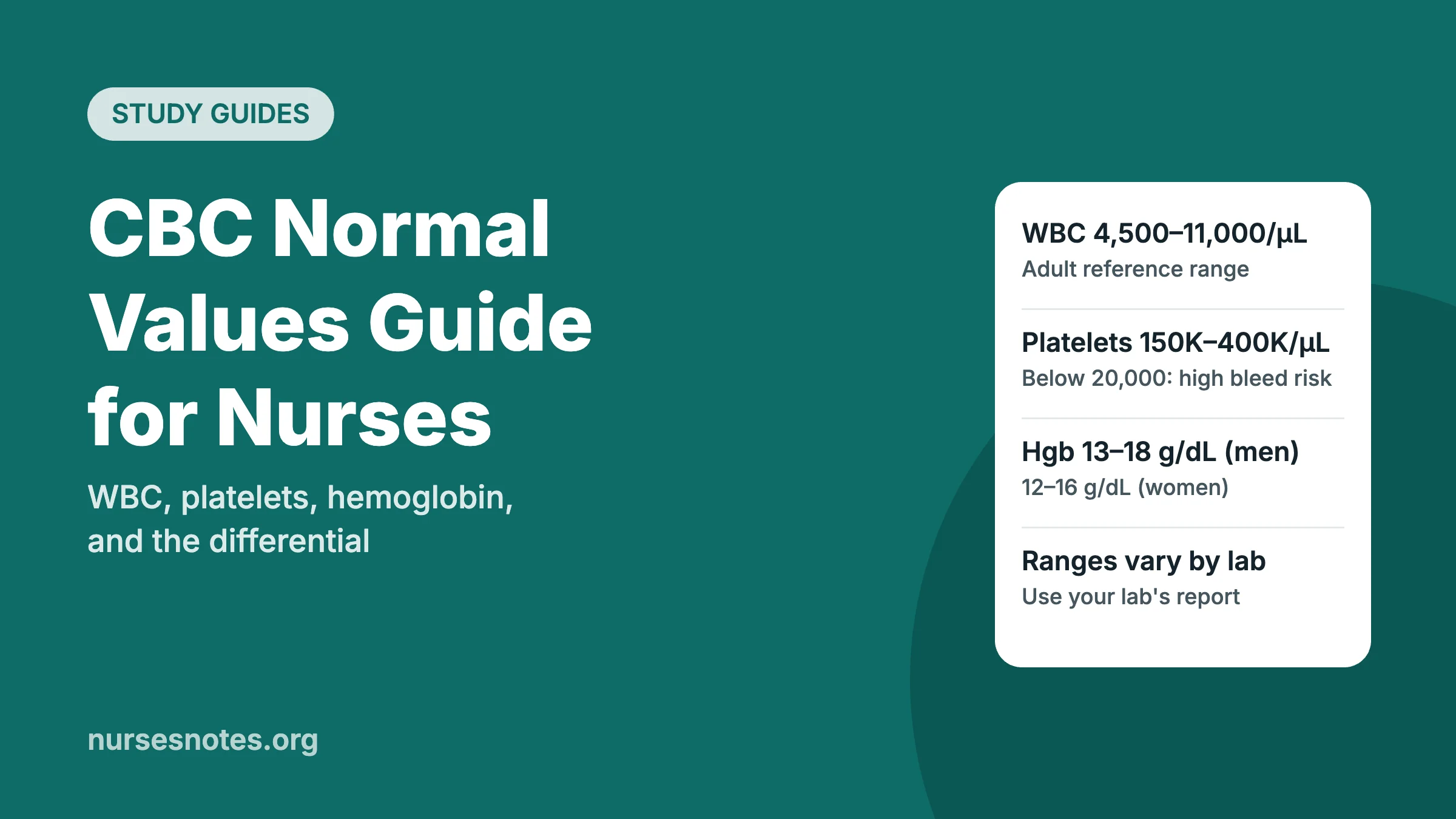
CBC normal values for adults are roughly 4,500 to 11,000 white blood cells per microliter, 150,000 to 400,000 platelets per microliter, and a hemoglobin of 13 to 18 g/dL in men or 12 to 16 g/dL in non-pregnant women. Ranges vary by laboratory, so always read a result against the reference range printed on the report and the patient in front of you.
Key points
- A complete blood count (CBC) measures red blood cells, white blood cells, and platelets, plus red cell indices such as MCV, MCH, and RDW.
- Normal ranges differ by laboratory, sex, age, pregnancy, and units, so the lab report range always wins.
- Low hemoglobin suggests anemia, a low platelet count raises bleeding risk, and a low white cell count raises infection risk.
- Check for interfering factors, such as platelet clumping, before acting on an unexpected result.
What is a complete blood count?
A complete blood count is one of the most common blood tests ordered in hospitals and clinics. It gives a snapshot of the three main cell lines made in the bone marrow: red blood cells that carry oxygen, white blood cells that fight infection, and platelets that help blood clot.
A CBC “with differential” also breaks the white cell count into its five main types. According to Cleveland Clinic, a CBC needs no fasting, and patients can usually eat, drink, and take their usual medicines unless other tests are drawn at the same time.
CBC normal values table
The adult reference ranges below are taken from the StatPearls chapter on the complete blood count. MedlinePlus lists very similar figures, while Cleveland Clinic lists slightly different ones, which is a good reminder that every lab sets its own range.
| Test | Men | Women |
|---|---|---|
| Red blood cells (RBC) | 4.6 to 6.2 million/µL | 4.2 to 5.4 million/µL |
| Hemoglobin (Hgb) | 13 to 18 g/dL | 12 to 16 g/dL (non-pregnant) |
| Hematocrit (Hct) | 40% to 54% | 36% to 48% |
| White blood cells (WBC) | 4,500 to 11,000 cells/µL | 4,500 to 11,000 cells/µL |
| Platelets | 150,000 to 400,000/µL | 150,000 to 400,000/µL |
| MCV | 80 to 100 fL | 80 to 100 fL |
| MCH | 27 to 32 pg | 27 to 32 pg |
| RDW | About 11.5% to 15% | About 11.5% to 15% |
StatPearls notes that the lower limit for hemoglobin in pregnancy is usually about 10 g/dL. Children have different ranges from adults, so pediatric results should always be read against age-specific values from the lab.
WBC differential normal values
| Cell type | % of total WBC | Absolute count | Main job |
|---|---|---|---|
| Neutrophils | 40% to 60% | 1,500 to 8,000/µL | First responders to bacterial and fungal infection |
| Lymphocytes | 20% to 40% | 1,000 to 4,000/µL | Fight viral infection and build immune memory |
| Monocytes | 2% to 8% | 200 to 1,000/µL | Clear debris and alert other immune cells |
| Eosinophils | 0% to 4% | 0 to 500/µL | Parasitic infection and allergic reactions |
| Basophils | 0.5% to 1% | 0 to 200/µL | Release histamine in allergic reactions |
What abnormal CBC results may mean
An abnormal value is a clue, not a diagnosis. MedlinePlus lists these common possible causes:
- Low RBC, hemoglobin, or hematocrit (anemia): blood loss, iron deficiency, poor nutrition, bone marrow failure, chronic illness, or cancer and its treatment.
- High RBC, hemoglobin, or hematocrit: dehydration, long-term low blood oxygen, smoking, kidney disease, or polycythemia vera.
- High WBC (leukocytosis): infection, inflammation, severe stress, corticosteroids, tissue damage, or leukemia.
- Low WBC (leukopenia): viral infection, chemotherapy, bone marrow failure, autoimmune disease, or some medicines.
- Low platelets (thrombocytopenia): platelet destruction, an enlarged spleen, pregnancy, bone marrow failure, or chemotherapy.
Red cell indices help narrow down the cause of anemia. StatPearls explains that MCV sorts anemia into microcytic (small cells), normocytic, or macrocytic (large cells), while RDW shows how much the cell size varies.
Platelet count and bleeding risk
StatPearls defines thrombocytopenia as a platelet count below 150,000/µL and gives these practical thresholds:
- Major bleeding is unusual while platelets stay above 50,000/µL.
- Bleeding risk rises sharply below 20,000/µL.
- The risk of bleeding into the brain rises dramatically below 10,000/µL.
- Thrombocytosis is a count above 450,000/µL and rarely causes symptoms unless it goes above 1,000,000/µL.
If dengue is common where you work, platelet trends are part of daily monitoring; see our guide to dengue warning signs for the symptoms that matter most.
Nursing assessment
- Review the trend, not just one result: compare with previous CBCs and the reason the test was ordered.
- Look for signs that match the numbers, such as pallor, fatigue, and shortness of breath with low hemoglobin, or bruising, petechiae, and bleeding gums with low platelets.
- Check temperature and look for signs of infection when the WBC or neutrophil count is low.
- Ask about recent bleeding, chemotherapy, new medicines, and fluid status, since dehydration can raise hemoglobin and hematocrit.
- Note the sample details: a clotted, hemolyzed, or poorly mixed sample can give a misleading result.
Nursing considerations
- Report critical or unexpected values promptly according to your facility’s policy.
- Before acting on a surprising result, check for interfering factors; StatPearls advises looking for spurious causes and confirming with a peripheral blood smear when needed.
- Remember that EDTA can make platelets clump, causing pseudothrombocytopenia (a falsely low platelet count), so a repeat sample may be needed.
- Follow your facility’s bleeding precautions for low platelets and infection-prevention precautions for low neutrophils.
- Explain to patients that no fasting is usually needed for a CBC on its own.
Many patients with abnormal blood counts also have electrolyte or acid-base problems. Our guide to sodium, potassium, calcium, and magnesium covers those values in the same format.
Exam tips
- Differential order: “Never Let Monkeys Eat Bananas” lists the white cells from most to least common: neutrophils, lymphocytes, monocytes, eosinophils, and basophils.
- Neutrophils mean bacteria; lymphocytes mean viruses is a helpful starting rule, though real patients do not always follow it.
- Exam trap: a high hemoglobin in a dehydrated patient may be concentration, not a true increase in red cells.
- Exam trap: a very low platelet count with no bleeding may be clumping; think about a repeat sample.
- Exam trap: answer choices that ignore the lab’s own reference range are usually wrong; ranges differ between labs.
Frequently asked questions
What is a normal CBC result?
A normal CBC means each value falls within the laboratory’s reference range. Typical adult ranges are a WBC of 4,500 to 11,000/µL, platelets of 150,000 to 400,000/µL, and hemoglobin of 13 to 18 g/dL in men or 12 to 16 g/dL in women. A value slightly outside the range is not always a problem.
What does a low WBC count mean?
A low white cell count, called leukopenia, can follow a viral infection, chemotherapy, bone marrow problems, autoimmune disease, or some medicines. It may raise the risk of infection, especially when neutrophils are low. The doctor will look at the differential, previous results, and symptoms before deciding what it means.
Do you need to fast before a CBC?
No, a CBC on its own does not need fasting. Cleveland Clinic advises that you can eat, drink, and take your usual medicines. However, a CBC is often drawn with other tests, such as glucose or lipids, that do need fasting, so check the instructions for every test ordered.
Related on Nurses Notes
- Electrolytes made simple: sodium, potassium, calcium, and magnesium
- ABG interpretation steps for nurses
- Dengue warning signs and when to go to hospital
- More nursing study guides
Sources
- Normal and Abnormal Complete Blood Count With Differential (StatPearls, NCBI Bookshelf, updated 2024)
- Complete blood count (MedlinePlus, U.S. National Library of Medicine, reviewed 2024)
- Complete Blood Count (CBC) (Cleveland Clinic, 2024)
This article is for education only and does not replace advice from your own doctor, nurse, or other qualified health professional. Always follow your facility’s policies and reference ranges.