On this page
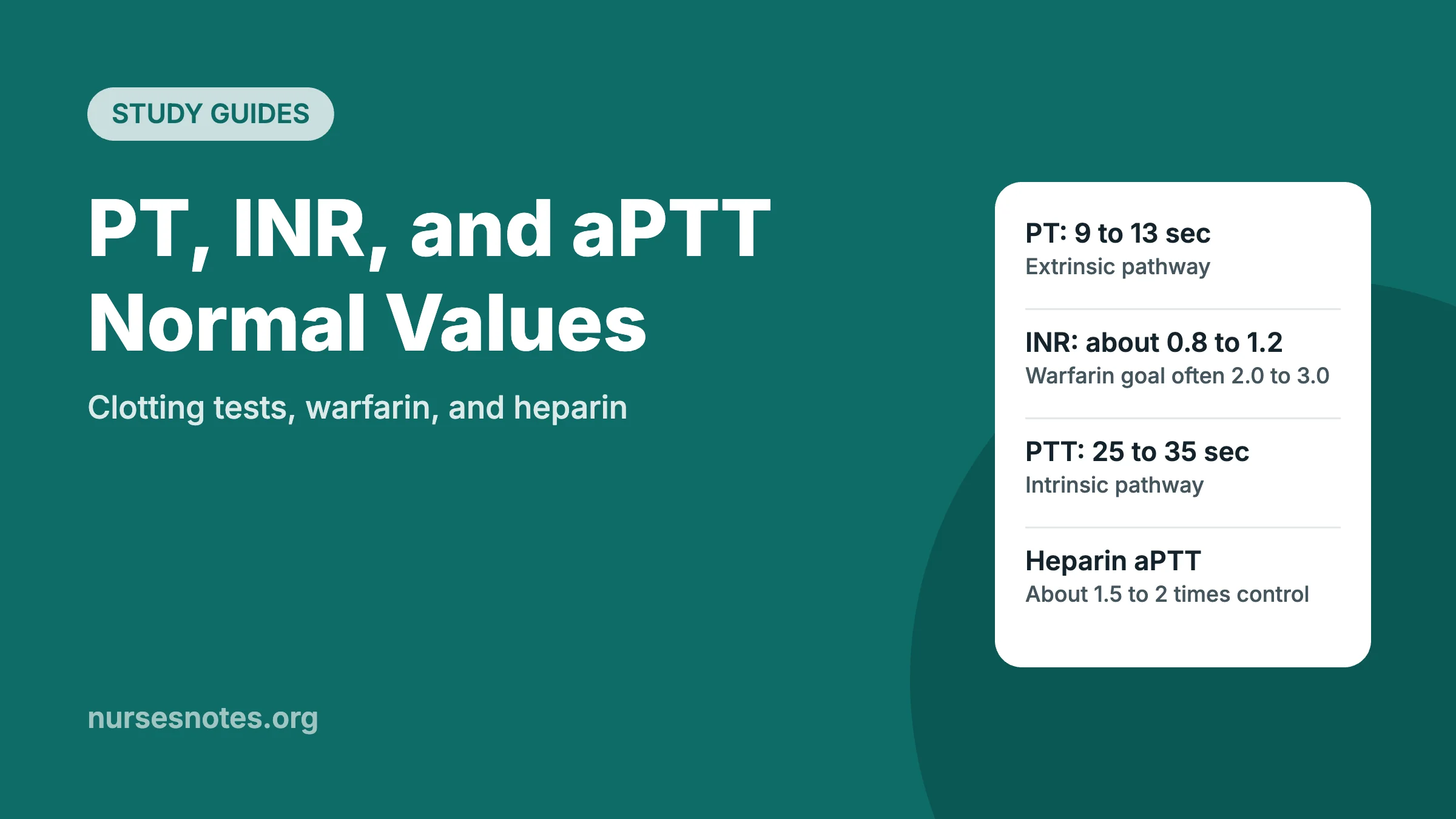
PT, INR, and aPTT normal values are roughly 9 to 13 seconds for PT, about 0.8 to 1.2 for INR, and about 25 to 35 seconds for PTT, although each laboratory sets its own reference ranges. These three clotting tests tell you how fast blood forms a clot and are used to monitor warfarin and heparin therapy.
Key points
- PT and INR check the extrinsic and common pathways and are used to monitor warfarin.
- PTT and aPTT check the intrinsic and common pathways and are used to monitor unfractionated heparin.
- The usual therapeutic INR on warfarin is 2.0 to 3.0, but targets can differ for mechanical heart valves.
- A prolonged result means a higher bleeding risk: assess the patient, check the order, and report promptly.
What are PT, INR, and aPTT?
These are routine coagulation studies taken from a venous blood sample. They measure how many seconds it takes plasma to form a clot after specific reagents are added in the laboratory.
- Prothrombin time (PT): measures the extrinsic and common pathways, including fibrinogen, prothrombin, and factors V, VII, and X.
- International normalized ratio (INR): a standardised version of the PT so results can be compared between laboratories. It is calculated as (patient PT ÷ control PT) raised to the power of the ISI, the international sensitivity index of the reagent.
- Partial thromboplastin time (PTT): measures the intrinsic and common pathways, including factors VIII, IX, XI, and XII, as well as fibrinogen.
- Activated PTT (aPTT): the same test as the PTT with an activator added, which gives a narrower, more specific range. Most hospitals now report the aPTT.
PT, INR, and aPTT normal values
The table below uses the values given in StatPearls. Always use the reference range printed on your own laboratory’s report, because ranges vary by laboratory, reagent, and facility.
| Test | Typical normal value | Therapeutic or critical values | Drug it monitors |
|---|---|---|---|
| PT | 9 to 13 seconds | Prolonged when clotting factors are low or warfarin is working | Warfarin |
| INR | About 0.8 to 1.2 (typically about 1.0 if not on anticoagulants) | Therapeutic 2.0 to 3.0 for most indications; above 4.9 is critical | Warfarin (vitamin K antagonists) |
| PTT | 25 to 35 seconds | Heparin therapeutic range often 60 to 100 seconds | Unfractionated heparin |
| aPTT | Narrower range set by each laboratory | Generally 1.5 to 2 times the control value on heparin | Unfractionated heparin |
INR targets with mechanical heart valves
StatPearls notes that INR targets vary with the type of prosthetic valve and the patient’s risk factors. Depending on the valve, the target may be 2.5, 3.0, or (for an On-X aortic valve after the first 3 months) 1.5 to 2.0. Always check the target written by the prescriber rather than assuming 2.0 to 3.0.
What does a high or low result mean?
Prolonged PT or high INR
- Warfarin or another vitamin K antagonist
- Liver disease, because the liver makes most clotting factors and metabolises warfarin
- Vitamin K deficiency from malnutrition, prolonged broad-spectrum antibiotics, or fat malabsorption
- Disseminated intravascular coagulation (DIC)
A PT that is lower than normal is uncommon and often points to a problem with how the specimen was collected or processed.
Prolonged PTT or aPTT
- Unfractionated heparin, including too much heparin
- Hemophilia A or B, and sometimes von Willebrand disease
- Severe liver disease or severe vitamin K deficiency
- DIC, or lupus anticoagulant (which can falsely prolong the PTT in the test tube)
A short PTT can be seen in early DIC or when clotting factors are high, for example during inflammation, pregnancy, or cancer.
Specimen collection tips
- Collect the sample into a light blue top tube that contains sodium citrate.
- Fill the tube to the correct line, because the blood-to-citrate ratio affects the result.
- For a patient on a heparin infusion, draw from the arm opposite the infusion, never from the line that is running heparin (follow your facility policy).
- A patient on warfarin may be asked to wait until after the blood test to take the daily dose; follow the prescriber’s instructions.
Nursing assessment
When a patient has a prolonged clotting time or is on an anticoagulant, look for bleeding at every assessment.
- Skin: bruising, petechiae, and oozing from IV, injection, or wound sites
- Mouth and nose: bleeding gums or nosebleeds
- Urine and stool: pink, red, or brown urine, and black or bloody stools
- Neurological: headache, confusion, or a change in level of consciousness, which may signal intracranial bleeding
- Vital signs: rising heart rate and falling blood pressure
- Related labs: hemoglobin, hematocrit, and platelet count (see our CBC normal values guide)
Nursing interventions and considerations
- Check the INR result before giving warfarin and the aPTT before adjusting a heparin infusion, and follow the prescriber’s order and your facility’s nomogram.
- On a heparin infusion, the aPTT is usually checked at baseline and every 6 hours until two or more consecutive values are therapeutic, then about every 24 hours.
- StatPearls advises checking hemoglobin, hematocrit, and platelets every 2 to 3 days during heparin therapy. A platelet count below 100,000/mm³ needs prompt review because of the risk of heparin-induced thrombocytopenia.
- Report critical values immediately. Protamine is the agent used to reverse heparin in serious bleeding, and only on a prescriber’s order.
- Teach patients on warfarin to keep vitamin K intake steady (for example green leafy vegetables), limit alcohol, and tell every health professional about new medicines and supplements. Our warfarin nursing considerations guide covers this in detail.
- Use bleeding precautions: soft toothbrush, electric razor, gentle handling, and pressure on puncture sites for longer.
- Remember that direct oral anticoagulants do not need routine INR monitoring.
Exam tips
- “PT plays Tennis outside”: PT goes with the extrinsic pathway and warfarin. “PTT plays Table Tennis inside”: PTT goes with the intrinsic pathway and heparin.
- Match the drug: Warfarin = PT/INR. Heparin = PTT/aPTT. A common trap pairs heparin with INR.
- Normal INR is about 1: an INR of 2.0 to 3.0 is not “abnormal” for a patient on warfarin; it is the goal.
- Priority question: if the INR is above the target and the patient has signs of bleeding, assess the patient and hold the dose per protocol, then notify the prescriber.
- Liver disease: raises the PT first, because the liver makes the vitamin K dependent factors.
Frequently asked questions
What is a normal INR for someone not on blood thinners?
For a healthy person who is not taking an anticoagulant, the INR is typically about 1.0, and StatPearls gives a normal range of around 0.8 to 1.2. A higher INR means blood takes longer to clot. Your laboratory report shows the exact reference range it uses, so always compare results with that range.
What is the difference between PTT and aPTT?
Both tests look at the intrinsic and common clotting pathways. The aPTT adds an activator to the sample, so the clot forms faster and the normal range is narrower and more specific. Many laboratories now report the aPTT, and it is the test usually used to adjust unfractionated heparin infusions.
Which test monitors heparin and which monitors warfarin?
Unfractionated heparin is monitored with the aPTT (or anti-factor Xa levels in some hospitals), while warfarin is monitored with the PT and INR. A quick memory aid is “War-PT” for warfarin and PT, leaving PTT for heparin. Low molecular weight heparins and direct oral anticoagulants do not usually need routine monitoring with these tests.
Related on Nurses Notes
- Warfarin nursing considerations and INR teaching
- CBC normal values for nurses
- Blood transfusion reaction nursing interventions
- All Study Guides on Nurses Notes
Sources
- Interpretation of Blood Clotting Studies and Values (PT, PTT, aPTT, INR, Anti-Factor Xa, D-Dimer), StatPearls, NCBI Bookshelf, updated October 2025
- International Normalized Ratio: Assessment, Monitoring, and Clinical Implications, StatPearls, NCBI Bookshelf, updated February 2025
- Partial Thromboplastin Time, StatPearls, NCBI Bookshelf, updated August 2023
- Heparin, StatPearls, NCBI Bookshelf, updated August 2025
- Prothrombin Time Test and INR (PT/INR), MedlinePlus, National Library of Medicine, 2024
- Partial Thromboplastin Time (PTT) Test, MedlinePlus, National Library of Medicine, 2026
This article is for education only and does not replace advice from your own doctor, nurse, or other qualified health professional. Always follow your facility’s policies and reference ranges.