On this page
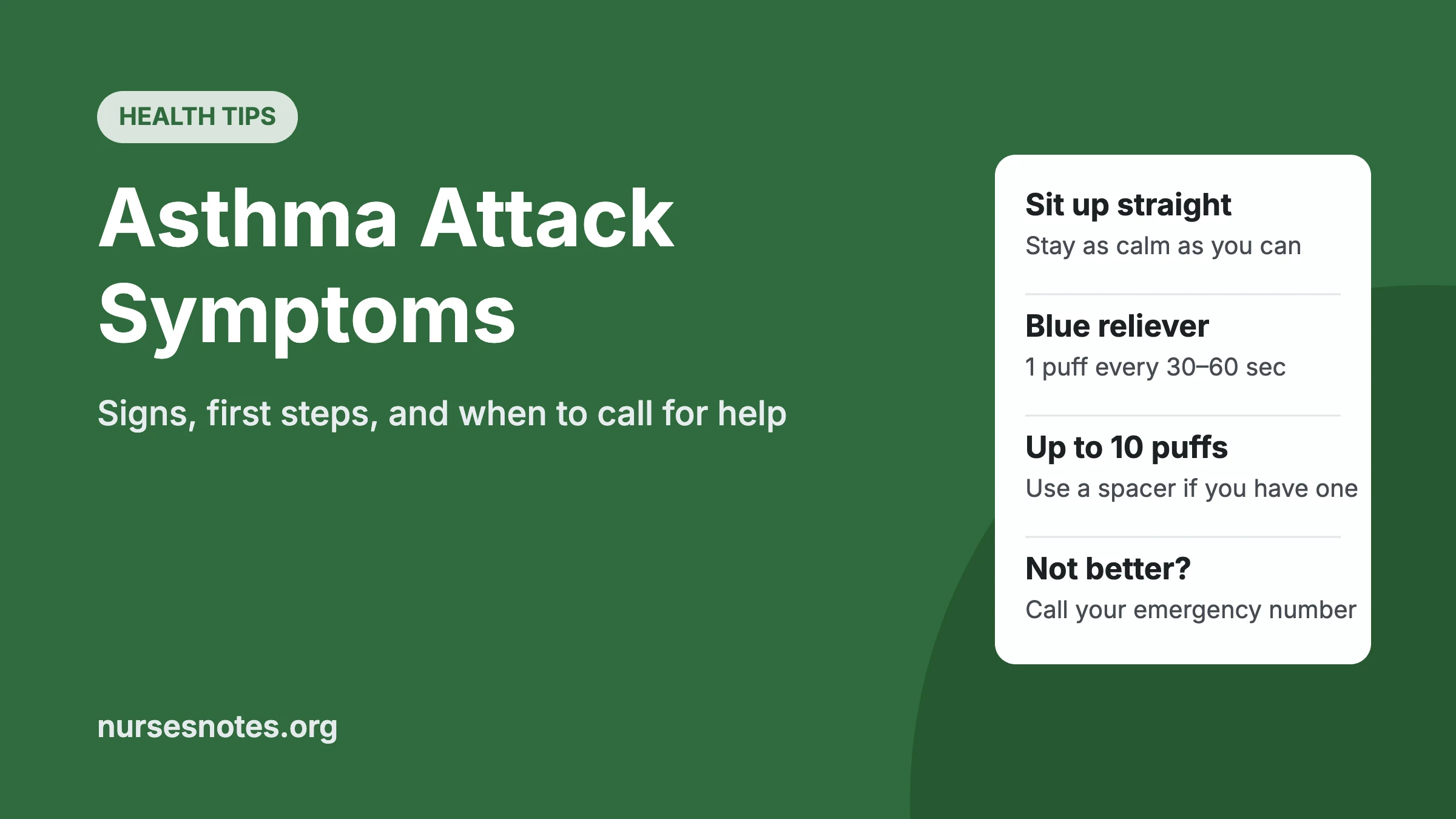
Asthma attack symptoms include a cough, wheeze, or tight chest that gets worse quickly, a reliever inhaler that is not helping, and being too breathless to talk, eat, or sleep. An asthma attack can be life-threatening, but knowing the steps below, and having your inhaler with you, makes it much easier to act fast.
Key points
- Sit up straight and stay as calm as you can. Do not lie down.
- With a blue reliever inhaler, take 1 puff every 30 to 60 seconds, up to 10 puffs, using a spacer if you have one.
- With an AIR or MART inhaler, follow your action plan; NHS advice is 1 puff every 1 to 3 minutes, up to 6 puffs.
- Call your local emergency number if you feel worse at any point, are not better after the maximum puffs, or do not have your inhaler.
What is an asthma attack?
In asthma, the airways in the lungs are sensitive and can become swollen and narrow. During an attack, the muscles around the airways tighten, the lining swells, and extra mucus builds up, so it becomes hard to move air in and out. Attacks can build over hours or days, or come on within minutes.
Common triggers include colds and flu, cold air, smoke, dust mites, pollen, pets, exercise, and stopping a preventer inhaler. In the Philippines and other tropical countries, haze, vehicle fumes, and mould in damp homes are also worth watching.
Asthma attack symptoms
According to the NHS and Ireland’s HSE, you may be having an asthma attack if:
- your cough, wheeze, breathlessness, or chest tightness is getting worse
- your reliever inhaler (usually blue) is not helping, or you need it more often than every 4 hours
- you are too breathless to speak, eat, or sleep
- your breathing is getting faster and you feel you cannot catch your breath
- your peak flow is lower than usual
Children may not describe a tight chest. They might say they have a tummy ache or chest ache, go quiet, or stop playing.
What to do during an asthma attack
These are the steps used in NHS and HSE advice for people with a blue reliever inhaler. If your personal asthma action plan gives a different dose, follow your plan.
- Sit up straight. Loosen tight clothing and try to take slow, steady breaths.
- Take 1 puff of your reliever inhaler every 30 to 60 seconds, up to a maximum of 10 puffs. Shake the inhaler between puffs and use a spacer if you have one.
- If you feel worse at any point, or you do not feel better after 10 puffs, call your local emergency number (911 in the Philippines and the US, 999 in the UK, 112 in the EU) and ask for an ambulance.
- While you wait for help, keep using the inhaler as your action plan or the emergency call handler advises.
- If you do not have your inhaler with you, call for an ambulance straight away.
If you use one inhaler for both prevention and relief (an AIR or MART inhaler), the NHS advises 1 puff every 1 to 3 minutes until you feel better, up to a maximum of 6 puffs, then calling an ambulance if you are not improving.
Signs of a life-threatening asthma attack
Get emergency help at once if the person has any of these:
- lips or fingertips turning blue or grey
- so breathless they cannot finish a sentence, or they are too tired to keep breathing hard
- confusion, drowsiness, or fainting
- a very quiet chest, with little air movement even though they are struggling
After an asthma attack
Even if the inhaler worked and you feel fine, an attack is a warning sign that your asthma is not well controlled. NHS services advise an urgent same-day appointment with your doctor or asthma nurse if you managed the attack at home, and a review within 48 hours if you were treated in hospital.
- Ask your doctor to check your inhaler technique and your treatment.
- Make or update a written asthma action plan.
- Keep your reliever inhaler with you at all times.
How to prevent asthma attacks
- Take your preventer or MART inhaler every day as prescribed, even when you feel well.
- Learn your triggers and reduce exposure where you can, for example by avoiding cigarette smoke.
- Get vaccines your doctor recommends, such as the yearly flu vaccine, since chest infections are a common trigger.
- Contact your doctor if you need your reliever 3 or more times a week; this suggests your asthma needs a review.
- See your doctor or asthma nurse at least once a year for a check-up.
Frequently asked questions
How many puffs of the blue inhaler can I take during an asthma attack?
NHS and HSE advice is 1 puff every 30 to 60 seconds, up to 10 puffs. If you are not better after 10 puffs, or you feel worse at any time, call for an ambulance. Your personal action plan may give different numbers, and you should follow it.
Should I go to the hospital after an asthma attack?
Go to the hospital or call an ambulance if your inhaler is not working, you have no inhaler, or you have any life-threatening signs. If the attack settled at home, you still need to see your doctor the same day so your treatment can be checked.
Can an asthma attack go away on its own?
Mild symptoms sometimes settle, but you should not wait to find out. Use your reliever inhaler as soon as symptoms start and follow the steps above, because attacks can get worse quickly.
Related on Nurses Notes
Sources
- Asthma. NHS.
- Asthma attacks. Health Service Executive (HSE), Ireland.
- What happens in an asthma attack and how will it be treated?. NHS Scotland Right Decisions (BTS/NICE/SIGN asthma pathway).
- Asthma attacks: what to do. NHS Ayrshire & Arran.
This article is for education only and does not replace advice from your own doctor, nurse, or other qualified health professional. In an emergency, call your local emergency number.