On this page
Baby eczema (atopic dermatitis) usually shows up as dry, itchy, rough patches on a baby’s cheeks, forehead, and scalp, and it is best managed with gentle bathing and lots of moisturiser every day. It is common, it is not contagious, and many children grow out of it or find it gets much milder as they get older.
Key points
- In babies, eczema usually starts on the face and scalp, and it usually does not affect the nappy (diaper) area.
- Daily moisturising, even when the skin looks clear, is the most important home care step.
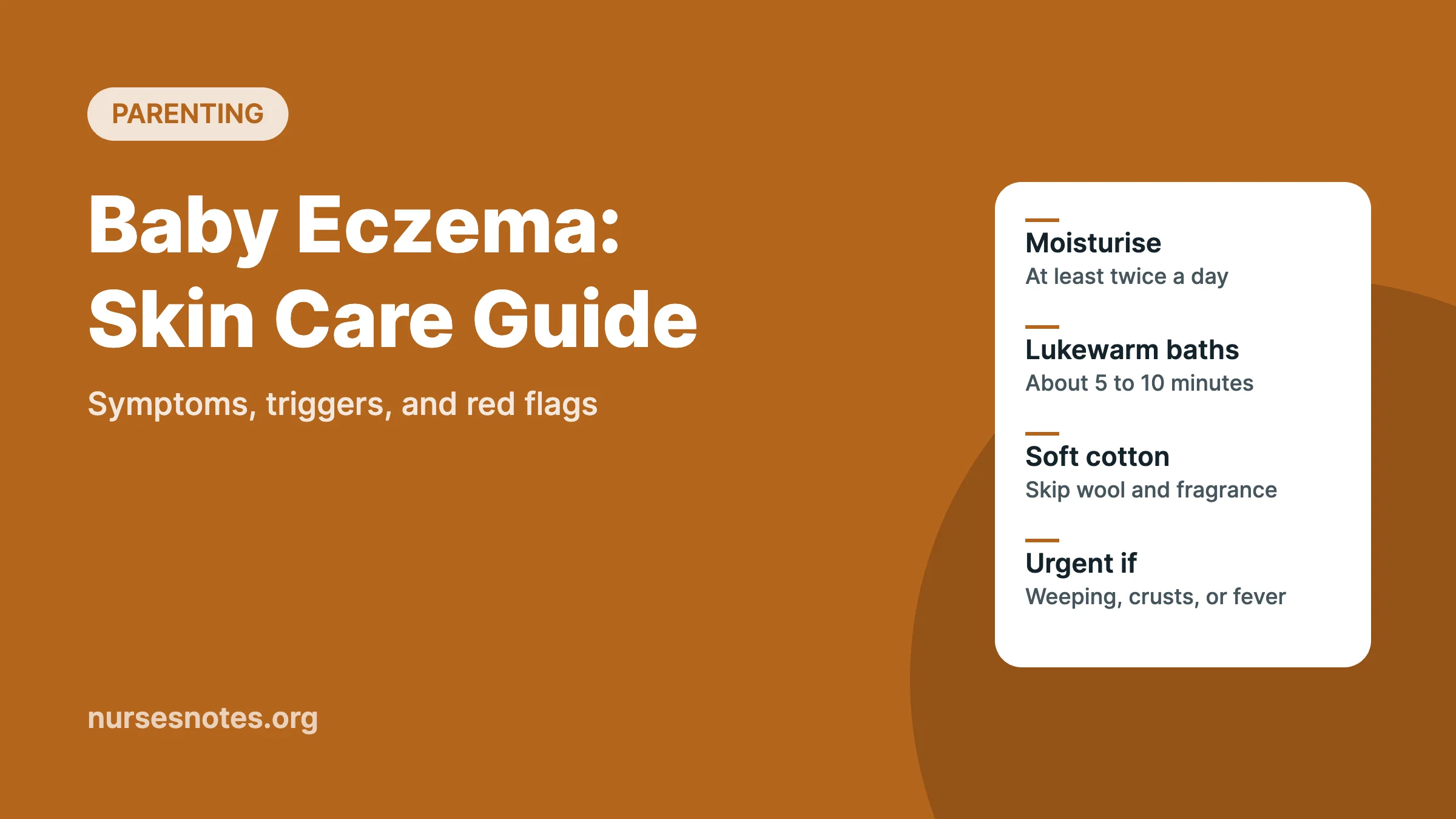
- Use short, lukewarm baths and a soap substitute, and dress your baby in soft cotton.
- Get urgent medical advice if the skin weeps, crusts, blisters, or has pus-filled spots, or if your baby has a fever or seems unwell.
What is baby eczema?
Eczema is a long-term skin condition where the skin barrier does not hold in water well, so the skin gets dry and lets irritants in more easily. The American Academy of Pediatrics (AAP) says up to 1 in 4 children have eczema. It often runs in families, especially where a parent has eczema, asthma, or hay fever.
What does eczema look like on a baby?
- Dry, rough, or scaly patches, often on the cheeks, forehead, around the mouth, and on the scalp
- Redness on lighter skin; on brown or black skin, patches may look darker, purple, grey, or lighter than the skin around them
- Itching, which may show as rubbing the face on bedding, fussiness, or poor sleep
- Patches that can crack, ooze, or bleed during a flare
As children grow, eczema often moves to the elbow creases, the backs of the knees, the neck, and around the eyes. Eczema tends to come and go, with flare-ups followed by calmer periods.
Not every rash is eczema. A greasy, yellow scale on the scalp is more likely to be cradle cap, and redness in the nappy area is more often diaper rash.
Common triggers
- Soap, bubble bath, and scented products
- Laundry detergent, fabric softener, wool, and some synthetic fabrics
- Heat, sweat, and sudden temperature changes
- Dust mites, pet dander, pollen, and tobacco smoke
- Skin infections and some viral illnesses
How to care for your baby’s eczema at home
1. Bathe gently
- Keep baths short (about 5 to 10 minutes) and lukewarm, not hot. The AAP suggests a bath every day or every other day.
- Skip soap and bubble bath. Use a soap substitute or emollient wash recommended by your doctor or pharmacist.
- Pat the skin dry with a soft towel. Do not rub.
2. Moisturise often
- Apply a thick, fragrance-free moisturiser (emollient) to the whole body straight after the bath, while the skin is still slightly damp.
- Moisturise several times a day. The NHS says at least twice a day, and Ireland’s HSE suggests 3 or 4 times a day if possible.
- Keep going even when the skin looks clear, as this helps prevent flare-ups.
- Thicker creams and ointments usually work better than lotions. The NHS advises not using aqueous cream, as it can irritate the skin.
- Scoop cream out with a clean spoon instead of your fingers to keep the tub clean.
- Emollients can soak into clothes and bedding and make them burn more easily, so keep your baby away from flames and do not smoke nearby.
3. Dress and protect
- Choose soft, breathable fabrics such as cotton, and use a mild, fragrance-free laundry detergent.
- Keep your baby cool. HSE suggests a bedroom temperature of about 18°C.
- Keep nails short, and use scratch mittens or soft cotton gloves at night.
4. Use prescribed treatments correctly
For flares, your doctor may prescribe a steroid cream or another medicated cream. The AAP says these are safe and effective when used as directed. Use only the cream your doctor recommends, follow the instructions on how much and how often, and ask before using any product on your baby’s face. Some doctors also suggest wet wrap therapy for bad flares; only do this with their guidance.
Does food cause baby eczema?
The AAP says many children with eczema also have food allergies, but foods themselves do not cause eczema. Do not cut out foods from your baby’s diet, or your own diet if you are breastfeeding, unless a doctor advises it. Removing foods without advice can affect growth. If you suspect a food reaction, keep a simple diary and talk to your doctor about an allergy check.
When to get medical help
See your doctor or health centre if:
- You think your baby has eczema, or the rash is affecting sleep or feeding
- A flare-up does not improve after 2 to 3 days of regular treatment
- Home care and prescribed creams are not helping
Get urgent medical advice the same day if your baby’s eczema:
- Is weeping, oozing, crusty, or covered in yellow or honey-coloured scabs
- Has blisters or pus-filled spots
- Is painful, swollen, or hot, or is suddenly getting worse or spreading
- Comes with a fever, or your baby seems generally unwell, floppy, or not feeding
These can be signs of infected eczema or eczema herpeticum, a serious infection caused by the cold sore virus. Keep anyone with a cold sore from kissing your baby. If your baby is very drowsy, has trouble breathing, or you are worried, go to emergency care.
Frequently asked questions
At what age does baby eczema start?
Eczema most often starts in babies and young children, usually on the cheeks, forehead, and scalp at first. The NHS notes that symptoms usually begin early in life and tend to improve with age, although eczema can appear at any age. If your baby develops a dry, itchy rash that keeps coming back, ask your doctor to check it.
Will my baby grow out of eczema?
Many children do. The AAP says eczema starts to fade for some children by around age 4, though some keep dry, sensitive skin for longer. There is no cure, but good daily skin care usually keeps it well controlled. It is hard to predict which children will grow out of it.
Is it okay to bathe a baby with eczema every day?
Yes, if the bath is short and lukewarm. The AAP suggests bathing every day or every other day for about 5 to 10 minutes, using no soap or only a gentle, fragrance-free cleanser where needed. The key step is putting on moisturiser right after the bath while the skin is still damp.
Related on Nurses Notes
- Cradle cap in babies: causes and safe home care
- How to treat diaper rash
- Chickenpox in children: symptoms and care
- All Parenting articles
Sources
- Eczema in Babies and Children: Symptoms and Causes, HealthyChildren.org, American Academy of Pediatrics, 2025
- How to Treat & Control Eczema (Atopic Dermatitis) Rashes in Children, HealthyChildren.org, American Academy of Pediatrics, 2025
- Atopic eczema, NHS, reviewed 2024
- Eczema in babies and children, HSE (Health Service Executive, Ireland), reviewed 2025
This article is for education only and does not replace advice from your own doctor, nurse, or other qualified health professional.