On this page
- What is bipolar disorder?
- Symptoms of mania and hypomania
- Symptoms of a depressive episode
- Types of bipolar disorder
- What causes bipolar disorder?
- How bipolar disorder is treated
- Self-care tips that help
- How to support someone with bipolar disorder
- When to get help
- Where to get help
- Frequently asked questions
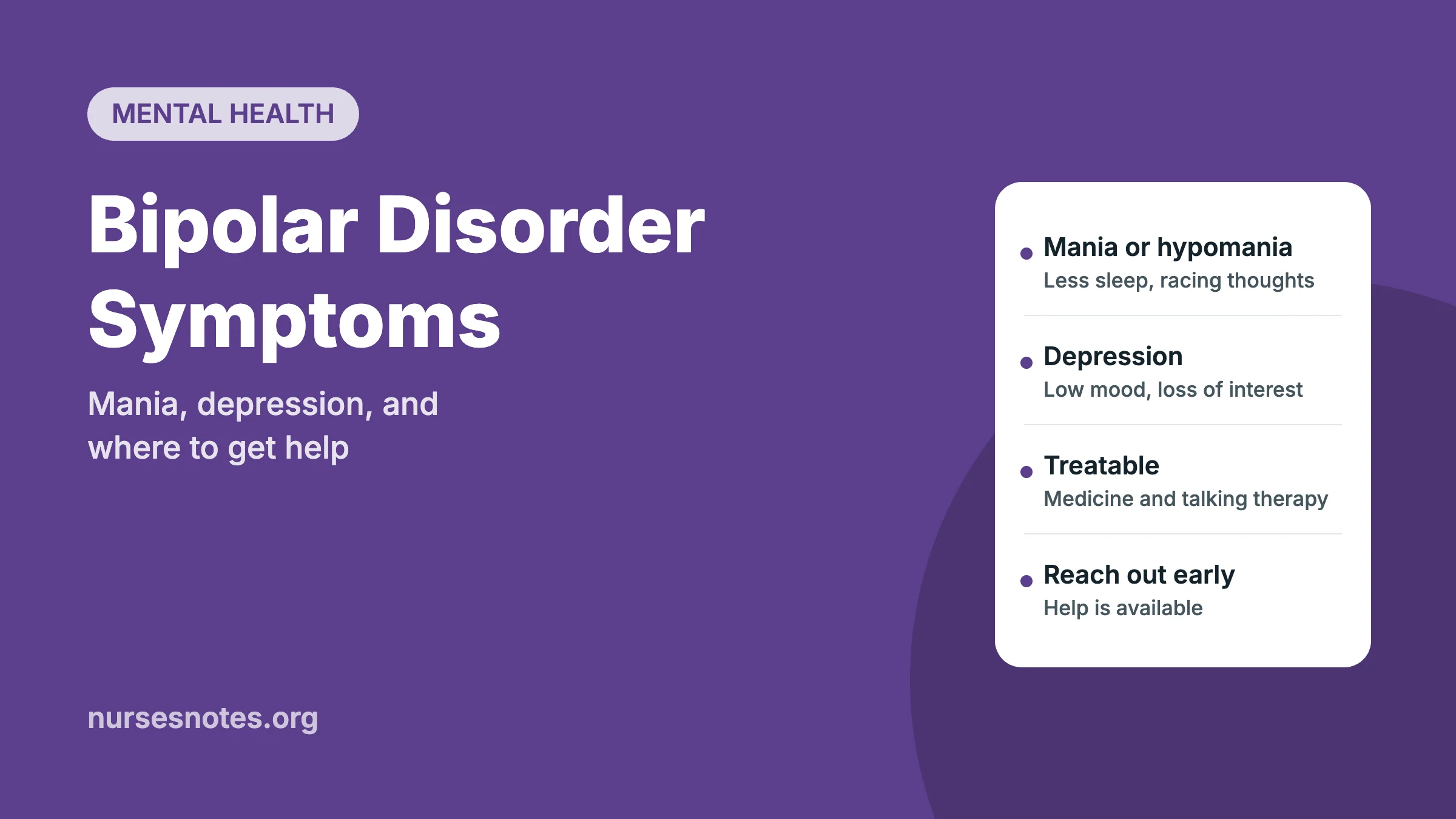
Bipolar disorder symptoms are episodes of extreme mood: periods of mania or hypomania, when energy, activity, and confidence are unusually high, and periods of depression, when mood is low and everyday life feels hard. It is a long-term condition, but it is treatable, and with the right support many people live full and stable lives.
Key points
- Bipolar disorder causes clear shifts in mood, energy, activity levels, and concentration.
- Mania or hypomania can bring much less need for sleep, racing thoughts, fast speech, and risky decisions.
- Depressive episodes bring low mood, loss of interest, tiredness, and feelings of worthlessness.
- It is usually managed long term with medicine and talking therapy, and early help makes a real difference.
What is bipolar disorder?
Bipolar disorder, once called manic depression, is a mental health condition that causes marked changes in mood, energy, activity, and the ability to think clearly. These changes come as episodes of extreme highs (mania or hypomania) and lows (depression).
Everyone has ups and downs, but bipolar episodes are more intense and affect work, study, relationships, and daily life. It can start at any age, although it is usually diagnosed in the teenage years or early twenties.
Symptoms of mania and hypomania
- Feeling unusually energetic, active, or agitated
- An exaggerated sense of well-being or self-confidence
- Needing much less sleep than usual
- Talking more, and faster, than usual
- Racing thoughts or jumping quickly between ideas
- Being easily distracted
- Irritability or aggression
- Impulsive choices, such as spending sprees, risky investments, or other risky behaviour
- In severe mania, seeing or hearing things others do not, or holding beliefs that are not based in reality
Hypomania is a milder form. Mania is more severe, causes obvious problems at work, school, or socially, and may need hospital care.
Symptoms of a depressive episode
- Feeling sad, empty, hopeless, or tearful
- Losing interest or pleasure in most activities
- Changes in appetite or weight
- Sleeping too much or too little
- Feeling restless or slowed down
- Tiredness and low energy
- Feelings of worthlessness or too much guilt
- Trouble concentrating or making decisions
- Avoiding other people
- Thoughts of death or suicide
Thoughts of suicide are a symptom of the illness, not a personal weakness. If they appear, it is a signal to reach out for help straight away; the help box below lists who to contact.
Types of bipolar disorder
| Type | What it involves |
|---|---|
| Bipolar I | At least one manic episode, which may come before or after hypomanic or major depressive episodes. Mania can include psychosis. |
| Bipolar II | At least one major depressive episode and at least one hypomanic episode, but never a full manic episode. It is a separate diagnosis, not a milder form of bipolar I. |
| Cyclothymia | At least 2 years (1 year in children and teens) of many periods of hypomanic and depressive symptoms that are less severe than full episodes. |
What causes bipolar disorder?
The exact cause is not known. It is likely to come from a mix of factors, including:
- Family history, especially a parent, brother, or sister with bipolar disorder
- Differences in how the brain works
- Very stressful life events, such as bereavement, relationship problems, or money worries
- Difficult experiences in childhood
- Drug or alcohol misuse
How bipolar disorder is treated
Bipolar disorder cannot be cured, but it can be managed well. Treatment usually combines medicines that help keep mood stable with talking therapy, such as cognitive behavioural therapy (CBT), and it is usually long term.
Do not stop or change medicine without talking to your doctor first, even if you feel well. Some medicines for bipolar disorder are not safe in pregnancy, so tell your doctor if you are planning a baby.
Self-care tips that help
- Keep a regular daily routine for meals, activity, and sleep.
- Protect your sleep; sleeping much less than usual can be an early warning sign. Our sleep hygiene tips can help.
- Eat a healthy diet and stay physically active.
- Learn your early warning signs and contact your care team early if they appear.
- Avoid recreational drugs, limit alcohol, and cut down on caffeine.
- If you work rotating shifts, as many nurses do, talk to your doctor or occupational health team about your schedule, because the NHS advises avoiding shift work and very long hours where possible.
How to support someone with bipolar disorder
- Encourage them to see a doctor or mental health professional, and offer to help with appointments.
- Learn their early warning signs together while they are well, and agree on what to do if an episode starts.
- Listen without judgement, and remember that symptoms are part of an illness.
- Look after your own health too; family and carer support groups can help.
When to get help
See a doctor if mood changes are extreme, last a long time, or affect daily life, work, or relationships.
Get urgent help if someone talks about suicide or self-harm, seems to have lost touch with reality, or may be at risk of harming themselves or others. Call a crisis line or your local emergency number, or go to the nearest emergency department.
Where to get help
If you are in crisis or worried about someone, reach out now. You do not have to face this alone.
- Philippines: NCMH Crisis Hotline 1553 (nationwide landline, toll-free), Globe/TM 0966-351-4518 or 0917-899-8727, Smart/Sun/TNT 0908-639-2672
- USA: call or text 988, or chat at 988lifeline.org (988 Suicide & Crisis Lifeline, free and available 24/7)
- UK and Ireland: Samaritans, call 116 123 (free, any time, day or night)
- Anywhere: if someone is in immediate danger, call your local emergency number
Frequently asked questions
What are the early warning signs of bipolar disorder?
Early signs differ from person to person. Before a high, people may need less sleep, talk faster, feel unusually confident, or become irritable. Before a low, they may withdraw, lose interest, or feel tired all the time. Keeping a mood and sleep diary can help you and your care team spot patterns early.
What is the difference between bipolar I and bipolar II?
Bipolar I involves at least one full manic episode, which can be severe enough to need hospital care. Bipolar II involves at least one hypomanic episode and at least one major depressive episode, but never full mania. Bipolar II is not simply a milder version, as depression can last longer.
Can bipolar disorder be cured?
There is no cure, but bipolar disorder is very treatable. Most people need long-term care that combines medicine, talking therapy, and healthy routines. With steady treatment, many people have long periods of stable mood, keep working, and enjoy good relationships. Getting help early makes episodes easier to manage.
Related on Nurses Notes
- Signs of depression: symptoms to know and when to get help
- How to help someone with depression: a practical guide
- Sleep hygiene tips: how to sleep better
- More mental health articles
Sources
- Bipolar Disorder. National Institute of Mental Health (NIMH), 2024.
- Bipolar disorder. NHS, 2024.
- Bipolar disorder – Symptoms and causes. Mayo Clinic, 2026.
- 988 Suicide & Crisis Lifeline. 988 Lifeline (USA).
- Contact Us. Samaritans (UK and Ireland).
- National Mental Health Week (NCMH Crisis Hotline numbers). Quezon City Government.
This article is for education only and does not replace advice from your own doctor, nurse, or other qualified health professional.