On this page
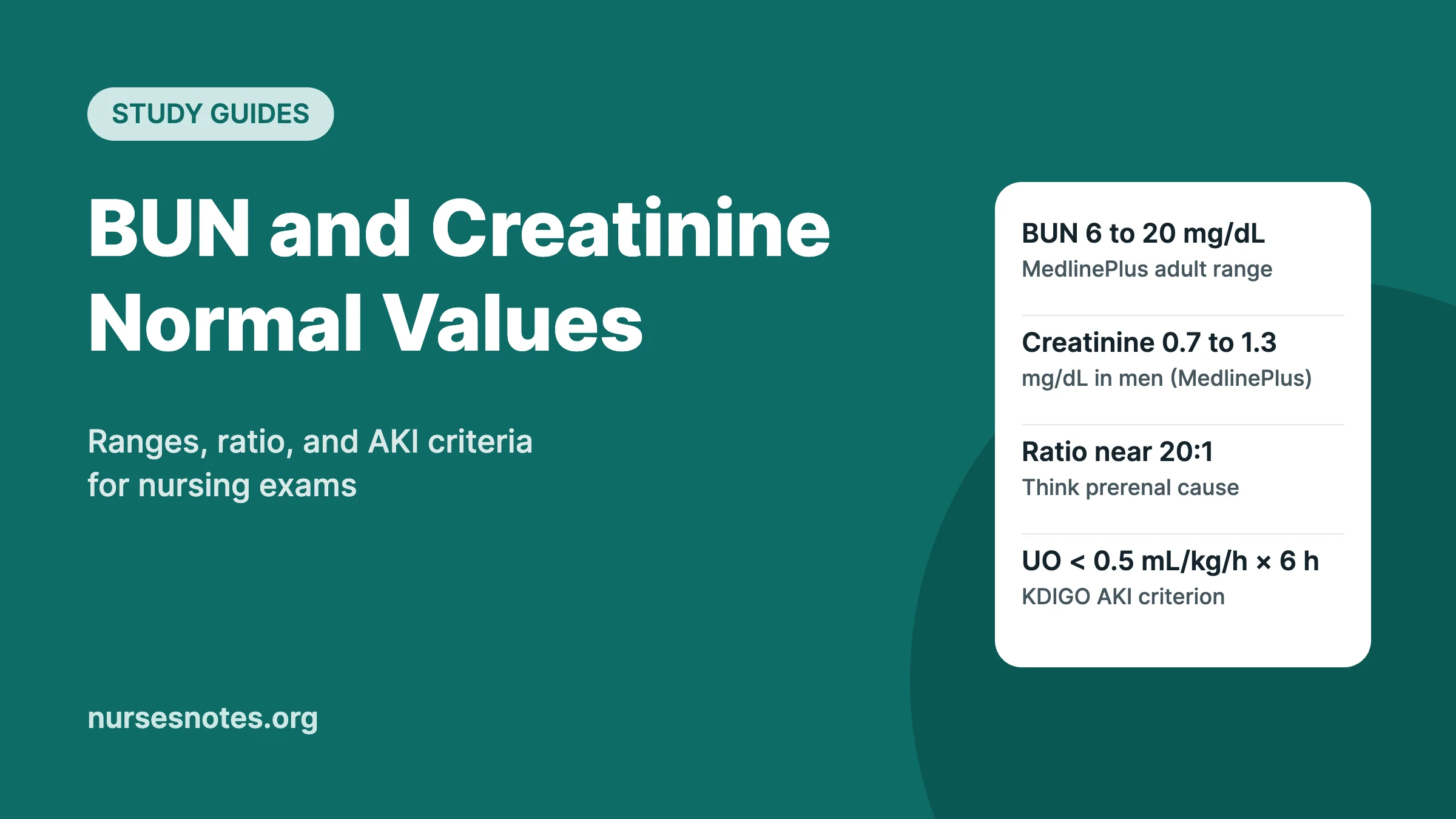
BUN and creatinine normal values in adults are roughly 6 to 20 mg/dL for blood urea nitrogen (BUN) and about 0.7 to 1.3 mg/dL for men and 0.5 to 0.95 mg/dL for women for serum creatinine, according to MedlinePlus. Together with eGFR and urine output, these two tests are the nurse’s main window into how well the kidneys are filtering the blood.
Key points
- Normal BUN is about 6 to 20 mg/dL (MedlinePlus) or 7 to 20 mg/dL (Mayo Clinic); ranges vary by laboratory.
- Creatinine depends on muscle mass, so men usually have higher values than women, older adults, or people with low muscle mass.
- A BUN-to-creatinine ratio near 20:1 points to a prerenal cause such as dehydration; intrinsic kidney disease is closer to 10:1.
- Falling urine output (below 0.5 mL/kg/h for 6 hours) can be the first sign of acute kidney injury, even before creatinine rises.
What are BUN and creatinine?
BUN measures urea nitrogen, a waste product made in the liver when protein is broken down. The kidneys clear it, so BUN rises when kidney filtration drops, but it also changes with hydration, protein intake, bleeding into the gut, and liver function.
Creatinine is a waste product of normal muscle activity. It is produced at a fairly steady rate and cleared almost entirely by the kidneys, which makes it a more specific marker of kidney function than BUN. Laboratories use serum creatinine, age, and sex to calculate the estimated glomerular filtration rate (eGFR).
BUN and creatinine normal values table
Use this table for revision only. Reference ranges differ between laboratories and facilities, so always interpret results against the range printed on your own lab report.
| Test | Adult reference value | Source |
|---|---|---|
| BUN | 6 to 20 mg/dL | MedlinePlus |
| BUN | 7 to 20 mg/dL (2.5 to 7.1 mmol/L) | Mayo Clinic |
| Creatinine, men | 0.7 to 1.3 mg/dL (62 to 115 µmol/L) | MedlinePlus |
| Creatinine, women | 0.5 to 0.95 mg/dL (44 to 84 µmol/L) | MedlinePlus |
| Creatinine, men | 0.74 to 1.35 mg/dL (65.4 to 119.3 µmol/L) | Mayo Clinic |
| Creatinine, women | 0.59 to 1.04 mg/dL (52.2 to 91.9 µmol/L) | Mayo Clinic |
| eGFR | Below 60 mL/min/1.73 m² for 3 months or more may be a sign of chronic kidney disease (CKD) | National Kidney Foundation |
BUN creatinine ratio: what it tells you
When BUN is high, comparing it with creatinine helps narrow down the cause. StatPearls notes that in prerenal disease the ratio is close to 20:1, while in intrinsic kidney disease it is closer to 10:1.
- Ratio high (about 20:1 or more): think of reduced blood flow to the kidneys, such as dehydration, blood loss, or heart failure.
- Very high ratio (sometimes above 30:1): StatPearls links this to upper gastrointestinal bleeding.
- Ratio low (closer to 10:1) with both values high: suggests damage within the kidney itself.
The ratio is a clue, not a diagnosis. Read it alongside the patient’s history, vital signs, and fluid balance.
Causes of high and low BUN
MedlinePlus and Mayo Clinic list these common causes:
- High BUN: dehydration (hypovolemia), heart failure, gastrointestinal bleeding, a high-protein diet, shock, severe burns, urinary tract obstruction, kidney disease, and some medicines such as prednisone.
- Low BUN: liver failure or liver disease, a low-protein diet, malnutrition, and over-hydration.
Causes of high and low creatinine
- High creatinine: kidney damage or failure, kidney infection, reduced blood flow to the kidneys, dehydration, a blocked urinary tract, rhabdomyolysis, and preeclampsia or eclampsia (MedlinePlus).
- Low creatinine: low muscle mass, including muscle and nerve conditions that cause muscle wasting, and malnutrition.
Mayo Clinic notes that creatine supplements and eating meat can affect creatinine results, so patients may be asked to stop supplements or avoid meat before testing.
Acute kidney injury criteria (KDIGO)
The KDIGO guideline defines acute kidney injury (AKI) when any one of these is present:
- Serum creatinine rises by 0.3 mg/dL (26.5 µmol/L) or more within 48 hours.
- Serum creatinine rises to 1.5 times baseline or more, known or presumed to have happened within the prior 7 days.
- Urine output is below 0.5 mL/kg/h for 6 hours.
| KDIGO stage | Serum creatinine | Urine output |
|---|---|---|
| 1 | 1.5 to 1.9 times baseline, or a rise of 0.3 mg/dL or more | Below 0.5 mL/kg/h for 6 to 12 hours |
| 2 | 2.0 to 2.9 times baseline | Below 0.5 mL/kg/h for 12 hours or more |
| 3 | 3.0 times baseline, or 4.0 mg/dL or more, or start of kidney replacement therapy | Below 0.3 mL/kg/h for 24 hours or more, or no urine for 12 hours or more |
For chronic kidney disease, the National Kidney Foundation stages eGFR as G1 (90 or higher), G2 (60 to 89), G3a (45 to 59), G3b (30 to 44), G4 (15 to 29), and G5 (below 15 or on dialysis).
Nursing assessment
- Monitor urine output closely; StatPearls notes that a fall in urine output may be the only early sign of AKI.
- Assess fluid status: dry mucous membranes, low blood pressure, a fast heart rate, and weight changes suggest volume depletion, while oedema and breathlessness suggest overload.
- Review trends, not single values: compare today’s creatinine with the patient’s baseline.
- Check potassium and other electrolytes, because falling kidney function can cause dangerous hyperkalaemia. See our electrolytes guide for nurses for normal values.
- Watch for signs of kidney injury such as reduced urine, swelling of the legs or ankles, fatigue, nausea, and confusion.
Nursing interventions and considerations
- Report a rising creatinine, a falling eGFR, or urine output below 0.5 mL/kg/h to the doctor promptly.
- Flag nephrotoxic medicines for review, such as NSAIDs, aminoglycosides, vancomycin, and iodinated contrast; ACE inhibitors, ARBs, and diuretics can add to the risk.
- Ask the prescriber or pharmacist whether medicines need renal dose adjustment.
- Keep accurate fluid balance records and follow any fluid or salt restrictions ordered.
- Know that diuretics can change BUN and creatinine; our furosemide nursing considerations explain what to monitor.
- Teach patients not to stop or change their medicines before a test without asking their provider.
Exam tips
- “BUN is moody, creatinine is loyal”: BUN changes with hydration, diet, and bleeding; creatinine tracks kidney function more closely.
- Ratio clue: about 20:1 suggests prerenal; about 10:1 suggests intrinsic kidney disease.
- Classic trap: a patient with a GI bleed can have a high BUN with a normal creatinine.
- Urine output first: below 0.5 mL/kg/h for 6 hours meets the KDIGO AKI criterion even if labs look normal.
- Muscle matters: an older, frail patient can have a “normal” creatinine despite reduced kidney function.
Frequently asked questions
What is a normal BUN and creatinine level?
MedlinePlus gives a normal BUN of about 6 to 20 mg/dL. Normal creatinine is about 0.7 to 1.3 mg/dL for men and 0.5 to 0.95 mg/dL for women. Other laboratories, such as Mayo Clinic, quote slightly different ranges, so always compare results with the reference range on your own lab report.
What does a high BUN with normal creatinine mean?
A high BUN with a normal creatinine often points to a cause outside the kidney, such as dehydration, gastrointestinal bleeding, a high-protein diet, or steroid medicines. The kidneys may still be filtering normally. The doctor will look at hydration, history, and trends before deciding what the result means for the patient.
What creatinine level is dangerous?
There is no single cut-off for every patient. What matters most is change from baseline: KDIGO defines acute kidney injury as a rise of 0.3 mg/dL within 48 hours or 1.5 times baseline within 7 days. Any sudden rise, or a high value with low urine output, should be reported promptly.
Related on Nurses Notes
- Electrolytes guide for nurses: normal values and imbalances
- Furosemide nursing considerations
- Nursing care plan for heart failure
- All study guides on Nurses Notes
Sources
- BUN – blood test. MedlinePlus Medical Encyclopedia, U.S. National Library of Medicine, 2025.
- Creatinine blood test. MedlinePlus Medical Encyclopedia, U.S. National Library of Medicine, 2025.
- Blood urea nitrogen (BUN) test. Mayo Clinic, 2026.
- Creatinine test. Mayo Clinic, 2025.
- Renal Function Tests. Gounden V, Bhatt H, Jialal I. StatPearls, NCBI Bookshelf, 2024.
- Acute Kidney Injury. Goyal A, Daneshpajouhnejad P, Bashir K. StatPearls, NCBI Bookshelf, 2026.
- Diagnosis, evaluation, and management of acute kidney injury: a KDIGO summary (Part 1). Kellum JA, Lameire N. Critical Care, 2013.
- Stages of Chronic Kidney Disease (CKD). National Kidney Foundation, 2026.
This article is for education only and does not replace advice from your own doctor, nurse, or other qualified health professional. Always follow your facility’s policies and reference ranges.