On this page
Abnormal lung sounds are added or changed breath sounds, such as crackles, wheezes, rhonchi, stridor, or a pleural friction rub, that you hear when you listen to the chest with a stethoscope. Each one points to a different problem in the airways, lung tissue, or pleura, so learning to tell them apart is one of the most useful skills in respiratory assessment.
Key points
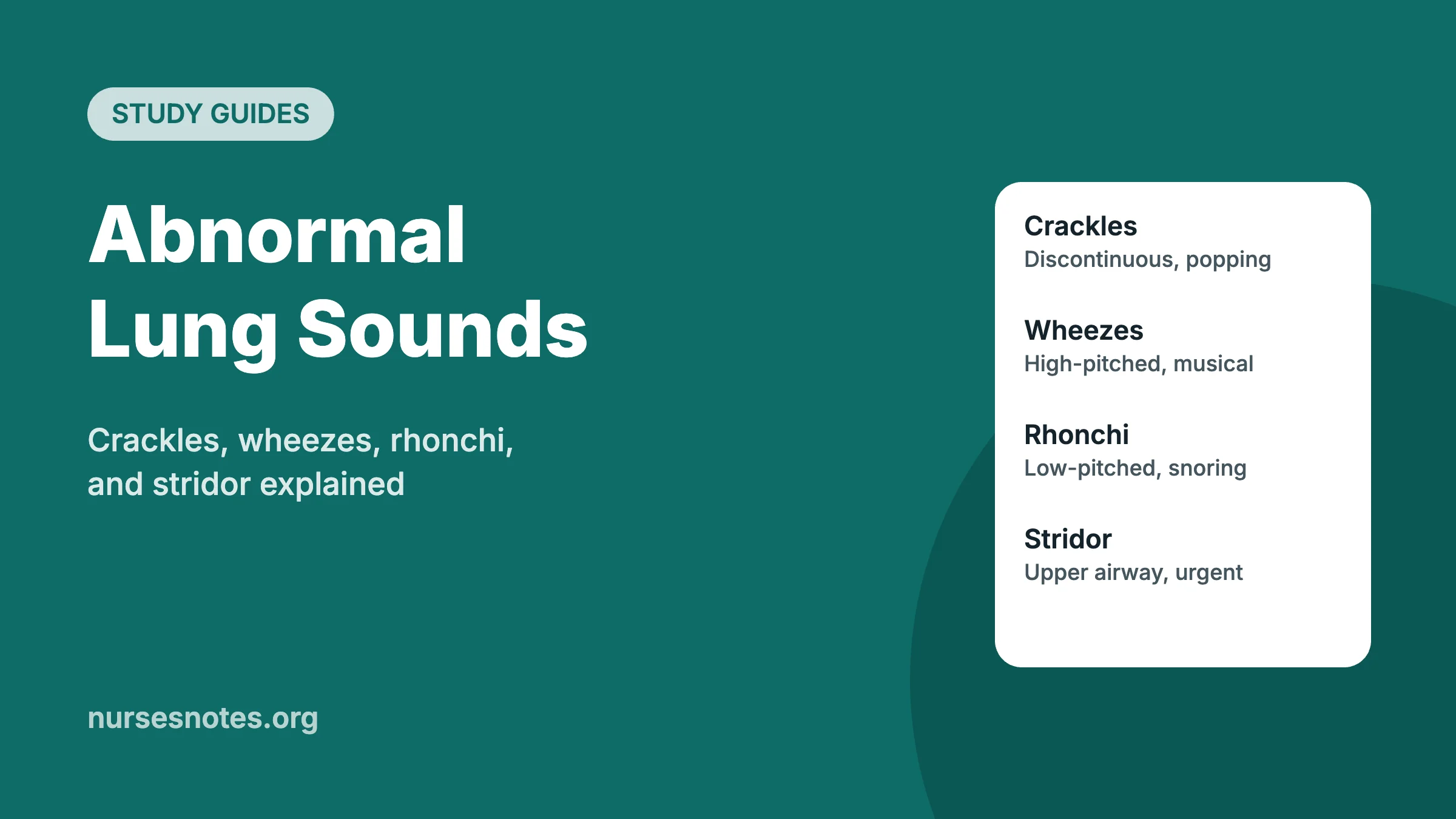
- Crackles are discontinuous (short, popping); wheezes, rhonchi, and stridor are continuous (longer, musical, or snoring).
- Wheezes are high-pitched and come from narrowed smaller airways; rhonchi are low-pitched and come from larger airways.
- Stridor is an upper airway sound heard loudest over the neck, and new stridor with breathing difficulty needs prompt escalation.
- Always describe the sound, its location, and when it occurs in the breath (inspiration, expiration, or both), and compare with the patient’s baseline.
Normal breath sounds first
You can only recognise abnormal lung sounds if you know what normal sounds like and where each normal sound belongs. StatPearls describes three normal types.
| Normal sound | What it sounds like | Where it is normally heard |
|---|---|---|
| Vesicular | Soft, low-pitched, heard mainly on inspiration | Most of the lung fields; best at the posterior lung bases |
| Bronchovesicular | Medium pitch and loudness, heard in both phases | Upper third of the anterior chest |
| Bronchial (tubular) | Loud, harsh, high-pitched, mainly expiratory | Over the trachea and at the right apex |
Bronchial sounds heard over the outer lung fields are abnormal. They usually suggest that the lung tissue is consolidated or collapsed, for example in pneumonia.
Types of abnormal lung sounds
| Sound | Character | Timing | Common causes |
|---|---|---|---|
| Fine crackles | Brief, high-pitched, popping; discontinuous | Mainly inspiratory | Pulmonary edema from heart failure, interstitial lung disease, pneumonia |
| Coarse crackles | Lower-pitched, deeper, longer than fine crackles; discontinuous | Inspiratory | Larger airways opening; secretions in larger airways (e.g. COPD, pneumonia) |
| Wheezes | High-pitched, musical; continuous | Expiration, or both phases | Asthma, COPD, mucus plug, or another airway obstruction |
| Rhonchi | Low-pitched, snoring-like; continuous | Expiration, or both phases | Mucus or fluid in the large airways from infection or chronic lung disease |
| Stridor | Loud, high-pitched, musical; loudest over the neck | Usually inspiratory | Upper airway narrowing, such as croup, laryngomalacia, or vocal cord lesions |
| Pleural friction rub | Grating, creaking, localized | Both phases | Inflamed pleural surfaces rubbing together |
| Diminished or absent sounds | Quieter or no breath sounds | Throughout | Pleural effusion, pneumothorax, hyperinflation (emphysema), airway obstruction, or shallow breathing |
Crackles (rales)
Crackles are short, non-musical clicking, bubbling, or rattling sounds. One StatPearls chapter explains fine crackles as small airways snapping open during inspiration, and coarse crackles as larger airways doing the same. A second StatPearls chapter links crackles to air moving through secretions, so expect textbooks to describe the mechanism differently.
In practice, new or spreading crackles at the lung bases in a patient with heart failure can be an early sign of fluid overload. Our nursing care plan for heart failure shows how this finding fits into the wider assessment.
Wheezes
Wheezes are continuous, high-pitched, musical sounds caused by air moving through narrowed smaller airways. They are heard on expiration or in both phases, and sometimes without a stethoscope. StatPearls notes that how much of the breathing cycle the wheeze fills says more about severity than its pitch.
Rhonchi
Rhonchi are continuous, low-pitched sounds that resemble snoring. They come from air passing through larger airways that contain mucus or fluid. StatPearls gives the example of a patient with COPD who develops new rhonchi, which may signal a new infection.
Stridor
Stridor is a loud, high-pitched sound from a narrowed upper airway, and it is often louder over the neck than the chest. Inspiratory stridor suggests a blockage above the chest, expiratory stridor suggests a problem inside the chest, and stridor in both phases suggests a fixed narrowing. In children, croup is a common cause.
Pleural friction rub
A friction rub is a grating sound made when inflamed layers of pleura rub together. It is usually localized, heard in both phases, and may come with chest wall tenderness at the same spot. It is easily mistaken for crackles.
Nursing assessment: how to listen
StatPearls recommends a systematic lung exam that follows the PIPPA sequence: positioning, inspection, palpation, percussion, and auscultation.
- Inspect first. Look for tripod positioning, pursed-lip breathing, and use of accessory muscles.
- Palpate. Decreased tactile fremitus suggests a pleural process such as effusion or pneumothorax.
- Listen in every zone. Cover the apical, middle, and basal areas, front and back.
- Compare side to side. A change heard on one side only is more likely to be significant.
- Grade the intensity. StatPearls uses 0 (none), 1 (barely heard), 2 (diminished), 3 (normal), and 4 (louder than normal).
- Check vocal resonance if needed. Egophony (a spoken “E” sounds like “A”), bronchophony, and whispered pectoriloquy suggest consolidation.
Pair your findings with the rest of the respiratory picture: respiratory rate, oxygen saturation, skin colour, and level of consciousness. Our guide to normal vital signs is a useful quick reference.
Nursing interventions and considerations
- Document each abnormal sound, its location, and its timing in the breath, and compare it with the previous assessment.
- Report new findings promptly, such as new crackles in heart failure, new rhonchi in COPD, or new stridor.
- Escalate immediately if the patient has bluish lips or skin (cyanosis), nasal flaring, or severe difficulty breathing, as MedlinePlus advises.
- Sit the patient upright if their condition allows and give oxygen only as prescribed or per protocol (see oxygen delivery devices).
- After intubation, listen to both sides of the chest; unequal breath sounds can mean the tube has passed into one bronchus.
- Reassess after treatments such as bronchodilators or diuretics and record the response.
Exam tips and common traps
- “Continuous = musical.” Wheezes, rhonchi, and stridor are continuous; crackles and rubs are not musical.
- Pitch tells you the airway size. High-pitched wheeze means smaller airways; low-pitched rhonchi mean larger airways.
- Stridor is an airway problem, not a lung problem. Listen over the neck, and treat it as a priority.
- Rub vs crackles: a rub is grating, localized, and heard in both phases, often with point tenderness.
- Bronchial sounds in the wrong place suggest consolidation.
- Silent is not always better. Diminished or absent sounds need an explanation, such as effusion or pneumothorax.
Frequently asked questions
What is the difference between crackles and rhonchi?
Crackles are short, popping, discontinuous sounds heard mainly on inspiration, often from small airways opening or fluid in the lungs. Rhonchi are longer, continuous, low-pitched sounds, like snoring, caused by mucus or fluid in larger airways. Describe both by location and timing, and report any new finding.
What do crackles in the lungs mean?
Crackles are a sign, not a diagnosis. MedlinePlus lists causes that include pneumonia, pulmonary edema, interstitial lung disease, and heart failure. The meaning depends on the whole picture, including history, vital signs, oxygen saturation, and other findings, so new crackles should always be reported and assessed further.
Are wheezes heard on inspiration or expiration?
Wheezes are most often heard on expiration, and they may be heard in both phases when narrowing is more severe. StatPearls notes that a wheeze heard only on inspiration is not typical, so an inspiratory high-pitched sound, especially over the neck, should make you think of stridor instead.
Related on Nurses Notes
- Nursing care plan for heart failure
- Oxygen delivery devices: flow rates and FiO2
- ABG interpretation steps
- Croup in children: barking cough and stridor
- More nursing study guides
Sources
- Lung Sounds. Zimmerman B, Williams D. StatPearls, NCBI Bookshelf, updated 28 August 2023.
- Lung Exam. Reyes FM, Modi P, Le JK. StatPearls, NCBI Bookshelf, updated 1 May 2024.
- Breath sounds. MedlinePlus Medical Encyclopedia, U.S. National Library of Medicine, reviewed 3 July 2025.
This article is for education only and does not replace advice from your own doctor, nurse, or other qualified health professional. Always follow your facility’s policies and reference ranges.