On this page
Contact, droplet, and airborne precautions are the three types of transmission-based precautions that nurses add on top of standard precautions when a patient has, or may have, an infection that spreads in a particular way. Contact precautions need a gown and gloves, droplet precautions need a mask, and airborne precautions need a fit-tested N95 or higher respirator and an airborne infection isolation room.
Key points
- Transmission-based precautions are always used together with standard precautions, never instead of them.
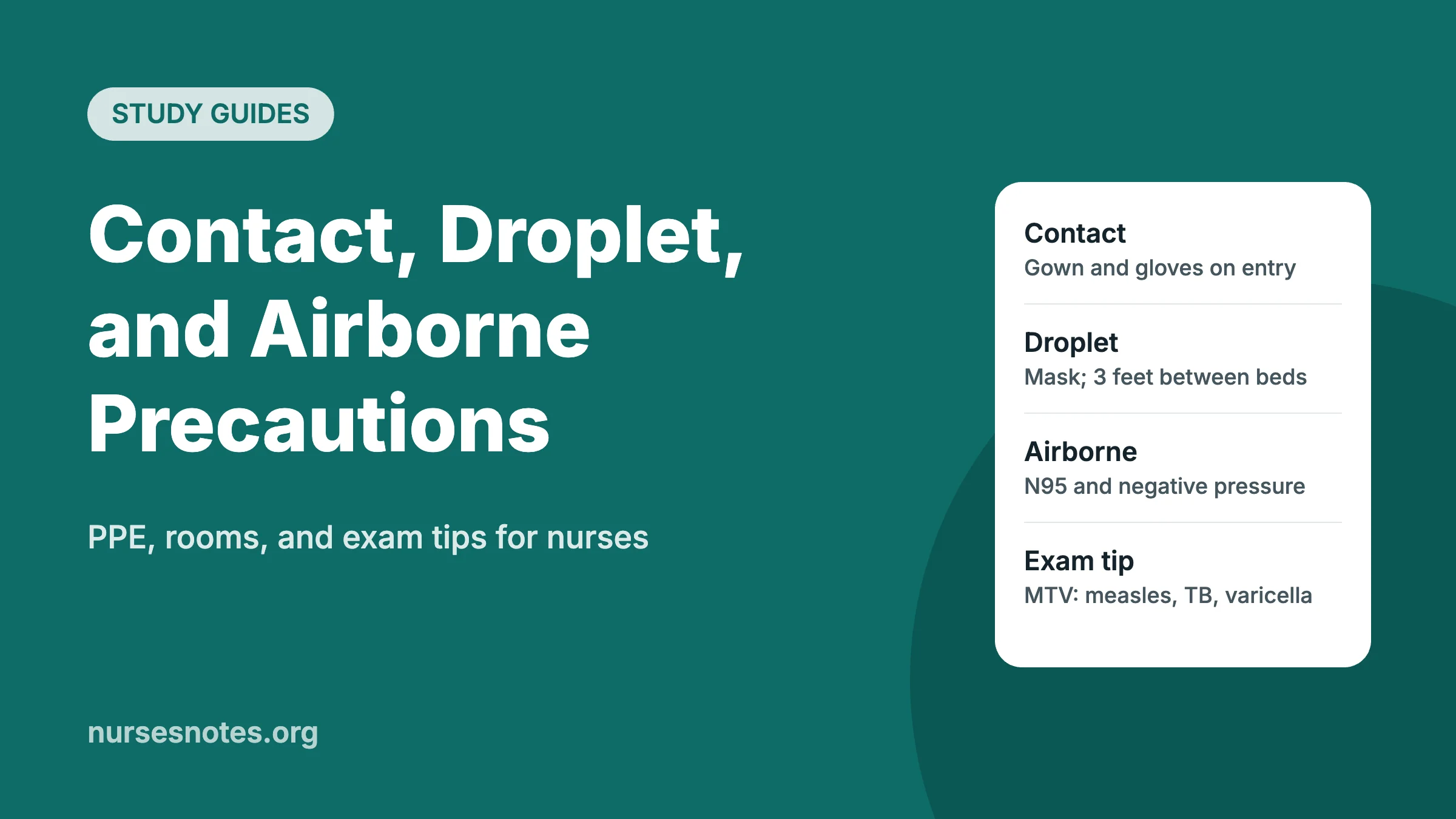
- Contact: gown and gloves on entry; droplet: mask on entry; airborne: fit-tested N95 or higher respirator and a negative-pressure room.
- Start precautions as soon as an infection is suspected, based on the patient’s symptoms, and adjust them once test results are back.
- Isolation rules and durations differ by organism, so always check your facility’s infection prevention policy.
What are transmission-based precautions?
The CDC describes infection control as two tiers. The first tier, standard precautions, applies to every patient in every setting and includes hand hygiene, PPE chosen for the expected exposure, safe injection practices, and respiratory hygiene.
The second tier, transmission-based precautions, is added for patients known or suspected to be infected or colonized with germs that need extra measures. They are often started empirically, based on the clinical syndrome, while tests are pending, and then changed once the cause is confirmed or ruled out.
Good isolation practice depends on solid basics, so review our 5 Moments for Hand Hygiene study guide alongside this one.
Contact, droplet, and airborne precautions compared
| Feature | Contact | Droplet | Airborne |
|---|---|---|---|
| How it spreads | Direct touch or touching contaminated surfaces and equipment | Large respiratory droplets over short distances | Small particles that stay infectious in the air over distance |
| Example organisms | VRE, C. difficile, norovirus, and RSV | Influenza, pertussis, N. meningitidis, adenovirus, and group A strep (first 24 hours of treatment) | Measles, chickenpox (varicella), and pulmonary or laryngeal tuberculosis |
| Room | Single room preferred; if shared, at least 3 feet between beds | Single room preferred; if shared, at least 3 feet between beds with the curtain drawn | Airborne infection isolation room (AIIR) with negative pressure |
| Staff PPE | Gown and gloves for any contact with the patient or their surroundings | Mask, put on when entering the room | Fit-tested N95 or higher respirator, put on before entering |
| Transport | Only if needed; cover or contain the infected area | Only if needed; patient wears a mask | Only if needed; patient wears a surgical mask if able |
Contact precautions
Contact precautions are used for organisms that spread by touch, such as vancomycin-resistant enterococci (VRE), C. difficile, norovirus, and respiratory syncytial virus (RSV). The CDC also advises them when a patient has heavy wound drainage, fecal incontinence, or other discharges that are likely to contaminate the environment.
- Place the patient in a single room when one is available. In a shared room, keep beds at least 3 feet apart.
- Put on a gown and gloves when entering the room for any interaction with the patient or their environment, and remove them before leaving.
- Use disposable or dedicated equipment, such as a blood pressure cuff. If equipment must be shared, clean and disinfect it between patients.
- Clean and disinfect the room at least daily, focusing on frequently touched surfaces and items close to the patient.
- Limit transport to what is medically necessary, and cover or contain the infected or colonized area before the patient leaves the room.
Special case: C. difficile
CDC guidance lists C. difficile diarrhea under contact precautions for the duration of illness. Handwashing with soap and water is preferred, because alcohol-based hand rubs do not kill the spores, and hypochlorite (bleach) solutions may be needed for cleaning if spread continues. Do not share electronic thermometers.
Droplet precautions
Droplet precautions are used for germs carried in larger respiratory droplets, which travel only a short distance. CDC examples include influenza, Bordetella pertussis, adenovirus, rhinovirus, Neisseria meningitidis, and group A streptococcus during the first 24 hours of antibiotic therapy.
- Place the patient in a single room if possible. If not, keep at least 3 feet between beds and draw the privacy curtain.
- Wear a mask when entering the room or patient space. Special air handling is not needed.
- If the patient must leave the room, they should wear a mask and follow cough etiquette.
Durations vary by organism. For example, CDC lists pertussis until 5 days after effective antibiotics are started, and meningococcal disease until 24 hours after effective therapy is started.
Airborne precautions
Airborne precautions are used for infections spread by small particles that remain infectious in the air, such as measles, chickenpox (varicella), disseminated herpes zoster, and tuberculosis. For a deeper look at TB signs, see our guide to tuberculosis symptoms.
- Place the patient in an airborne infection isolation room (AIIR). This is a single room with monitored negative pressure, at least 12 air changes per hour in new or renovated facilities (6 in existing ones), and air exhausted outside or filtered through HEPA filters.
- Keep the door closed. If no AIIR is available, mask the patient and place them in a private room with the door closed until transfer.
- Wear a fit-tested, NIOSH-approved N95 or higher respirator, put on before entering the room.
- When possible, staff who are not immune should not care for patients with measles, chickenpox, or disseminated zoster if immune staff are available.
- For transport, the patient wears a surgical mask if they can and follows cough etiquette, and skin lesions are covered.
Combined and special precautions
- Chickenpox (varicella): airborne plus contact precautions until the lesions are dry and crusted.
- Disseminated zoster (or localized zoster in an immunocompromised patient until spread is ruled out): airborne plus contact precautions for the duration of illness.
- Measles: airborne precautions until 4 days after the rash starts (longer if the patient is immunocompromised).
- Pulmonary or laryngeal TB: CDC advises stopping precautions only when the patient is on effective therapy, improving clinically, and has 3 consecutive negative sputum smears for acid-fast bacilli collected on separate days.
Nursing assessment
- Screen every patient early for fever, new cough, rash, diarrhea, or draining wounds, and ask about recent exposures and travel.
- Check the chart for flags such as a known multidrug-resistant organism (MDRO).
- Identify the most likely route of spread and start empiric precautions while waiting for test results.
- Assess the patient’s understanding of isolation, their ability to wear a mask, and their emotional response to being isolated.
Nursing interventions and considerations
- Post the correct isolation sign at the door and keep a supply of the right PPE outside the room.
- Follow the correct order for putting on and taking off PPE; see our PPE donning and doffing sequence guide.
- Explain to the patient and family why precautions are needed, how long they may last, and how visitors can protect themselves.
- Isolation can feel lonely, so check on the patient regularly and keep call bells and personal items within reach.
- Report and document the start and end of precautions, and stop them only as your facility’s policy or infection prevention team advises.
Exam tips
- “MTV” for airborne: Measles, TB, and Varicella. Remember the N95 and the negative-pressure room.
- Droplet = surgical mask, 3 feet. If the answer choice offers an N95 for influenza or pertussis, it is usually a distractor.
- Contact = gown and gloves, with dedicated equipment such as a stethoscope or blood pressure cuff.
- C. difficile = soap and water, not alcohol rub, because of spores.
- Chickenpox and disseminated zoster need both airborne and contact precautions.
- Exam questions often test priorities: the first action for a suspected airborne infection is usually to mask the patient and move them to an AIIR or private room.
Frequently asked questions
What is the difference between droplet and airborne precautions?
Droplet precautions protect against larger droplets that travel only a short distance, so a mask and at least 3 feet of separation are enough. Airborne precautions protect against tiny particles that stay infectious in the air, so staff need a fit-tested N95 or higher respirator, and the patient needs a negative-pressure isolation room.
Do you need a gown and gloves for droplet precautions?
Droplet precautions themselves call for a mask. However, standard precautions still apply, so you add gloves, a gown, or eye protection whenever you expect contact with blood, body fluids, secretions, or contaminated surfaces. Some organisms also need combined precautions, so always check the isolation sign and your facility’s policy.
Which diseases need airborne and contact precautions together?
According to CDC guidance, chickenpox (varicella) needs airborne plus contact precautions until all lesions are dry and crusted. Disseminated herpes zoster, or localized zoster in an immunocompromised patient until spread is ruled out, also needs both. Extrapulmonary TB with a draining lesion is another example listed by the CDC.
Related on Nurses Notes
- PPE donning and doffing sequence: nursing study guide
- 5 Moments for Hand Hygiene: nursing study guide
- Tuberculosis symptoms: signs of TB and when to get tested
- All nursing study guides
Sources
- Transmission-Based Precautions, Centers for Disease Control and Prevention (CDC), 2024.
- III. Precautions to Prevent Transmission of Infectious Agents (Guideline for Isolation Precautions), CDC, last reviewed 2023.
- Appendix A: Type and Duration of Precautions Recommended for Selected Infections and Conditions, CDC, accessed November 2026.
This article is for education only and does not replace advice from your own doctor, nurse, or other qualified health professional. Always follow your facility’s policies and reference ranges.