On this page
A nursing care plan for heart failure aims to relieve fluid overload, improve breathing and activity tolerance, and teach the patient how to take medicines, limit salt, and check their weight every day. This study guide covers the key assessment findings, nursing diagnoses, interventions, medicines, and exam traps for NCLEX and Philippine nursing board revision.
Key points
- Heart failure means the heart cannot pump enough blood to meet the body’s needs. It does not mean the heart has stopped.
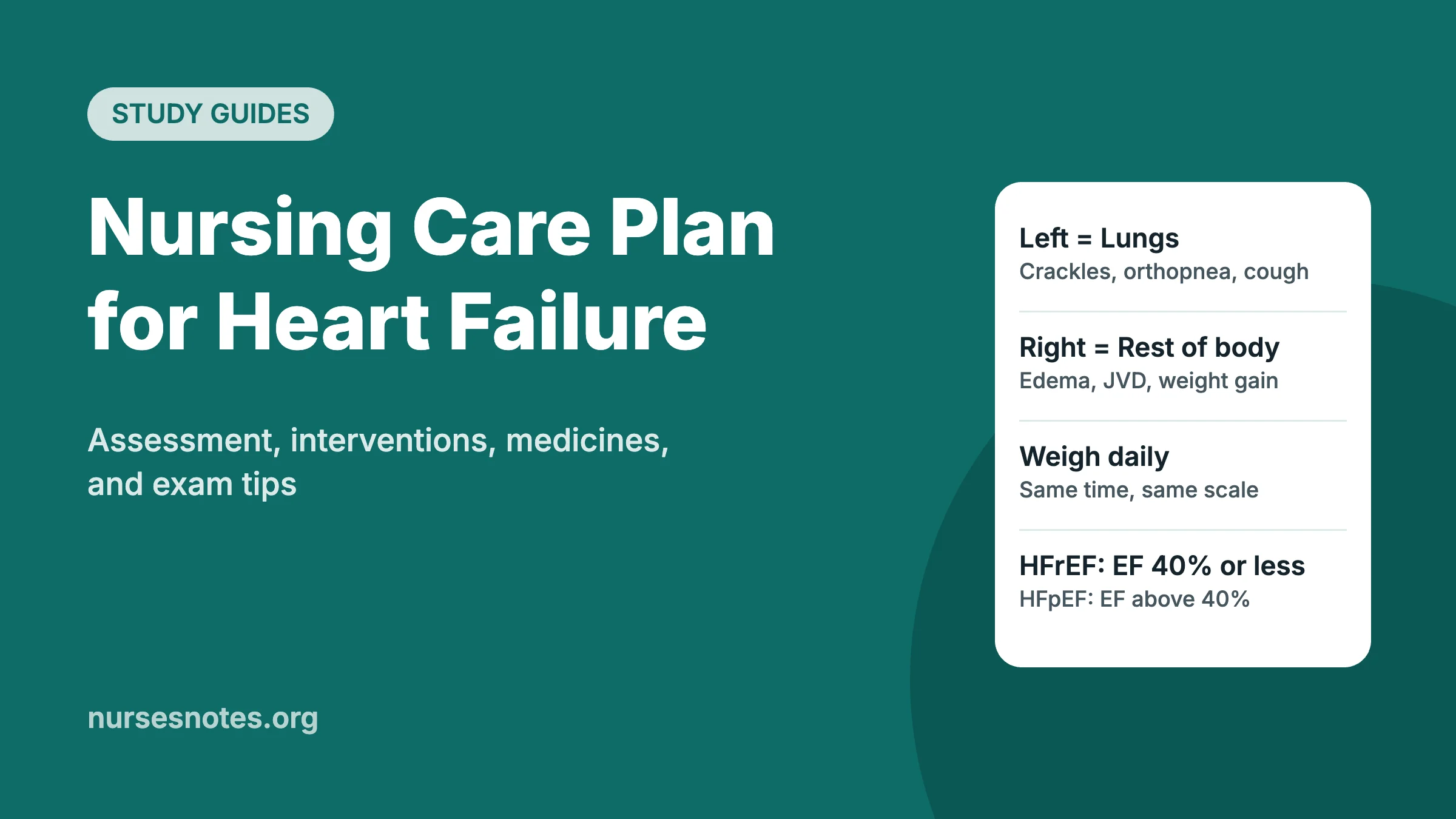
- Left-sided failure mainly causes lung signs (breathlessness, cough, and crackles), while right-sided failure mainly causes systemic congestion (edema, weight gain, and distended neck veins).
- Daily weights are a core monitoring tool for every patient with heart failure.
- Teaching about medicines, sodium and fluid limits, and warning signs helps patients stay out of hospital.
What is heart failure?
Heart failure is a common, complex syndrome in which a structural or functional heart problem impairs how the ventricles fill with or pump out blood. The result is that the heart cannot supply enough blood for the body’s needs.
StatPearls classifies heart failure by left ventricular ejection fraction (LVEF): heart failure with reduced ejection fraction (HFrEF) has an LVEF of 40% or less, and heart failure with preserved ejection fraction (HFpEF) has an LVEF above 40%. Cut-offs can differ between guidelines, so follow the ones your facility uses.
Left-sided vs right-sided heart failure
Exam questions often ask you to match signs to the failing side. Many patients have features of both, because left-sided failure commonly leads to right-sided failure over time.
| Feature | Left-sided heart failure | Right-sided heart failure |
|---|---|---|
| Where blood backs up | Lungs (pulmonary congestion) | Body veins and organs (systemic congestion) |
| Breathing | Dyspnea on exertion or at rest, orthopnea, paroxysmal nocturnal dyspnea, and cough | Breathing may be less affected unless left-sided failure is also present |
| Physical findings | Crackles (rales), S3 heart sound, and bluish lips or fingers in severe cases | Edema of the ankles, feet, legs, and abdomen, plus distended neck veins |
| Other symptoms | Fatigue, weakness, sleepiness, and poor concentration | Nausea, poor appetite, abdominal discomfort from liver congestion, and weight gain |
NYHA functional classification
The New York Heart Association (NYHA) classes describe how much symptoms limit daily activity. They help guide treatment and are a favourite exam topic.
| NYHA class | Symptoms appear with |
|---|---|
| Class I | More than ordinary physical activity |
| Class II | Ordinary physical activity |
| Class III | Minimal physical activity |
| Class IV | Rest |
Nursing assessment
- Breathing: respiratory rate, effort, oxygen saturation (SpO2), crackles, cough, orthopnea, and waking at night short of breath.
- Circulation: heart rate and rhythm, blood pressure, extra heart sounds such as S3, distended neck veins, and capillary refill.
- Fluid status: daily weight, intake and output, edema, and abdominal swelling.
- Mental status: new confusion or drowsiness can signal poor perfusion or low oxygen.
- Activity and comfort: fatigue, breathlessness with activity, appetite, sleep, and anxiety.
- Results to review: ECG, chest X-ray, echocardiogram, BNP or NT-proBNP, electrolytes, BUN, creatinine, liver function tests, and CBC.
On a chest X-ray, StatPearls lists a cardiothoracic ratio above 50%, upper-lobe venous congestion (cephalization), Kerley B lines, and pleural effusions as findings of heart failure. MedlinePlus notes that an echocardiogram is often the best first test to see how well the heart pumps.
Common nursing diagnoses
| Nursing diagnosis | Related to | Example goal |
|---|---|---|
| Excess fluid volume | Reduced pumping and sodium and water retention | Stable daily weight, less edema, and clear lung sounds |
| Decreased cardiac output | Weakened or stiff ventricles | Vital signs within target range and no new confusion |
| Impaired gas exchange | Fluid in the lungs | SpO2 within prescribed target and easier breathing |
| Activity intolerance | Low cardiac output and fatigue | Completes daily activities with planned rest periods |
| Deficient knowledge | New diagnosis or complex treatment | Patient explains medicines, diet limits, and warning signs |
Nursing interventions
- Monitor vital signs, SpO2, and heart rhythm (telemetry if ordered), and report worsening hypoxia, uncontrolled tachycardia, or a new rhythm promptly.
- Give oxygen as prescribed, and help the patient sit upright to make breathing easier.
- Weigh the patient daily at the same time, on the same scale, and in similar clothing, and record intake and output.
- Give diuretics and other heart failure medicines as prescribed, and check blood pressure, heart rate, electrolytes, and kidney function.
- Support sodium and fluid limits when prescribed. StatPearls gives examples of 2 to 3 g of sodium a day and a 2 L daily fluid limit, but the right limit is set by the patient’s provider.
- Plan rest between activities, increase activity gradually, and watch for breathlessness or chest pain.
- Protect swollen skin from pressure injury, and reduce anxiety with calm explanations.
- Start discharge teaching early and involve the family or caregiver.
Heart failure medicines: nursing considerations
| Drug class | Examples | What to monitor |
|---|---|---|
| ACE inhibitors and ARBs | Enalapril, lisinopril, and losartan | Cough (ACE inhibitors), low blood pressure, and a short-term drop in kidney function |
| ARNI | Sacubitril-valsartan | Low blood pressure; StatPearls notes it must not be given within 36 hours of an ACE inhibitor dose |
| Beta-blockers | Carvedilol, metoprolol succinate, and bisoprolol | Slow or irregular heart rate and fatigue |
| Diuretics | Furosemide | Low blood pressure, kidney function, electrolytes, and urine output |
| Mineralocorticoid receptor antagonists (MRAs) | Spironolactone | High potassium and kidney function |
| SGLT2 inhibitors | Dapagliflozin and empagliflozin | NHLBI notes they may reduce heart failure hospital stays |
| Digoxin | Digoxin | Digestive upset, confusion, and vision changes |
For detailed drug notes, see our guides to furosemide nursing considerations, beta-blocker nursing considerations, and digoxin nursing considerations. MedlinePlus also advises patients to avoid ibuprofen and naproxen, which can worsen heart failure, and to check with their provider before taking any new medicine or herbal product.
Patient and family teaching
- Take medicines exactly as prescribed, and report side effects instead of stopping them.
- Follow a low-salt diet, and keep to any fluid limit the provider sets.
- Weigh yourself every morning, write it down, and call your provider about sudden weight gain or new swelling, using the limits they give you.
- Stop smoking, limit alcohol, and ask about treatment for sleep apnea if you snore or stop breathing in your sleep.
- Stay active as advised, but MedlinePlus advises not exercising on days your weight has gone up from fluid or you feel unwell.
- Keep follow-up appointments; MedlinePlus says these are usually at least every 3 to 6 months.
When to escalate: red flags
Prompt medical review is needed for worsening fluid overload or hypoxia, uncontrolled tachycardia, a change in heart rhythm, a change in mental status, or falling urine output despite diuretics. Patients at home should seek emergency care for fainting, a fast or irregular heartbeat with other symptoms, or severe chest pain.
Exam tips
- Memory aid: “Left = Lungs, Right = Rest of the body.” Crackles and orthopnea point left; edema and neck vein distension point right.
- Daily weight beats intake and output as the best everyday measure of fluid gain, because 1 kg of sudden weight gain is roughly 1 L of retained fluid.
- Priority questions: a breathless patient with crackles comes first (airway and breathing), so sit them up and give oxygen as prescribed before teaching.
- Common trap: do not choose an answer that encourages extra fluids or a high-salt diet for a patient with heart failure.
- Digoxin and beta-blockers: check the apical pulse before giving them and follow your facility’s hold parameters.
Frequently asked questions
What is the priority nursing diagnosis for heart failure?
It depends on the patient, but during an acute episode impaired gas exchange or excess fluid volume usually comes first, because fluid in the lungs threatens breathing. In exam questions, choose the answer that protects airway, breathing, and circulation before education or comfort goals, then plan teaching once the patient is stable.
Why are daily weights important in heart failure?
Weight changes show fluid build-up earlier and more reliably than swelling or intake and output records. StatPearls says all patients with heart failure need daily weights. Patients should weigh themselves each morning on the same scale and report sudden gains to their provider, using the limits their care team gives them.
What is the difference between HFrEF and HFpEF?
In HFrEF the left ventricle pumps weakly, with an ejection fraction of 40% or less. In HFpEF the ejection fraction is above 40%, but the ventricle is stiff and fills poorly. Both cause similar symptoms, and NHLBI notes that diuretics are the main treatment for HFpEF, while several drug classes improve survival in HFrEF.
Related on Nurses Notes
- Furosemide nursing considerations and side effects
- Digoxin nursing considerations and toxicity signs
- Nursing care plan for hypertension
- More nursing study guides
Sources
- Heart Failure (Congestive Heart Failure) (Nursing) — StatPearls Publishing, NCBI Bookshelf, updated 2025
- What Is Heart Failure? — National Heart, Lung, and Blood Institute (NIH), 2022
- Heart Failure – Treatment — National Heart, Lung, and Blood Institute (NIH), 2022
- Heart failure — MedlinePlus Medical Encyclopedia, U.S. National Library of Medicine, reviewed 2024
This article is for education only and does not replace advice from your own doctor, nurse, or other qualified health professional. Always follow your facility’s policies and reference ranges.