On this page
Furosemide nursing considerations focus on three things: fluid balance, electrolytes (especially potassium), and safe administration to prevent low blood pressure and hearing damage. Furosemide is a strong loop diuretic, so careful monitoring before and after each dose is what keeps patients safe.
Key points
- Furosemide blocks the Na-K-2Cl cotransporter in the thick ascending limb of the loop of Henle, so the body loses water, sodium, chloride, potassium, magnesium, and calcium.
- The most tested side effects are hypokalemia, dehydration, orthostatic hypotension, and ototoxicity.
- Monitor daily weight, intake and output, blood pressure, and electrolytes, and check potassium closely in patients who also take digoxin.
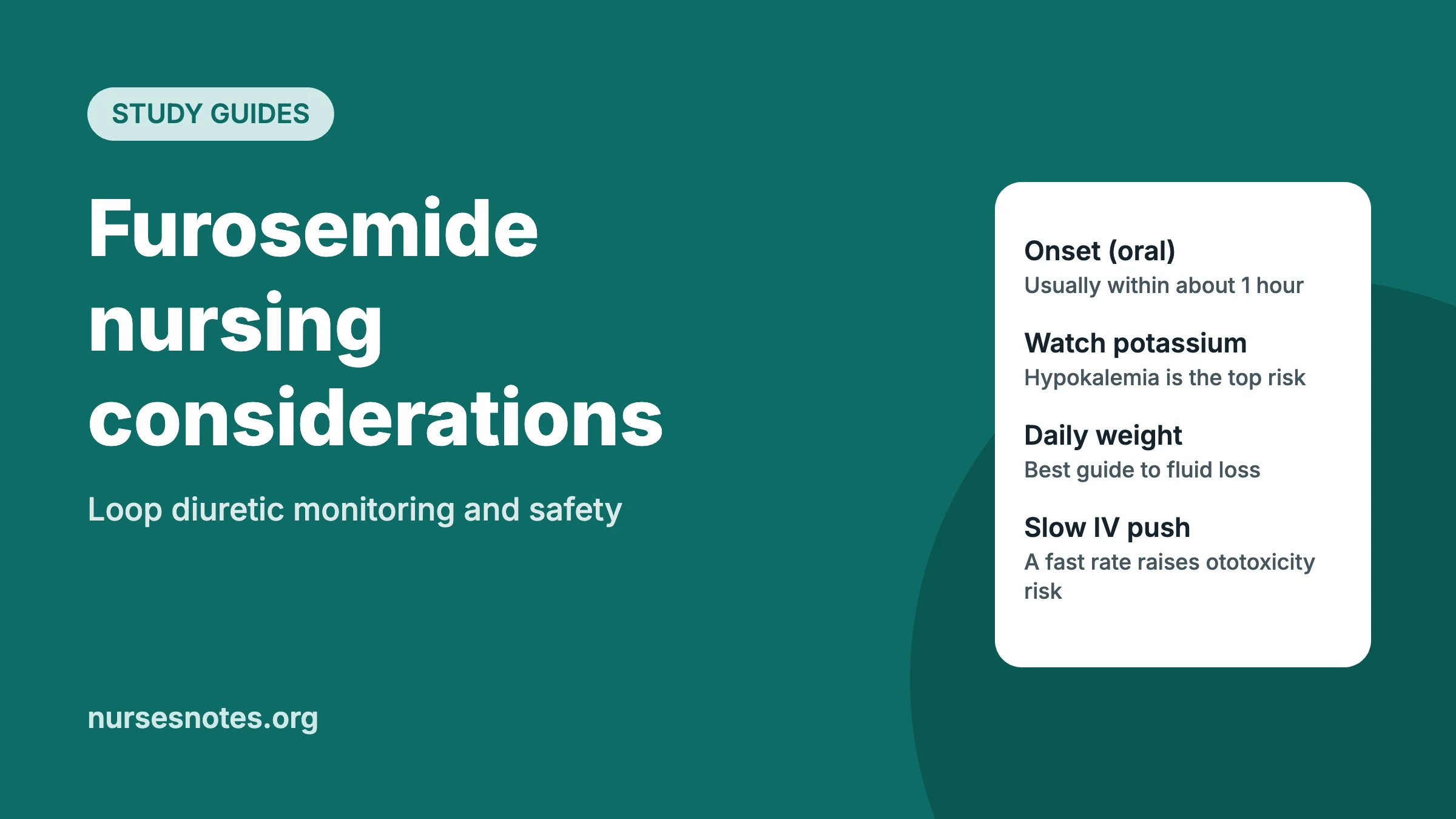
- Giving IV furosemide too fast raises the risk of ototoxicity.
What is furosemide?
Furosemide (brand name Lasix) is a loop diuretic. It makes the kidneys remove extra water and salt from the body. StatPearls lists its FDA-approved use as treating edema from fluid overload caused by heart failure, liver failure, or kidney failure, including nephrotic syndrome.
MedlinePlus notes that furosemide is also used to treat high blood pressure. However, loop diuretics are not first-line drugs for hypertension in most patients. It comes as oral tablets, an oral solution, and an injection.
Mechanism of action
Loop diuretics bind to the Na-K-2Cl (NKCC2) cotransporter on the inner surface of the thick ascending limb of the loop of Henle. Blocking this pump stops sodium and chloride from being reabsorbed, so more water follows them into the urine.
Blocking this pump also stops potassium from being reabsorbed, and the body loses calcium and magnesium as well. This explains why electrolyte problems are the main safety concern for this drug.
Onset, peak, and duration
| Feature | Oral furosemide (per StatPearls) |
|---|---|
| Onset | Usually within the first hour |
| Peak effect | 1 to 2 hours |
| Total therapeutic effect | 6 to 8 hours |
| Half-life | About 2 hours |
| Oral bioavailability | About 51% on average |
| IV vs oral | IV furosemide is about twice as potent as oral |
Side effects of furosemide
Most adverse effects come from the drug doing its job too well: losing too much fluid or too many electrolytes. The table below links each common problem to what to look for and what the nurse does.
| Adverse effect | What to look for | Nursing action |
|---|---|---|
| Hypokalemia | Muscle cramps, weakness, or an irregular or pounding heartbeat | Check potassium before and during diuresis; report low results before giving the dose |
| Hyponatremia and hypochloremia | Confusion, drowsiness, weakness, or nausea | Monitor sodium, especially in adults aged 65 and older |
| Hypomagnesemia and hypocalcemia | Muscle cramps or arrhythmias | Monitor magnesium and calcium with routine labs |
| Dehydration and orthostatic hypotension | Thirst, dry mouth, dizziness on standing, or passing less urine | Monitor intake and output, daily weight, and lying and standing blood pressure |
| Ototoxicity | Ringing in the ears (tinnitus) or hearing loss | Give IV doses slowly as per policy; report hearing changes at once |
| Hyperuricemia and hyperglycemia | Gout flare (painful, swollen joint); high blood sugar | Watch patients with gout or diabetes closely |
| Metabolic alkalosis | Linked to chloride and potassium loss | Review blood gases and electrolytes when ordered |
Other reported effects include photosensitivity, acute kidney injury from fluid loss, pancreatitis, low platelets, and severe allergic skin reactions. Electrolyte imbalances can trigger serious arrhythmias, which is why lab monitoring matters so much. For a refresher on electrolyte values, see our electrolytes guide for nurses.
Contraindications and cautions
- Anuria (no urine output).
- Known hypersensitivity to furosemide or other loop diuretics.
- Hepatic coma or severe electrolyte depletion.
- Sulfonamide (“sulfa”) allergy: use caution. StatPearls describes the risk of cross-reactivity as low, but it has not been studied extensively.
- Liver cirrhosis: rapid shifts in fluid and electrolytes may trigger hepatic encephalopathy.
Drug interactions to remember
- Digoxin: furosemide-induced hypokalemia increases the risk of digoxin toxicity. Check potassium before giving either drug. Read more in our digoxin nursing considerations guide.
- Aminoglycosides and ethacrynic acid: higher risk of ototoxicity when combined with furosemide.
- Corticosteroids, ACTH, and laxatives: add to potassium loss.
- Aspirin and NSAIDs (such as ibuprofen or naproxen): may interact, so patients should tell their prescriber.
- Sucralfate: MedlinePlus advises taking it 2 hours before or after furosemide.
Nursing assessment
- Baseline and daily weight at the same time, on the same scale, and in similar clothing.
- Intake and output, and signs of fluid overload (edema, crackles, or shortness of breath) or fluid deficit (thirst, dry mouth, or low urine output).
- Blood pressure, including orthostatic readings, and heart rate and rhythm.
- Serum potassium, sodium, magnesium, BUN, and creatinine.
- Blood glucose in patients with diabetes, and uric acid in patients with gout.
- Hearing, especially with high doses, kidney impairment, low albumin, or aminoglycosides.
Nursing interventions
- Check the latest potassium and kidney results before giving the dose; report abnormal values to the prescriber.
- Give IV furosemide at the rate set by your facility’s policy and drug reference; never push it faster than allowed.
- Weigh the patient daily and keep an accurate intake and output chart.
- Help patients rise slowly and assist with mobility to prevent falls from orthostatic hypotension.
- Keep a urinal or commode close by, since diuresis starts within about an hour of an oral dose.
- Follow orders for potassium supplements or potassium-rich foods and any low-sodium diet.
Patient teaching
- Get out of bed slowly, resting your feet on the floor for a few minutes before standing.
- Avoid alcohol, which can make dizziness worse.
- Protect your skin from the sun, because furosemide can increase sun sensitivity.
- Keep all blood test and blood pressure appointments.
- Report decreased urination, extreme thirst, muscle cramps, ringing in the ears, hearing loss, a racing heartbeat, or a rash straight away.
Exam tips
- “Loop loses K”: hypokalemia is the classic exam answer for loop diuretics.
- Digoxin plus furosemide: the priority is checking potassium.
- Fast IV push: think ototoxicity, especially with aminoglycosides.
- Best way to judge fluid loss: daily weight, then intake and output.
- Equivalent doses (StatPearls): 40 mg furosemide = 20 mg torsemide = 1 mg bumetanide.
- Contraindication trap: anuria. If the patient is not making urine, a diuretic will not work.
Frequently asked questions
Why do you check potassium before giving furosemide?
Furosemide makes the kidneys excrete potassium along with sodium and water. Low potassium can cause muscle weakness and dangerous heart rhythm problems, and it raises the risk of digoxin toxicity. Checking the latest potassium result lets the nurse hold the dose and alert the prescriber when the level is already low.
How fast does furosemide work?
According to StatPearls, oral furosemide usually starts working within the first hour, peaks at 1 to 2 hours, and lasts 6 to 8 hours in total. IV furosemide works faster and is about twice as potent as the same oral dose, so patients need a urinal or commode close by after either route.
Can you give furosemide to a patient with a sulfa allergy?
Sulfonamide allergy is a caution rather than an absolute contraindication. StatPearls describes a low potential for cross-allergy between sulfa antibiotics and loop diuretics, although it has not been studied extensively. Always check the allergy history, inform the prescriber, and watch closely for rash or other allergic reactions after the first dose.
Related on Nurses Notes
- Digoxin nursing considerations: pulse, potassium, and toxicity
- Electrolytes made simple: what nurses need to know
- Nursing care plan for hypertension
- Signs of dehydration in adults
- All Study Guides on Nurses Notes
Sources
- Furosemide. Khan TM, Patel R, Siddiqui AH. StatPearls, StatPearls Publishing (NCBI Bookshelf), last updated 8 May 2023.
- Loop Diuretics. StatPearls, StatPearls Publishing (NCBI Bookshelf), last updated 22 May 2023.
- Furosemide. MedlinePlus Drug Information, U.S. National Library of Medicine, revised 15 April 2025.
This article is for education only and does not replace advice from your own doctor, nurse, or other qualified health professional. Always follow your facility’s policies and reference ranges.