On this page
The Braden scale is a nursing tool that predicts a patient’s risk of developing a pressure injury by scoring six risk factors, with totals from 6 to 23. The lower the total score, the higher the risk, so a low score should trigger prevention measures straight away.
Key points
- The Braden scale has six subscales: sensory perception, moisture, activity, mobility, nutrition, and friction and shear.
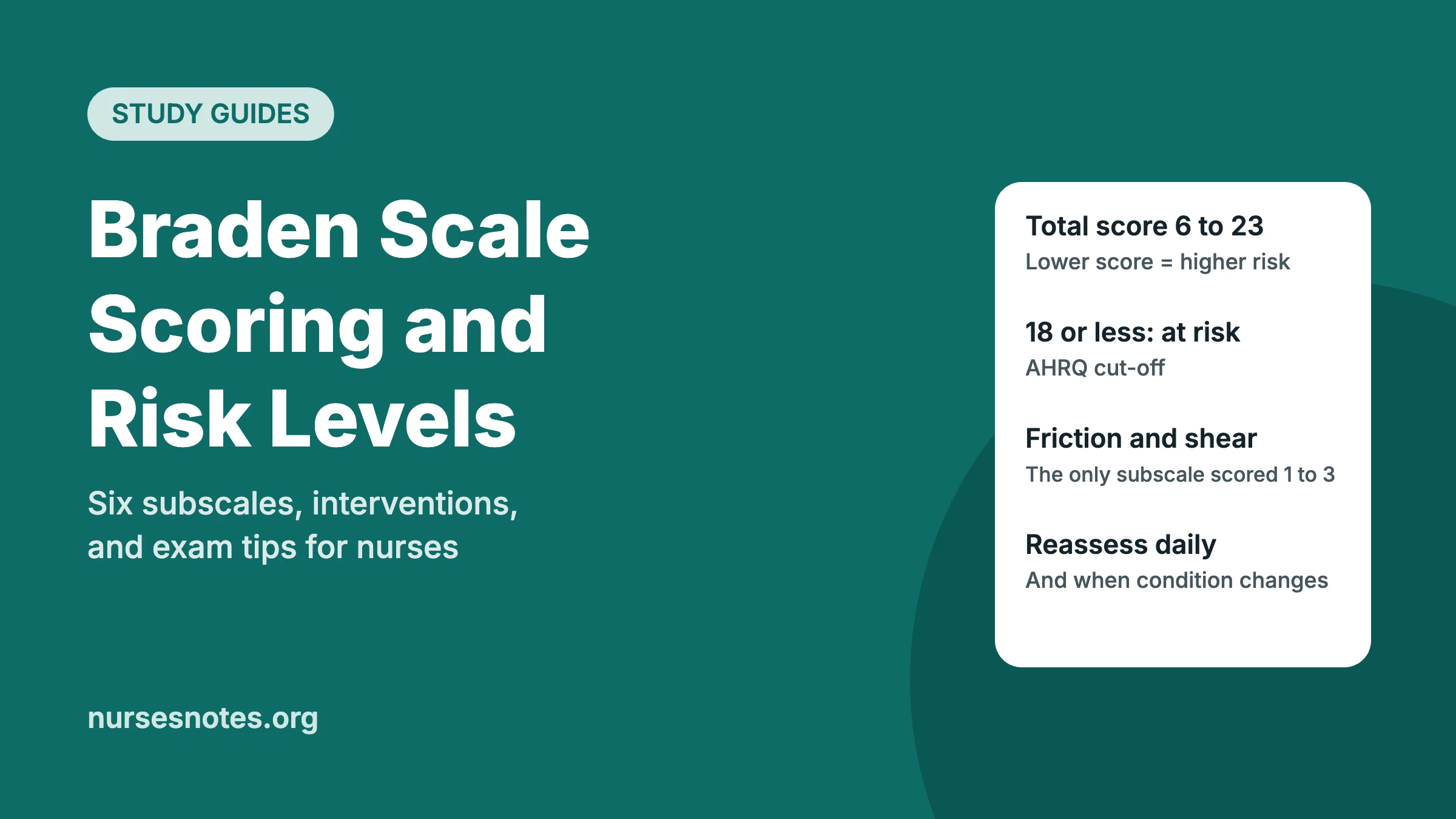
- Five subscales are scored 1 to 4, and friction and shear is scored 1 to 3, giving a total of 6 to 23.
- AHRQ treats a score of 18 or less as “at risk”; lower scores mean higher risk.
- Assess on admission, daily, and whenever the patient’s condition changes, or as your facility’s policy states.
What is the Braden scale?
The Braden scale (full name: the Braden Scale for Predicting Pressure Sore Risk) is one of the most widely used pressure injury risk assessment tools in hospitals and long-term care. It helps nurses spot patients who need extra skin protection before any damage appears.
It does not stage a wound. If a pressure injury is already present, you describe it using the staging system covered in our guide to pressure ulcer stages.
Braden scale subscales and scoring
Each subscale is rated with a number, where 1 is the worst function and the highest number is the best. Add the six numbers to get the total score.
| Subscale | What it measures | Score range |
|---|---|---|
| Sensory perception | Ability to respond meaningfully to pressure-related discomfort | 1 to 4 |
| Moisture | How much the skin is exposed to moisture (sweat, urine, or wound drainage) | 1 to 4 |
| Activity | Degree of physical activity (for example, bedfast, chairfast, or walking) | 1 to 4 |
| Mobility | Ability to change and control body position | 1 to 4 |
| Nutrition | Usual food intake pattern, including protein, or tube feeding, TPN, or NPO status | 1 to 4 |
| Friction and shear | Sliding of the skin against bed or chair surfaces during movement | 1 to 3 |
| Total | 6 to 23 |
Braden scale risk categories
Sources differ slightly on cut-offs, so learn both the single “at risk” threshold and the graded categories used in many nursing textbooks.
| Total score | Risk level (Open RN) |
|---|---|
| 15 to 18 | Mild risk |
| 13 to 14 | Moderate risk |
| 10 to 12 | High risk |
| Less than 9 | Severe risk |
The AHRQ toolkit notes that the at-risk cut-off may need adjusting for a unit’s own patient population. Always follow the categories in your facility’s policy.
Worked example
Mr. Santos, 78, is recovering from a hip fracture. He is slightly confused but responds to discomfort, is often damp from incontinence, stays in a chair, barely shifts position, eats about half his meals, and slides down the bed.
- Sensory perception 3, moisture 2, activity 2, mobility 2, nutrition 2, and friction and shear 2.
- Total: 3 + 2 + 2 + 2 + 2 + 2 = 13.
- Result: moderate risk by the Open RN categories, and “at risk” by the AHRQ cut-off of 18 or less.
Nursing assessment
- Complete the Braden assessment on admission, then daily, and again whenever the patient’s condition gets worse (Open RN and AHRQ).
- The AHRQ nursing handbook also recommends assessment at discharge and notes that the Institute for Healthcare Improvement advises reassessing hospitalized patients every 24 hours.
- Pair the score with a head-to-toe skin inspection, paying close attention to bony areas such as the sacrum, heels, and hips.
- Look at each subscale, not just the total. A patient with a “safe” total can still have one very low subscale that needs a targeted plan.
- Document the score, the skin findings, and the interventions you started.
Nursing interventions by risk factor
Match your interventions to the subscales that scored lowest. The measures below come from StatPearls, AHRQ, and Open RN.
Pressure and immobility
- Reposition the patient at least every 2 hours. AHRQ calls this the long-standing standard while noting the evidence on exact schedules is limited.
- Keep side-lying turns at no more than 30 degrees, and use pillows or wedges between the legs and under the calves to offload the heels.
- Use a pressure-redistributing support surface matched to the patient’s risk. StatPearls suggests an air mattress for patients with a Braden score of 12 or less.
Moisture
- Keep the skin clean and dry, using mild cleansers and avoiding hot water.
- Apply moisture barrier ointment for patients who are often moist.
- For patients who are constantly moist, check incontinence pads every 2 to 3 hours and assess the skin every shift (Open RN).
Nutrition
- Request a dietitian or nutrition consult when intake is probably inadequate.
- Support adequate calories, fluids, protein, vitamin C, and zinc, as ordered.
- If a patient has been NPO for more than 24 hours, discuss the nutrition plan with the doctor (AHRQ).
Friction and shear
- Use at least two people and a draw sheet to move the patient instead of dragging them.
- Keep the head of the bed at 30 degrees or lower when it is safe to do so.
- Use protective films, dressings, or lubricants over areas that rub, and avoid vigorous massage over reddened bony areas.
For bedbound patients who also need tube feeding, see our guide to nasogastric tube insertion.
Exam tips
- Memory aid for the six subscales: “Sensible Mothers Always Make Nutritious Food” (Sensory perception, Moisture, Activity, Mobility, Nutrition, and Friction and shear).
- Lowest possible score is 6, highest is 23. If an answer choice says 24 or 0, it is wrong.
- Friction and shear is the only subscale scored 1 to 3.
- Low score equals high risk. A common trap is choosing the patient with the highest Braden score as the priority.
- Activity is about how much the patient moves around (walking or chair); mobility is about changing body position. Exams like to swap these.
- The Braden scale predicts risk; it does not stage a wound.
Frequently asked questions
What is a good Braden score?
Higher scores mean lower risk, and the maximum is 23. AHRQ uses 18 or less as the point where a patient is considered at risk of pressure injury, so scores of 19 to 23 are generally lower risk. Even so, keep checking the skin, because a patient’s condition and score can change quickly.
How often should the Braden scale be done?
Open RN and AHRQ recommend a Braden assessment on admission, at least daily, and whenever the patient’s condition deteriorates. Some units, such as critical care, assess every shift. Your facility’s policy sets the exact frequency, so always check it and document each score along with your skin assessment.
Which Braden subscale is scored from 1 to 3?
Friction and shear is the only Braden subscale scored from 1 to 3. The other five (sensory perception, moisture, activity, mobility, and nutrition) are each scored from 1 to 4. That is why the total ranges from 6 to 23 rather than 6 to 24, a detail that often appears in nursing exam questions.
Related on Nurses Notes
- Pressure ulcer stages explained for nurses
- Nasogastric tube insertion: step-by-step guide
- Normal vital signs by age
- More nursing study guides
Sources
- 10.5 Braden Scale — Open Resources for Nursing (Open RN), Nursing Fundamentals 2e, 2024.
- 3D: The Braden Scale for Predicting Pressure Sore Risk (Preventing Pressure Ulcers in Hospitals, Section 7) — Agency for Healthcare Research and Quality (AHRQ), 2011, reviewed 2014.
- 3. What are the best practices in pressure ulcer prevention that we want to use? — AHRQ, 2011, reviewed 2014.
- Pressure Ulcers: A Patient Safety Issue — Lyder CH, Ayello EA. In: Patient Safety and Quality: An Evidence-Based Handbook for Nurses. AHRQ, 2008.
- Wound Pressure Injury Management — Al Aboud AM, Manna B. StatPearls Publishing, NCBI Bookshelf, updated 2023.
- Pressure ulcers (pressure sores) — NHS, reviewed 2023.
This article is for education only and does not replace advice from your own doctor, nurse, or other qualified health professional. Always follow your facility’s policies and reference ranges.