
On this page
Foley catheter care means keeping an indwelling urinary catheter clean, closed, draining freely, and in place only for as long as it is truly needed. These revision notes summarize the CDC guideline on preventing catheter-associated urinary tract infection (CAUTI), plus patient-care advice from MedlinePlus and the NHS.
Key points
- Insert a catheter only for an appropriate indication, and remove it as soon as it is no longer needed.
- Use hand hygiene, aseptic technique, and sterile equipment for insertion in acute care.
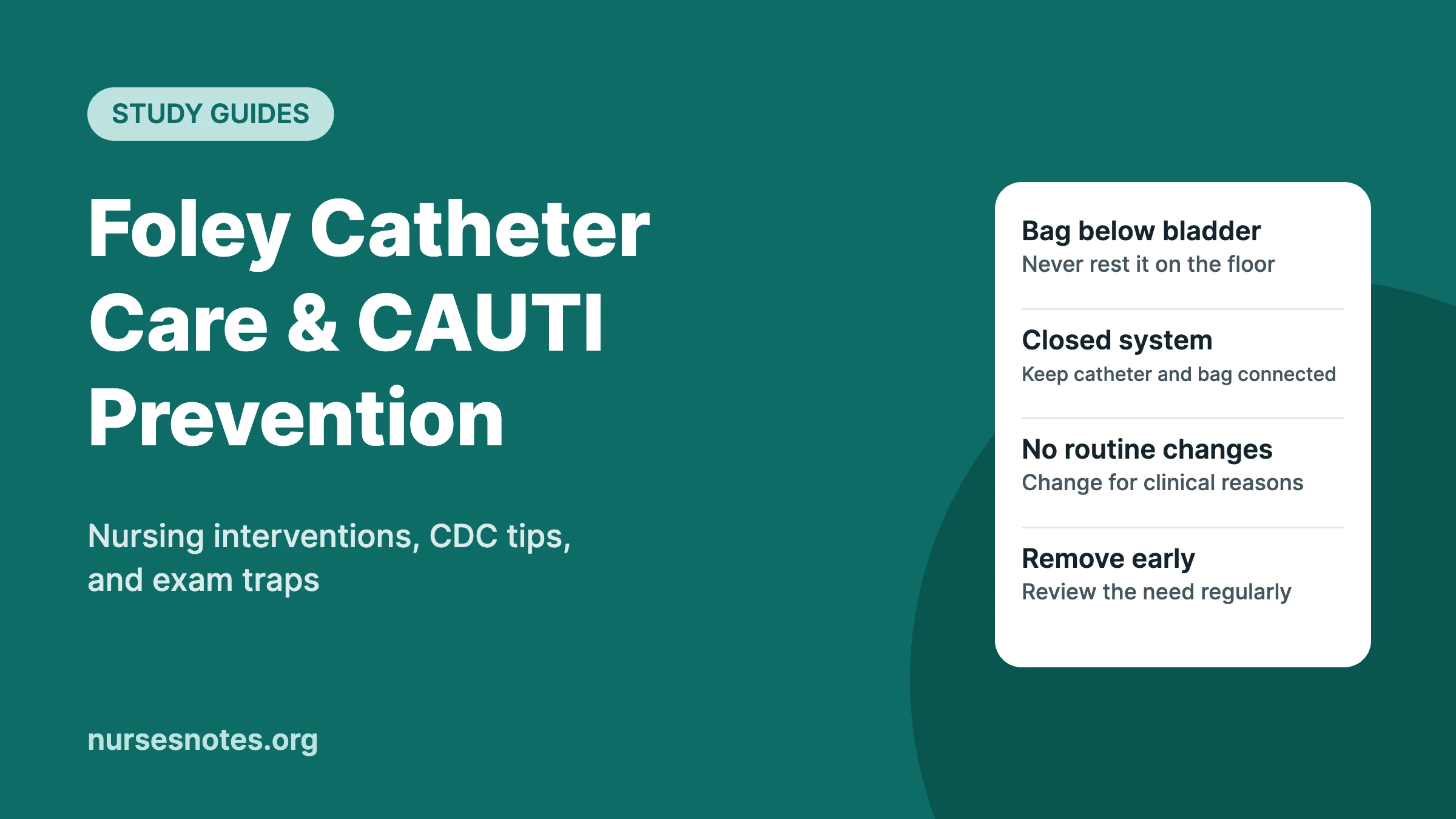
- Keep a closed system, unobstructed flow, and the bag below the level of the bladder, never on the floor.
- Do not change catheters or bags at fixed routine intervals, and do not clean the periurethral area with antiseptics to prevent CAUTI; routine daily hygiene is enough.
What is a Foley catheter?
A Foley catheter is an indwelling urinary catheter: a flexible tube passed through the urethra into the bladder and held in place by a small inflated balloon. Urine drains continuously into a collection bag.
The NHS describes two main types of urinary catheter. Intermittent catheters are put in to empty the bladder and then removed, while indwelling catheters stay in for days or weeks.
Indwelling catheters are more convenient, but the NHS notes they are more likely to cause problems such as infection. Possible problems include urinary tract infections, bladder spasms, leakage, blockage, and damage to the urethra.
Appropriate and inappropriate uses
The CDC guideline says to insert catheters only for appropriate indications and to leave them in only as long as needed. Use this table to revise the examples it gives.
| Appropriate uses (CDC examples) | Inappropriate uses (CDC examples) |
|---|---|
| Acute urinary retention or bladder outlet obstruction | As a substitute for nursing care of a patient with incontinence |
| Accurate urine output measurement in critically ill patients | To get urine for culture or other tests when the patient can void voluntarily |
| Selected surgical procedures (perioperative use) | Prolonged use after surgery without an appropriate indication |
| To help heal open sacral or perineal wounds in incontinent patients | — |
| Patients who need prolonged immobilization | — |
| Comfort during end-of-life care, if needed | — |
For surgical patients, the CDC advises removing the catheter as soon as possible after surgery, preferably within 24 hours, unless there is an appropriate reason to keep it.
The CDC also lists alternatives. Consider an external catheter for cooperative male patients without urinary retention or bladder outlet obstruction, and intermittent catheterization in preference to an indwelling catheter for patients with bladder emptying problems.
Nursing considerations during insertion
- Perform hand hygiene immediately before and after insertion or any handling of the catheter or its site.
- In acute care, use aseptic technique and sterile equipment: sterile gloves, a drape, sponges, an appropriate antiseptic or sterile solution for periurethral cleaning, and a single-use packet of lubricant.
- Consider the smallest bore catheter possible that still allows good drainage.
- Secure the catheter after insertion to prevent movement and urethral traction.
Nursing interventions: maintaining the catheter
- Keep the system closed. Keep the catheter connected to the drainage tubing and bag.
- Keep urine flowing. Check that the catheter and tubing are not kinked or blocked.
- Bag below the bladder. Keep the collection bag below the level of the bladder at all times, including during transfers and walks, and never rest it on the floor.
- Empty regularly. Use a separate, clean collecting container for each patient. The NHS advises emptying the bag when it is about half to three-quarters full.
- Routine hygiene only. Cleaning the meatal surface during daily bathing is appropriate. The CDC advises against cleaning the periurethral area with antiseptics to prevent CAUTI while the catheter is in place.
- No routine changes. Do not change catheters or drainage bags at fixed intervals; change them based on clinical indications such as infection, obstruction, or a compromised closed system.
- No routine irrigation. Avoid bladder irrigation unless obstruction is expected, and do not use routine antimicrobial irrigation or routine systemic antibiotics to prevent CAUTI.
- Fluids and bowels. Unless fluids are restricted, encourage drinking enough to keep urine pale, and help prevent constipation, as the NHS advises.
Good hand hygiene is the foundation of all of this; revise the WHO 5 moments for hand hygiene alongside these notes.
Collecting a urine specimen
- For a small sample for urinalysis or culture, clean the needleless sampling port with a disinfectant, then aspirate urine with a sterile syringe or cannula adapter.
- For larger volumes needed for tests other than culture, take urine from the drainage bag using aseptic technique.
- Never disconnect the catheter from the tubing to get a sample, because this breaks the closed system.
Nursing assessment
Check the following every shift, or as often as your facility policy requires:
- Ongoing need: Is there still an appropriate indication? Prompt the team to review it regularly.
- Drainage: urine flow, color, clarity, and amount; no kinks or signs of blockage.
- Signs of infection: fever or chills, pain in the sides or lower back, cloudy or bad-smelling urine, burning or pain in the bladder or pelvis, or the patient feeling generally unwell. Compare with the usual signs of a urinary tract infection.
- Other problems: leaking around the catheter, blood in the urine, bladder spasms, grit or stones in the urine, and pain near the catheter.
- Securement and skin: catheter secured with no pull on the urethra, and skin around the catheter clean and intact.
Teaching patients who go home with a catheter
- Wash your hands before and after touching the catheter or bag.
- Clean the skin around the catheter at least once a day with mild soap and warm water; females should wipe from front to back. Avoid creams, powders, or sprays near the area.
- Keep the bag below the bladder and check the tubing for kinks.
- The NHS says leg bags should be changed every 7 days and long-term indwelling catheters replaced at least every 3 months; follow the plan from your own care team.
- Contact your nurse or doctor promptly for signs of infection, a blocked catheter, leaking, blood in the urine, severe bladder spasms, or a catheter that falls out.
When to escalate
In hospital, report promptly to the doctor or charge nurse if there is no urine draining after you have checked for kinks, fever with urinary symptoms, bright red blood in the urine, severe or ongoing bladder spasms, or a catheter that has come out. At home, patients should contact their community nurse or doctor straight away for these problems, and call their local emergency number if they feel very unwell.
Exam tips
- “Bag below the bladder, never on the floor” is a classic priority answer.
- Incontinence alone is not an indication for an indwelling catheter.
- Changing catheters or bags at set intervals is a trap; the CDC says to change them based on clinical need.
- Antiseptic meatal cleaning is not recommended; routine hygiene with soap and water is the right answer.
- Never take a culture specimen from the drainage bag; use the sampling port after cleaning it.
- The best CAUTI prevention is avoiding unnecessary catheters and removing them early.
Frequently asked questions
How often should Foley catheter care be done?
MedlinePlus advises cleaning the skin around the catheter once a day, every day, or more often if needed, using mild soap and warm water. The CDC says routine hygiene, such as cleaning the meatal surface during daily bathing, is appropriate. Your facility may also require checks of drainage, securement, and skin every shift.
Why should the urine bag be kept below the bladder?
Keeping the collection bag below the level of the bladder lets urine drain by gravity and keeps flow unobstructed. The CDC lists this as a core CAUTI prevention step and also says never to rest the bag on the floor. Remember it whenever you transfer, reposition, or walk with a patient who has a catheter.
How often should a Foley catheter be changed?
The CDC does not recommend changing indwelling catheters or drainage bags at routine, fixed intervals. Instead, change them for clinical reasons, such as infection, obstruction, or a compromised closed system. For long-term catheters at home, the NHS says they are usually replaced at least every 3 months. Always follow your facility’s policy and the manufacturer’s instructions.
Related on Nurses Notes
- Signs and symptoms of a urinary tract infection
- The WHO 5 moments for hand hygiene
- Contact, droplet, and airborne precautions explained
- More Study Guides for nursing students and nurses
Sources
- Summary of Recommendations (Guideline for Prevention of Catheter-Associated Urinary Tract Infections, 2009). Centers for Disease Control and Prevention (CDC), reviewed 2024.
- I. Executive Summary. Centers for Disease Control and Prevention (CDC), reviewed 2024.
- Indwelling catheter care. MedlinePlus Medical Encyclopedia, US National Library of Medicine, reviewed 2025.
- Urinary catheters. NHS, reviewed 2023.
- Living with a urinary catheter. NHS, reviewed 2023.
This article is for education only and does not replace advice from your own doctor, nurse, or other qualified health professional. Always follow your facility’s policies and reference ranges.