On this page
DKA nursing interventions centre on four priorities: restoring fluid volume, giving insulin safely, keeping potassium in a safe range, and watching closely for complications. Diabetic ketoacidosis (DKA) is a life-threatening complication of diabetes, so nurses need to recognise it early and know what the team is aiming for at each stage.
Key points
- DKA is classically defined by high blood glucose, metabolic acidosis, and ketones in the blood or urine.
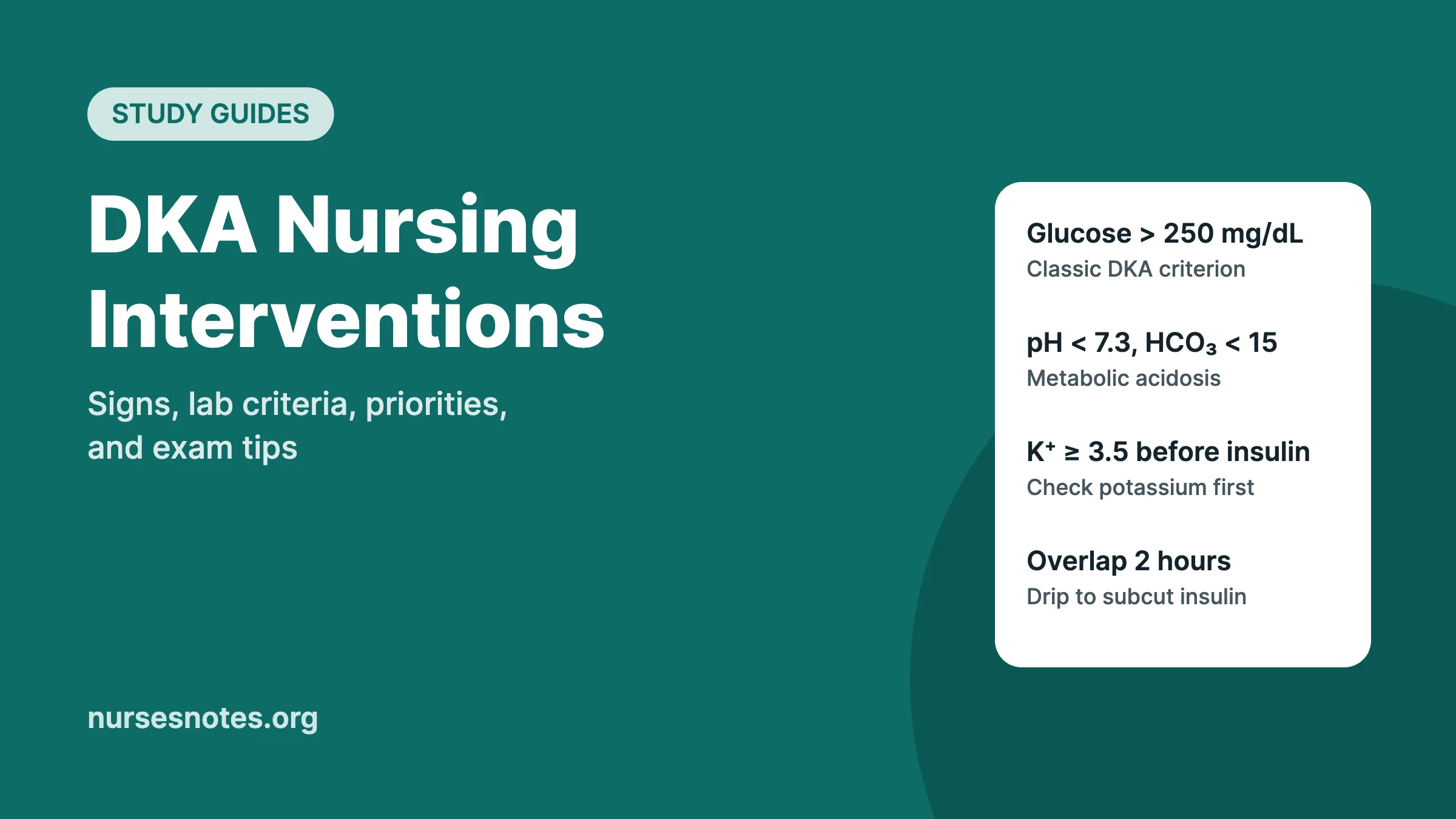
- Fluids come first, and insulin is started only once serum potassium is at least 3.5 mmol/L (StatPearls).
- When glucose falls to about 200 to 250 mg/dL while the anion gap is still open, dextrose-containing fluid is usually added so insulin can continue.
- Watch for hypokalaemia, hypoglycaemia, and changes in mental status, which can signal cerebral oedema.
What is diabetic ketoacidosis?
DKA happens when the body has too little insulin. Glucose cannot get into cells, the liver keeps releasing more glucose, and fat is broken down so fast that ketones (acids) build up in the blood (MedlinePlus).
It is most often linked with type 1 diabetes and can be the first sign that someone has it. People with type 2 diabetes can also develop DKA, sometimes with only mildly raised glucose (euglycaemic DKA).
Common causes and triggers
- Illness or infection, especially when the person is eating and drinking less (CDC)
- Missed insulin doses, a blocked insulin pump, or the wrong insulin dose
- Heart attack, stroke, or physical injury
- Alcohol or drug use
- Some medicines, including certain diuretics and corticosteroids
- Surgery or another serious illness (MedlinePlus)
Signs and symptoms of DKA
Early on, the person is usually very thirsty and passes much more urine than usual. Severe symptoms can then appear quickly (CDC):
- Fast, deep breathing (Kussmaul respirations), the body’s attempt to blow off acid
- Fruity-smelling breath
- Nausea, vomiting, and abdominal pain
- Dry skin and mouth, flushed face, and other signs of dehydration
- Headache, muscle aches or stiffness, and marked tiredness
- Reduced alertness or confusion
DKA lab values and diagnostic criteria
Criteria differ slightly between guidelines, so always use the values your facility follows. The table below uses the commonly accepted criteria and resolution targets described in StatPearls. Reference ranges vary by laboratory and facility.
| Test | In DKA (diagnosis) | Target for resolution |
|---|---|---|
| Blood glucose | Greater than 250 mg/dL (may be lower in euglycaemic DKA) | Less than 200 mg/dL |
| pH | Arterial pH less than 7.3 | Venous pH greater than 7.3 |
| Serum bicarbonate | Less than 15 mEq/L | 15 mEq/L or more |
| Anion gap | Raised; above about 14 to 15 mEq/L suggests a high anion gap acidosis | 12 mEq/L or less |
| Ketones | Present in blood (ketonaemia) or urine (ketonuria) | Clearing |
| Serum potassium | Often normal or high at first, even though total body potassium is low | Kept in the safe range set by your protocol |
Other tests usually include a basic metabolic panel, blood gas, serum osmolality, and an ECG. Cultures of blood, urine, or sputum may be sent to look for an infection that triggered the episode.
Nursing assessment
- Airway and breathing: rate, depth, and pattern; Kussmaul breathing; oxygen saturation.
- Circulation and fluid status: heart rate, blood pressure, capillary refill, skin turgor, mucous membranes, and accurate intake and output.
- Neurological status: level of consciousness, orientation, and any new headache or behaviour change (use the Glasgow Coma Scale if your unit does).
- Cardiac rhythm: peaked T waves suggest high potassium, while flattened T waves with U waves suggest low potassium.
- Triggers: signs of infection, missed insulin, pump problems, recent illness, and current medicines.
Nursing interventions for DKA
1. Fluid replacement
Isotonic crystalloids are the first step. Normal saline 0.9% has traditionally been used, and balanced solutions such as Ringer’s lactate are an alternative; very large volumes of saline can cause hyperchloraemic acidosis (StatPearls).
- Insert and secure large-bore IV access as ordered.
- Give fluids at the prescribed rate and track hourly intake and output.
- Report low urine output, worsening blood pressure, or signs of fluid overload such as crackles.
2. Safe insulin therapy
IV insulin is usually given by continuous infusion following a protocol, though mild DKA may be managed with subcutaneous rapid-acting insulin in some settings. Insulin is a high-alert medicine, so use an infusion pump and independent double checks where your policy requires them.
- Do not start insulin until serum potassium is at least 3.5 mmol/L. Giving it earlier drives potassium into cells and can cause dangerous arrhythmias and respiratory muscle weakness.
- Check capillary glucose at the frequency set by your DKA protocol.
- When glucose reaches about 200 to 250 mg/dL and the anion gap is still open, expect dextrose-containing fluids to be added and the insulin rate possibly reduced. The goal is to keep insulin running until the acidosis clears, not just to lower the glucose.
3. Potassium and electrolyte monitoring
Potassium is often high at first because acidosis and lack of insulin shift it out of cells. Once insulin and fluids start, the level can fall fast. Monitor serum potassium closely, give replacement as prescribed, and keep the patient on cardiac monitoring. Review our electrolytes guide for nurses for normal values and ECG changes.
4. Bicarbonate and acid-base status
Routine sodium bicarbonate does not appear to speed recovery. StatPearls notes that current ADA guidance reserves it for a pH below 7.1. Use step-by-step ABG interpretation to track the trend.
5. Transition to subcutaneous insulin
Once DKA has resolved and the patient can eat, they move to subcutaneous insulin. Keep the IV insulin running for 2 hours after the first subcutaneous dose to stop ketoacidosis returning, and recheck glucose and a metabolic panel before the infusion is stopped (StatPearls).
6. Education before discharge
- Sick-day rules: the CDC advises people with diabetes who are sick, or whose glucose is 250 mg/dL or above, to check blood sugar every 4 to 6 hours and test urine for ketones.
- Never stop insulin during illness without medical advice, and check pumps and supplies.
- Know when to seek emergency care (see below).
Complications to watch for
- Hypokalaemia during insulin therapy, which can cause arrhythmias
- Hypoglycaemia as glucose falls; see low blood sugar symptoms
- Cerebral oedema, especially in children: report headache, falling consciousness, or behaviour change at once
- Cardiac arrest and acute kidney injury (MedlinePlus)
Most people respond to treatment within 24 hours, but untreated DKA can be fatal (MedlinePlus).
When to seek emergency care
The CDC advises calling emergency services or going to an emergency department if a person with diabetes has blood sugar that stays at 300 mg/dL or above, fruity breath, vomiting with inability to keep food or fluids down, trouble breathing, or several DKA symptoms together.
Exam tips
- Potassium before insulin: if a question gives K below 3.5 mmol/L, the priority is potassium replacement, not starting insulin.
- “Normal” potassium is not reassuring: total body potassium is low even when the serum value is high.
- Dextrose does not mean stop insulin: dextrose is added so insulin can keep closing the anion gap.
- Kussmaul breathing is compensation for metabolic acidosis, not a primary lung problem.
- Overlap rule: subcutaneous insulin starts before the drip stops (2 hours of overlap).
Frequently asked questions
What is the first priority in DKA?
Airway, breathing, and circulation come first. In DKA, the first treatment step is usually IV fluid replacement with an isotonic crystalloid, because most patients are severely dehydrated. Potassium is checked before insulin, and insulin is started only when potassium is at least 3.5 mmol/L, following your facility’s DKA protocol.
Why is potassium checked before giving insulin in DKA?
Insulin moves potassium from the blood into cells. If the serum level is already low, insulin can push it dangerously lower and cause arrhythmias, cardiac arrest, or respiratory muscle weakness. That is why StatPearls advises starting insulin only when serum potassium is 3.5 mmol/L or higher, with replacement given first if needed.
How do you know DKA has resolved?
StatPearls lists resolution as a blood glucose under 200 mg/dL plus at least 2 of these: serum bicarbonate of 15 mEq/L or more, venous pH above 7.3, and an anion gap of 12 mEq/L or less. After that, and once the patient can eat, the team moves to subcutaneous insulin with an overlap.
Related on Nurses Notes
- Types of insulin chart: onset, peak, and duration
- ABG interpretation steps
- Electrolytes: a nurse’s guide
- All Study Guides
Sources
- Adult Diabetic Ketoacidosis. StatPearls, NCBI Bookshelf. Last updated 30 November 2025.
- Diabetic ketoacidosis. MedlinePlus Medical Encyclopedia, U.S. National Library of Medicine. Reviewed 10 January 2025.
- Diabetic Ketoacidosis. Centers for Disease Control and Prevention (CDC). Updated 15 May 2024.
This article is for education only and does not replace advice from your own doctor, nurse, or other qualified health professional. Always follow your facility’s policies and reference ranges.