On this page
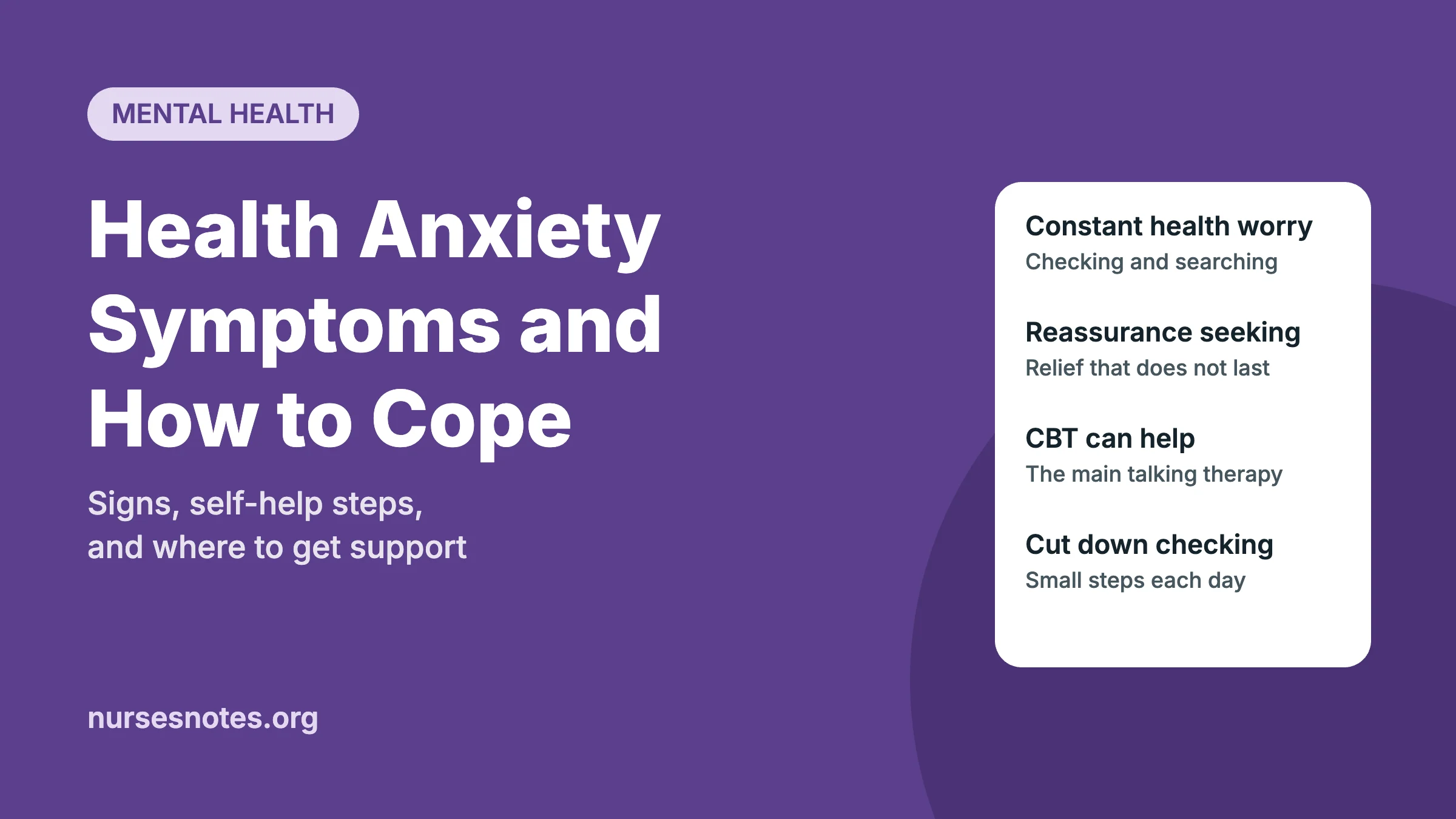
Common health anxiety symptoms include constant worry that you are seriously ill, frequently checking your body, searching symptoms online, and needing reassurance that never seems to last. Health anxiety is common and treatable, and talking therapies such as CBT help many people feel more in control.
Key points
- Health anxiety is when worry about being ill, or becoming ill, starts to take over your life.
- Checking, reassurance seeking, and avoiding health information can all keep the worry going.
- Self-help steps, such as gradually cutting down on checking, can make a real difference.
- If worry is affecting your daily life, a doctor can refer you for talking therapy or discuss medicine.
What is health anxiety?
The NHS describes health anxiety as spending so much time worrying that you are ill, or will become ill, that it starts to take over your life. You may also hear the terms illness anxiety disorder, somatic symptom disorder, or the older word hypochondria.
Health anxiety is closely related to obsessive compulsive disorder (OCD), Mind and the NHS explain. It is a real condition, and people do not bring on their symptoms on purpose.
Common health anxiety symptoms
Thoughts and feelings
- Worrying about your health most of the time
- Jumping to the worst explanation for a normal body sensation, such as a headache or a fast heartbeat
- Fearing that a doctor or test has missed something serious
- Feeling relief after reassurance, but only for a short while
Checking and reassurance seeking
- Checking your body often for lumps, pain, tingling, or other changes
- Searching symptoms online, reading health stories, or asking AI chatbots health questions
- Asking family, friends, or doctors again and again whether you are okay
Avoidance
- Avoiding doctors, tests, or appointments in case you get bad news
- Avoiding TV programmes, news, or conversations about serious illness
- Acting as if you are ill, for example by avoiding exercise or activities you used to enjoy
Anxiety itself can cause physical sensations like a racing heart or headaches. These can then feel like proof of illness, which feeds the worry cycle. This overlaps with general signs of anxiety.
What can trigger health anxiety?
Mind notes that there is no single cause, but some experiences may make health anxiety more likely:
- having a long-term health condition, or a past serious illness or health scare;
- living with another mental health problem, such as anxiety or OCD;
- going through stressful life events or difficult experiences in childhood, such as a bereavement;
- past experiences that make it hard to trust health services.
How to cope with health anxiety
These self-help steps are based on NHS and Mind advice. Change can feel uncomfortable at first, so go gently and give it time.
- Keep a diary. Note how often you check your body, ask for reassurance, or search symptoms. Then aim to cut down a little each day over a week.
- Challenge worried thoughts. Write your worry in one column and a more balanced thought next to it.
- Keep busy when the urge comes. Go for a walk, call a friend, or do a task that takes your attention.
- Limit online searching. If you need health information, use a trusted source such as the NHS website, and avoid relying on AI chatbots for medical advice.
- Return to things you have avoided, such as sport or seeing friends, one small step at a time.
- Try relaxation. Slow breathing can calm the body. Our box breathing technique guide shows you how.
Treatment for health anxiety
A doctor can talk through your worries and help you decide on next steps. MedlinePlus suggests having one regular primary care provider, which can help avoid repeated, unnecessary tests.
- Cognitive behavioural therapy (CBT): the main talking therapy for health anxiety. It helps you notice what makes the worry worse and learn new ways to respond.
- Medicine: antidepressants may help reduce worry if talking therapy alone has not helped enough. Your doctor will explain the options.
- Self-referral (UK): in England, you can refer yourself to an NHS Talking Therapies service without seeing a GP first.
When to get medical help
See a doctor if worry about your health is stopping you from living normally, or if self-help is not working. It is also important to get any new or changing symptoms checked once, properly, rather than avoiding care altogether.
If you ever feel hopeless, overwhelmed, or unable to keep yourself safe, reach out for support straight away using the contacts below.
Where to get help
- Philippines: NCMH Crisis Hotline, 24/7: call 1553 or 0917 899 8727.
- USA: 988 Suicide & Crisis Lifeline, 24/7: call or text 988, or chat at 988lifeline.org.
- UK: Samaritans, free, 24 hours a day: call 116 123.
- Anywhere: if you or someone else is in immediate danger, call your local emergency number.
You do not have to wait for a crisis to ask for help. Talking to a doctor, nurse, or someone you trust is a strong first step.
Frequently asked questions
Can health anxiety cause physical symptoms?
Yes. Anxiety can cause real physical sensations, such as a racing heartbeat, headaches, tense muscles, or stomach upset. With health anxiety, these sensations are easily read as signs of serious illness, which raises worry further. Learning to recognise this cycle, often with help from CBT, can make the sensations feel less frightening.
Is health anxiety the same as hypochondria?
Hypochondria, or hypochondriasis, is an older term for what is now usually called health anxiety or illness anxiety disorder. Some people with mainly physical symptoms may be described as having somatic symptom disorder. Mind notes it is your choice which term, if any, you use. What matters most is getting the right support.
Can health anxiety go away?
Yes, health anxiety can improve a lot with the right support. Talking therapies such as CBT help many people reduce checking and worry, and some people also benefit from medicine. MedlinePlus notes that without treatment it can become long-term, so speaking to a doctor early gives you the best chance of feeling better.
Related on Nurses Notes
- Signs of anxiety and when to get help
- OCD symptoms: what to look for
- Box breathing technique for stress
- More mental health articles
Sources
- Health anxiety — NHS, reviewed 2023.
- Health anxiety — Mind, June 2026.
- Illness anxiety disorder — MedlinePlus, U.S. National Library of Medicine, reviewed 2026.
- 988 Suicide & Crisis Lifeline — 988 Lifeline, accessed November 2026.
- Contact Samaritans — Samaritans, accessed November 2026.
- WHO and Government promote mental health wellness on World Suicide Prevention Day — United Nations Philippines and WHO, 2020.
This article is for education only and does not replace advice from your own doctor, nurse, or other qualified health professional.