On this page
- What is heparin and how does it work?
- Unfractionated heparin vs low molecular weight heparin
- Lab monitoring for heparin
- How to give heparin safely
- Adverse effects and heparin-induced thrombocytopenia
- Contraindications to heparin
- Protamine sulfate: the heparin antidote
- Nursing care plan points
- Exam tips
- Frequently asked questions
Heparin nursing considerations come down to three jobs: give the right dose safely, watch the lab values that tell you whether the dose is working, and catch bleeding or heparin-induced thrombocytopenia (HIT) early. Heparin is a high-risk medicine, so small slips with units, pumps, or monitoring can cause serious harm.
Key points
- Unfractionated heparin (UFH) works mainly by boosting antithrombin, which switches off thrombin and factor Xa.
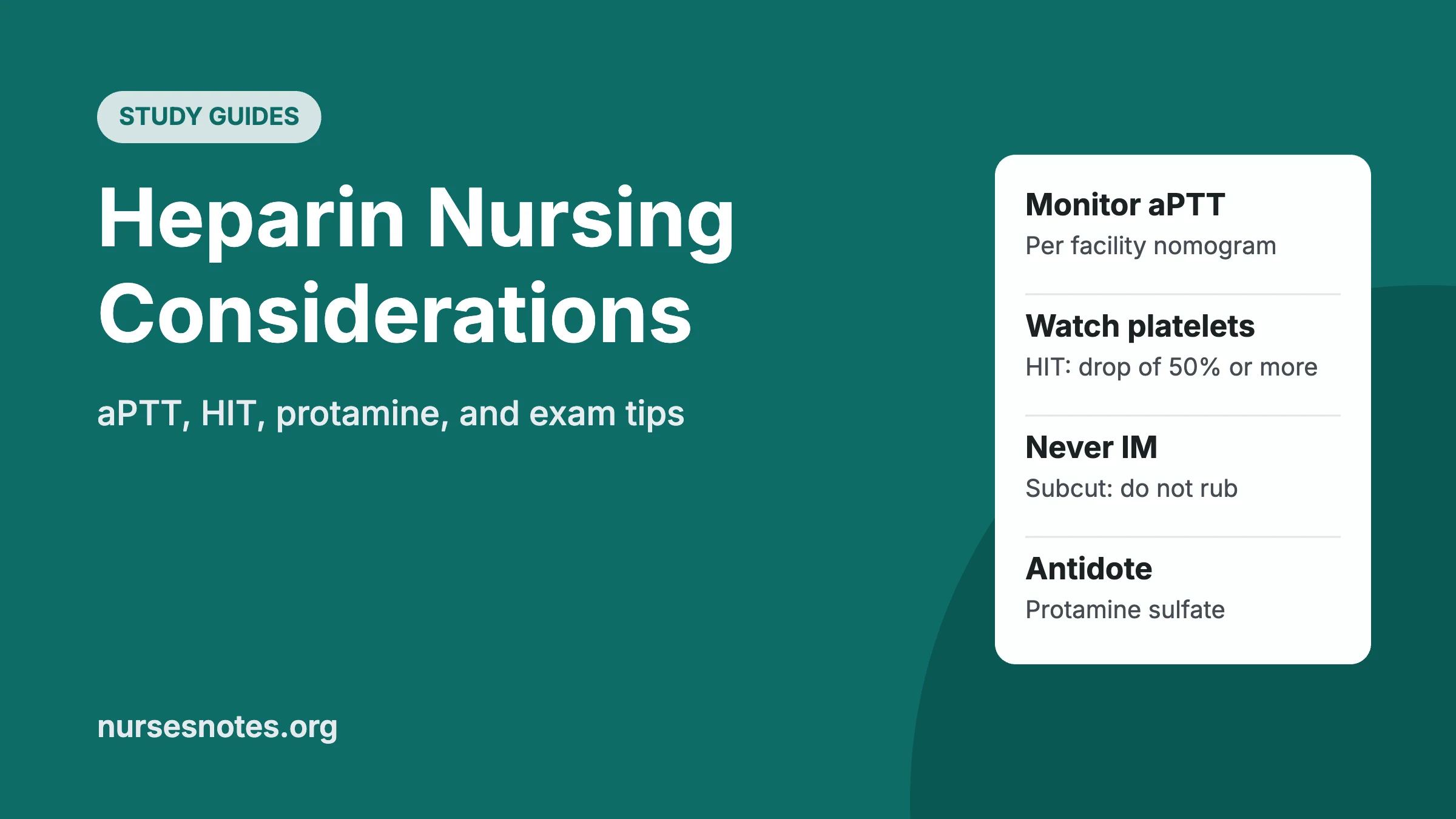
- Full-dose IV heparin is monitored with the aPTT (or an anti-Xa level), checked daily and 4 to 6 hours after any rate change, per local protocol.
- Watch the platelet count: a fall of 50% or more, usually 5 to 10 days after starting, is a red flag for HIT.
- The antidote is protamine sulfate: about 1 mg neutralises 100 units of heparin, given slowly IV.
What is heparin and how does it work?
Heparin is an injectable anticoagulant. It binds to antithrombin and makes it far more active, so thrombin (factor IIa) and factor Xa are inactivated faster. This stops new clots forming and stops existing clots from growing. It does not dissolve a clot that is already there; the body breaks that down over time.
Heparin is used to prevent and treat deep vein thrombosis (DVT) and pulmonary embolism, in acute coronary syndromes, during dialysis and cardiac surgery, and to keep some lines and circuits from clotting. It does not cross the placenta, which is why heparins are often chosen for anticoagulation in pregnancy.
Unfractionated heparin vs low molecular weight heparin
Exam questions often ask you to tell these two apart. The table below summarises the differences most programmes expect you to know.
| Feature | Unfractionated heparin (UFH) | Low molecular weight heparin (LMWH), e.g. enoxaparin |
|---|---|---|
| Main action | Inactivates thrombin and factor Xa | Acts mainly on factor Xa |
| Routes | IV infusion or subcutaneous | Subcutaneous |
| Monitoring | aPTT or anti-Xa level for full-dose therapy | Usually none; anti-Xa in special cases such as severe obesity, kidney impairment, or pregnancy |
| Half-life | Short, so effect wears off within hours of stopping | Longer, allowing once- or twice-daily doses |
| HIT risk | Higher | Lower |
| Reversal | Protamine fully reverses | Protamine only partly reverses |
Lab monitoring for heparin
For full-dose IV heparin, the activated partial thromboplastin time (aPTT) is the usual test. StatPearls describes the therapeutic range as about 1.5 to 2 times the control value, and the UK product information for heparin sodium gives 1.5 to 2.5 times the midpoint of the normal range. Each hospital sets its own target because aPTT reagents differ, so always use your local nomogram.
- aPTT: checked about 4 to 6 hours after starting or changing the infusion, then at least daily once stable.
- Anti-Xa level: some hospitals titrate heparin by anti-Xa instead of aPTT, especially when the aPTT is unreliable.
- Platelet count: get a baseline before the first dose and monitor regularly to detect HIT.
- CBC and signs of bleeding: watch the haemoglobin and look for hidden bleeding.
- Prophylactic (low) doses: routine aPTT monitoring is usually not needed, because low doses barely change the aPTT.
How to give heparin safely
Heparin appears on high-alert medication lists because dosing errors are easy to make. These habits reduce the risk.
- Check the order, the patient’s weight, and the concentration on the label. Heparin comes in many strengths, so read the units per mL every time.
- Use an infusion pump for every IV infusion and do an independent double-check with a second nurse for bolus doses and rate changes, if your policy requires it.
- For subcutaneous doses, inject into the abdomen at least 5 cm (2 inches) away from the navel. Do not aspirate and do not rub the site afterwards, to limit bruising.
- Rotate injection sites and never give heparin intramuscularly, because of the risk of a large haematoma.
- Keep protamine sulfate available, and know where your unit’s anticoagulant reversal protocol is.
Adverse effects and heparin-induced thrombocytopenia
Bleeding is the most common problem, from oozing at injection sites to gastrointestinal or intracranial bleeding. Other effects to remember are hyperkalaemia, osteoporosis with long-term use, injection-site reactions, and allergy, since most heparin comes from pig intestine.
HIT is the complication examiners love. StatPearls separates it into two types:
- Type I: a mild, non-immune drop in platelets in the first couple of days. Platelets usually recover without stopping heparin.
- Type II: an immune reaction in which antibodies form against heparin bound to platelet factor 4. It typically causes a platelet drop of 50% or more 5 to 10 days after starting heparin, and it paradoxically causes clots in veins and arteries.
If HIT is suspected, the prescriber usually calculates a 4Ts score, all heparin is stopped (including flushes and heparin-coated lines), and a non-heparin anticoagulant is started. The UK product information also notes that HIT can appear up to several weeks after heparin is stopped, so ask about recent heparin exposure.
Contraindications to heparin
- Platelet count of 100,000/mm³ or lower, or a history of HIT
- Active bleeding that cannot be controlled (disseminated intravascular coagulation is the exception, under specialist care)
- Situations where the needed blood tests cannot be done
- Known allergy to heparin or pork products
Protamine sulfate: the heparin antidote
Protamine binds heparin and neutralises it. About 1 mg of protamine neutralises roughly 100 units of heparin still in the body, so the dose depends on how much heparin was given and how long ago. It is given slowly IV, because a fast push can cause low blood pressure, slow heart rate, and breathing problems. People with a fish allergy, previous protamine exposure, or protamine-containing insulin are at higher risk of a reaction.
Nursing care plan points
- Nursing diagnosis: risk for bleeding related to anticoagulant therapy.
- Assess: vital signs, gums, urine, stool, skin, and neurological status for signs of bleeding.
- Prevent injury: soft toothbrush, electric razor, fall precautions, and pressure on puncture sites for longer than usual.
- Check interactions: aspirin, NSAIDs, clopidogrel, and thrombolytics raise bleeding risk.
- Teach: report black stools, blood in urine, unusual bruising, nosebleeds, or sudden severe headache straight away.
Exam tips
- Heparin = aPTT, warfarin = INR.
- Antidotes: protamine for heparin, vitamin K for warfarin.
- Platelets falling by half after day 5? Think HIT: stop all heparin and notify the prescriber.
- Trap: heparin prevents clot growth but does not dissolve existing clots.
- Route trap: never IM, and do not rub a subcutaneous site.
Frequently asked questions
What is the normal aPTT for a patient on heparin?
There is no single number. StatPearls gives about 1.5 to 2 times the control value, and many labs translate that into a range of roughly 60 to 80 seconds or similar. Because reagents differ between labs, your hospital’s heparin protocol sets the exact target.
Why is the platelet count checked on heparin?
To catch heparin-induced thrombocytopenia. HIT type II usually shows up as a fall of 50% or more in platelets 5 to 10 days after starting heparin, and it can cause dangerous clots. Early detection lets the team stop heparin and switch to another anticoagulant.
Can you give heparin during pregnancy?
Yes, heparins are commonly used in pregnancy because they do not cross the placenta. Dosing and monitoring in pregnancy are adjusted by the obstetric or haematology team.
Related on Nurses Notes
- Warfarin nursing considerations
- PT, INR, and aPTT normal values
- CBC normal values for nurses
- All nursing study guides
Sources
- Heparin. StatPearls, NCBI Bookshelf.
- Heparin Sodium 5,000 I.U./ml Solution for Injection: Summary of Product Characteristics. Electronic Medicines Compendium (emc).
- Heparin Interpharma Injection: Consumer Medicine Information. Published by MIMS (April 2024).
- Anticoagulation safety education (UFH, LMWH, and warfarin). Johns Hopkins School of Nursing.
This article is for education only and does not replace advice from your own doctor, nurse, or other qualified health professional. Always follow your facility’s policies, protocols, and reference ranges.