
On this page
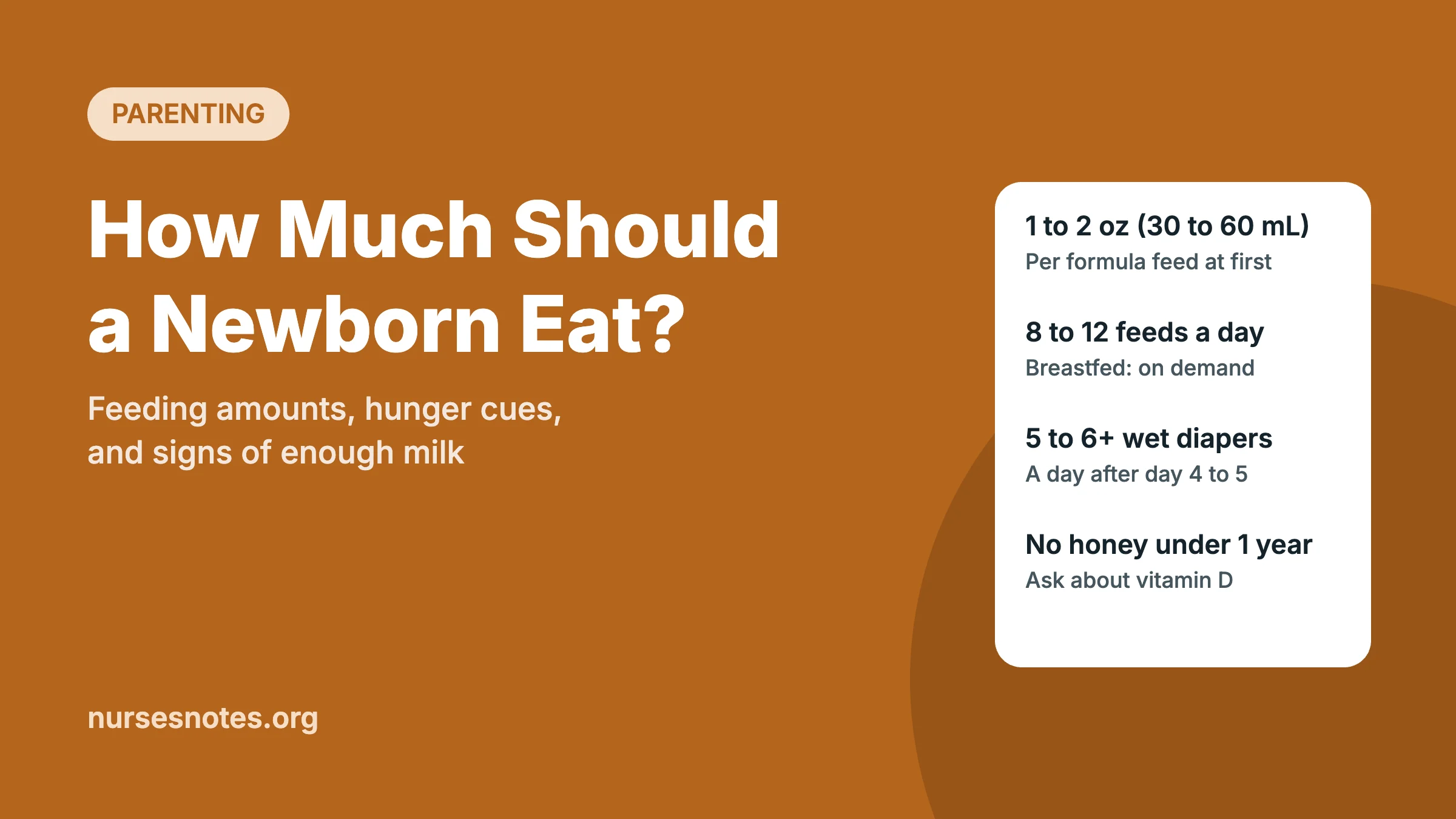
How much should a newborn eat? In the first days, most newborns take about 1 to 2 ounces (30 to 60 mL) of formula per feed, or breastfeed about every 2 hours, adding up to 8 to 12 feeds in 24 hours. Amounts grow quickly, so watch your baby’s hunger cues and wet diapers rather than the clock alone.
Key points
- Breastfed newborns usually feed 10 to 12 times in 24 hours, on demand, day and night.
- Formula-fed newborns often start with 1 to 2 ounces (30 to 60 mL) every 2 to 3 hours, rising to about 3 to 4 ounces per feed by the end of the first month.
- After the first 4 to 5 days, expect at least 5 to 6 wet diapers a day.
- Call your doctor right away if your baby has fewer wet diapers, a dry mouth, or is unusually sleepy.
Newborn feeding schedule at a glance
| Age | Breastfed baby | Formula-fed baby |
|---|---|---|
| First 1 to 2 days | About every 2 hours, on demand | About ½ ounce per feed (AAP), building to 1 to 2 ounces (30 to 60 mL) |
| First weeks | 10 to 12 feeds in 24 hours, about 1 ounce per feed | 1 to 2 ounces every 2 to 3 hours, at least 8 feeds in 24 hours |
| End of month 1 | Still on demand; feeds may space out | At least 3 to 4 ounces per feed, about every 3 to 4 hours |
How often should a breastfed newborn eat?
The American Academy of Pediatrics (AAP) says 10 to 12 breastfeeding sessions in 24 hours is normal for a newborn, or roughly every 2 hours. The WHO recommends feeding on demand, as often as your baby wants, day and night.
WHO and UNICEF advise exclusive breastfeeding for the first 6 months. That means breast milk only, with no other foods or drinks, not even water.
How much formula does a newborn need?
CDC says most formula-fed newborns take 1 to 2 ounces every 2 to 3 hours in the first days, and feed 8 to 12 times in 24 hours. By the end of the first month, AAP says many babies take at least 3 to 4 ounces per feed.
- Prepare formula exactly as the package instructions say, and ask your doctor before adding anything else to the bottle.
- Never put a baby to bed with a bottle (MedlinePlus).
- Pause during feeds. AAP notes babies do not always pull away when full, and overfeeding can cause tummy pain, gas, or spit-up.
Hunger cues to watch for
Feed your baby when you see early hunger signs. Crying is a late sign, and a very upset baby can find it harder to latch or settle.
- Licking lips or sticking out the tongue
- Rooting (turning the head and opening the mouth toward the breast or your hand)
- Putting hands to the mouth or sucking on fingers or other things
- Fussing or squirming
Should you wake a newborn to feed?
Yes, in the early weeks it is fine to wake your baby to feed. MedlinePlus advises that newborns should not go more than about 4 hours at night without a feed (4 to 5 hours for formula-fed babies). CDC suggests gently waking a baby by patting, stroking, undressing, or changing the diaper.
If your baby looks yellow, tell your doctor promptly. Read more in our guide to newborn jaundice.
Signs your baby is getting enough milk
- Wet diapers: 2 to 3 a day in the first few days, then at least 5 to 6 a day after day 4 to 5 (AAP). MedlinePlus says at least 6 wet diapers once your milk comes in.
- Dirty diapers: AAP says breastfed babies often have at least 4 stools a day by day 4; MedlinePlus says 3 or more a day once milk is in.
- Weight: babies lose a little weight after birth, then start gaining again about 4 to 5 days after birth (MedlinePlus). Your doctor will track growth at check-ups.
Feeding safety reminders
- Never give honey to a baby under 12 months, because of the risk of infant botulism.
- Do not give cow’s milk as a drink before age 1.
- Wait until around 6 months before starting other foods, as WHO recommends.
- Ask your doctor or pharmacist about vitamin D drops. CDC says breastfed babies, and babies taking less than about 32 ounces of formula a day, need vitamin D from shortly after birth. The amount depends on the product, so follow the label or your doctor’s advice.
When to get medical help
Call your baby’s doctor right away if you notice signs of dehydration (AAP):
- fewer than 6 wet diapers a day after the first few days;
- a dry, parched mouth or fewer tears when crying;
- a sunken soft spot on the top of the head;
- your baby is feeding poorly, playing less than usual, or not gaining weight.
Go to emergency care or call your local emergency number if your baby is excessively sleepy or hard to wake, very fussy and cannot be settled, has sunken eyes, cool or discoloured hands and feet, wets a diaper only once or twice a day, has a seizure, or becomes unresponsive.
For safe sleep after night feeds, see our safe sleep guide for babies.
Frequently asked questions
How many ounces should a 1-week-old drink?
In the first week, many formula-fed babies take about 1 to 2 ounces (30 to 60 mL) per feed, every 2 to 3 hours. Breastfed babies take roughly 1 ounce per feed but feed more often, about 10 to 12 times a day. Your baby may want a little more or less, so follow hunger and fullness cues and check wet diapers.
Can I overfeed a newborn?
Yes, it can happen, especially with bottle feeding, because milk flows easily and babies may keep sucking even when full. AAP notes overfeeding can cause tummy pain, gas, and spit-up. Feed slowly and take short breaks during the feed. If you are unsure about amounts, ask your doctor or nurse.
Does a newborn need water?
No. WHO and UNICEF recommend breast milk only for the first 6 months, with no water, because breast milk already gives babies all the fluid they need. Correctly prepared formula also provides enough fluid. Giving extra water can fill a small tummy and reduce milk intake, so ask your doctor before offering it.
Related on Nurses Notes
- Newborn jaundice: signs and when to worry
- Safe sleep for babies
- Colic in babies: causes and soothing tips
- More parenting guides
Sources
- How Often and How Much Should Your Baby Eat? — Jain S, Bunik M. American Academy of Pediatrics (HealthyChildren.org), 2024.
- How Much and How Often to Feed Infant Formula — Centers for Disease Control and Prevention (CDC), updated 2026.
- Feeding patterns and diet – babies and infants — MedlinePlus, U.S. National Library of Medicine, reviewed 2025.
- Breastfeeding — World Health Organization (WHO), accessed 2026.
- Signs of Dehydration in Infants & Children — American Academy of Pediatrics (HealthyChildren.org), 2019.
- Dehydration — MedlinePlus, U.S. National Library of Medicine, reviewed 2025.
This article is for education only and does not replace advice from your own doctor, nurse, or other qualified health professional.