On this page
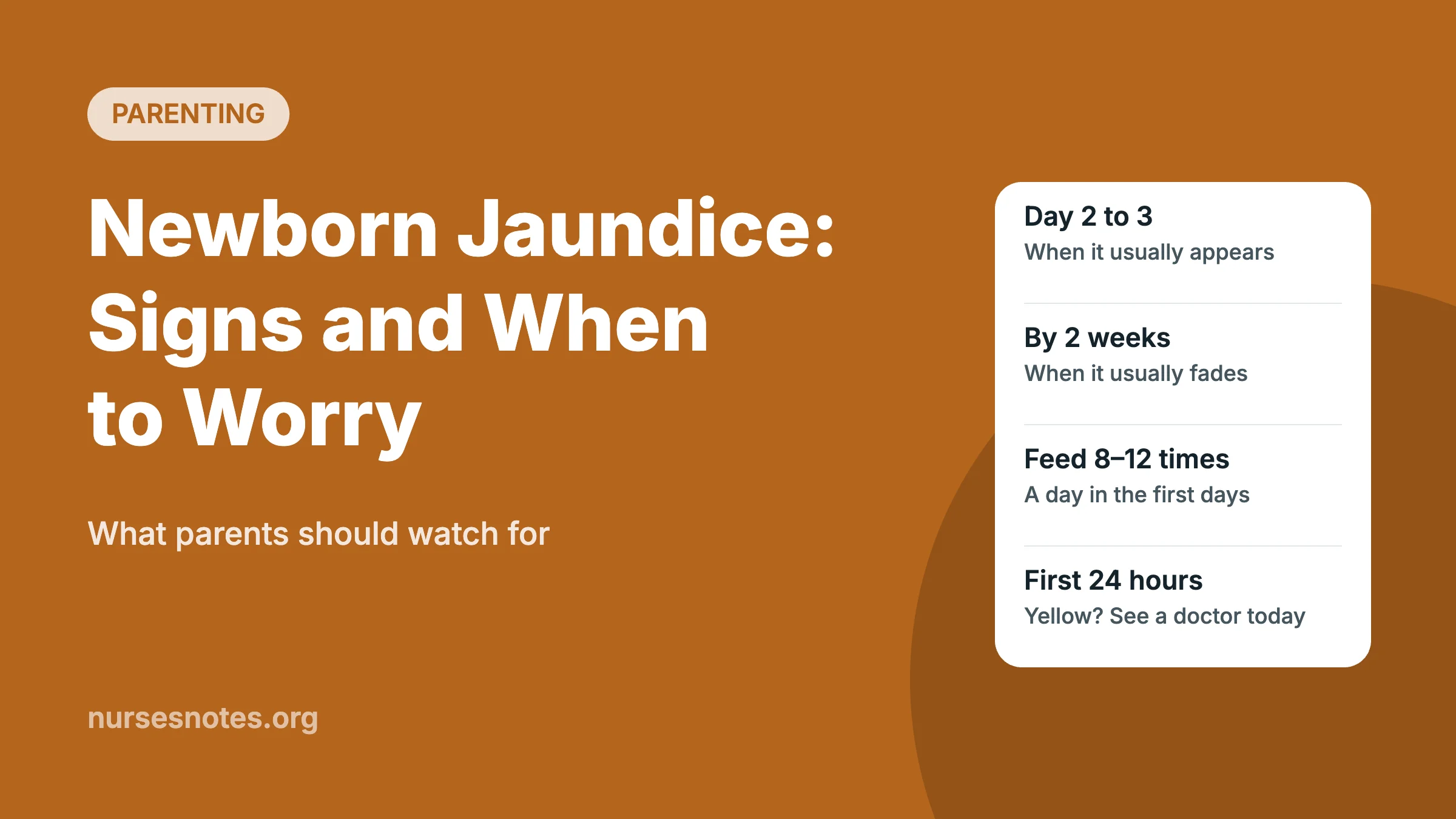
Newborn jaundice is yellowing of a baby’s skin and the whites of the eyes, caused by a build-up of bilirubin while the baby’s liver is still maturing. It is very common, usually appears 2 to 3 days after birth and fades by about 2 weeks, but some babies need treatment, so it is important to know the warning signs.
Key points
- Jaundice in the first 24 hours of life, or yellowing that is getting worse quickly, needs a doctor or midwife the same day.
- A baby who is very sleepy, hard to wake, feeding poorly or has a high-pitched cry needs urgent medical care.
- Pale or chalky poo and still being yellow at 2 weeks should always be checked.
- Frequent feeding (8 to 12 times a day for breastfed babies) helps prevent jaundice.
What is newborn jaundice?
Bilirubin is a yellow substance made when red blood cells break down. Before birth, the mother’s liver clears it. After birth, a baby’s liver may take a few days to catch up, so bilirubin builds up and the skin turns yellow.
Mayo Clinic notes that it is especially common in premature babies and in some breastfed babies. Most babies born at 35 weeks or later do not need treatment.
Signs and symptoms
- Yellow skin, often seen first on the face and head, then spreading to the chest, tummy, arms and legs
- Yellow whites of the eyes
- Yellow colour inside the mouth, or on the palms and soles
- Dark yellow urine and pale poo
- Sleepiness or less interest in feeding
How to check your baby for jaundice at home
- Look at your baby in good light, ideally natural daylight.
- Gently press on the tip of the nose or the forehead. If the skin looks yellow as you release, your baby may have jaundice.
- On brown or black skin, yellowing is harder to see. NHS advice is to check the whites of the eyes, gums, inside of the mouth, palms and soles.
- Check nappies for dark urine and pale or chalky poo.
- Keep track of feeds and wet nappies, and mention anything unusual to your midwife or doctor.
Common timeline
| Baby | When jaundice usually appears | When it usually fades |
|---|---|---|
| Born at full term | About day 2 to 3 | By about 2 weeks |
| Premature | About day 5 to 7 | Around 3 weeks |
| Exclusively breastfed | Day 2 to 3 | Can last longer, sometimes a few months; breastfeeding can continue |
Babies at higher risk
- Born early (premature)
- Significant bruising from birth
- Mother and baby with different blood types
- Difficulty breastfeeding or not getting enough milk
- Family history of blood conditions such as G6PD deficiency, or a sibling who needed treatment for jaundice
How newborn jaundice is treated
Most babies need no treatment, and the yellowing clears within 10 to 14 days. A health worker may measure the bilirubin level. If it is high, the baby may need:
- Phototherapy: the baby lies under a special light with their eyes covered. The light helps break down bilirubin so the body can remove it.
- Exchange transfusion: rarely, for very high levels or when phototherapy has not worked, some of the baby’s blood is replaced with donor blood.
The American Academy of Pediatrics (AAP) updated its guidance on newborn jaundice in 2022, including follow-up after the baby goes home. Keep every check-up your doctor or midwife arranges, even if your baby seems well.
How to help at home
- Feed often. Mayo Clinic advises 8 to 12 breastfeeds a day in the first days. Good feeding helps your baby pass bilirubin in their poo.
- Watch the colour each day in good light and note whether it is spreading or fading.
- Ask for feeding support early if latching is difficult or you are worried your baby is not getting enough.
When to get medical help
Contact your doctor, midwife or health centre the same day if:
- Jaundice appears in the first 24 hours after birth
- The yellow colour is spreading or getting deeper, or reaches the tummy, arms or legs
- Your baby has pale, chalky poo (keep a nappy to show the doctor) or dark urine
- Your baby is still yellow at 2 weeks (3 weeks if born early)
- Your baby is not feeding well or has fewer wet nappies
Go to the emergency department or call your local emergency number now if your baby:
- Is very sleepy, floppy or hard to wake
- Will not feed or has a weak, high-pitched cry
- Arches their neck or body backwards
- Has a fit (seizure)
- Has a temperature of 38°C or above, or below 36°C
- Looks pale, blue or mottled, or is struggling to breathe
These can be signs of very high bilirubin affecting the brain or of another serious illness. Untreated, very high bilirubin can rarely cause permanent brain damage (kernicterus), which is why quick treatment matters. For more on high temperatures in children, see how to bring down a child’s fever safely.
Frequently asked questions
Is newborn jaundice normal?
Yes, mild jaundice is very common in the first week and usually goes away by itself within about 2 weeks. It is still important to have it checked by a midwife, nurse or doctor, because the only way to know the bilirubin level is to measure it, and some babies need phototherapy to keep the level safe.
Should I stop breastfeeding if my baby has jaundice?
Usually not. NHS advice says breastfeeding can continue, and frequent feeds help your baby clear bilirubin. Breastfed babies can stay slightly yellow for longer. If your doctor finds a reason to change feeding, they will explain what to do. Ask for breastfeeding support if your baby is not latching or feeding well.
When is newborn jaundice dangerous?
It is more concerning when it starts within 24 hours of birth, rises quickly, lasts beyond 2 weeks, or comes with pale poo, poor feeding, unusual sleepiness, a high-pitched cry or arching of the back. These need prompt medical review, and the last few need emergency care, because very high bilirubin can harm the brain.
Related on Nurses Notes
Sources
- Infant jaundice: symptoms and causes – Mayo Clinic (September 2025)
- Jaundice – newborn – NHS 111 Wales (updated October 2025)
- Jaundice in babies – NHS Healthier Together
- Hyperbilirubinemia (newborn jaundice) – American Academy of Pediatrics (updated 2026)
This article is for education only and does not replace advice from your own doctor, nurse or other qualified health professional.