On this page
To clean a wound, wash your hands, stop any bleeding with gentle pressure, rinse the wound under clean running water, and wash the skin around it with soap. Then apply a thin layer of petroleum jelly or antibiotic ointment, cover it with a clean dressing, and watch for signs of infection.
Key points
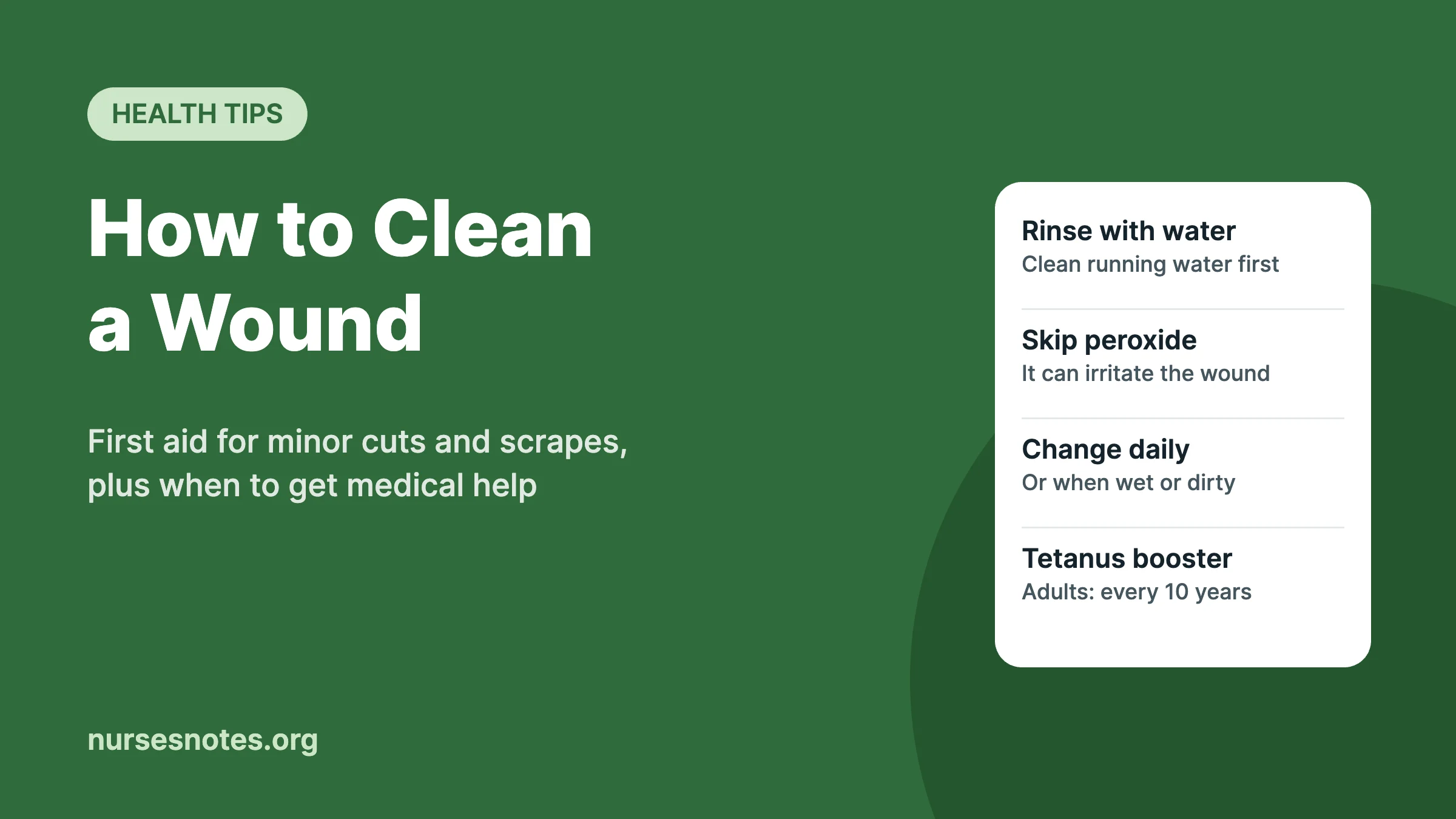
- Rinse with clean water, and keep soap around the wound rather than inside it.
- Mayo Clinic advises against using hydrogen peroxide or iodine, because they can irritate wounds.
- Change the dressing at least once a day, or sooner if it gets wet or dirty.
- Get urgent help for bleeding that will not stop, deep or gaping cuts, bites, objects stuck in the wound, or numbness.
What you need
- Clean running water (tap or bottled)
- Mild soap
- A clean cloth or sterile gauze
- Tweezers cleaned with rubbing alcohol, for small bits of dirt
- Petroleum jelly or antibiotic ointment
- An adhesive bandage (plaster) or a sterile dressing
- Disposable gloves, if you have them and are helping someone else
How to clean a wound step by step
- Wash your hands with soap and water, and dry them. Wear gloves if you are caring for someone else and have them.
- Stop the bleeding. Most minor cuts stop on their own. If not, press gently but firmly with a clean cloth or bandage, and raise the injured part, for example a hand above the head or a leg above heart level. If blood soaks through, add another pad on top instead of removing the first one.
- Rinse the wound under clean running water to wash away dirt. For a small puncture wound, MedlinePlus suggests rinsing for 5 minutes under running water.
- Wash around it. Clean the skin around the wound with soap and water, wiping away from the wound, and try to keep soap out of the wound itself.
- Remove small debris. Lift out small bits of dirt or grit with tweezers cleaned with alcohol. Do not dig or poke into the wound. If you cannot remove it all, see a health professional.
- Pat dry and protect. Pat the area dry with clean gauze, then apply a thin layer of petroleum jelly or antibiotic ointment to keep the surface moist. Stop using an ointment if a rash appears.
- Cover it with an adhesive bandage, a sterile dressing, or gauze held with paper tape. Mayo Clinic notes that a minor scrape or scratch can be left uncovered.
- Change the dressing at least once a day, or whenever it gets wet or dirty. Once the wound has closed, usually after a few days, you can stop covering it.
What not to do
- Do not pour hydrogen peroxide or iodine on the wound, as Mayo Clinic says they can irritate it.
- Do not pull out an object that is stuck deep in the wound, such as glass or a nail. The NHS advises pressing firmly on either side of it instead and getting medical help.
- Do not assume a wound is clean just because you cannot see dirt.
- Do not breathe on an open wound, or pick or push at debris.
- Do not try to clean a large, deep wound yourself; control the bleeding and get medical help.
Does the cut need stitches?
Some cuts need to be closed with stitches, staples, adhesive strips, or skin glue. MedlinePlus advises contacting a health professional right away if a cut is more than a quarter inch (about 0.64 cm) deep, is on the face, or reaches the bone, because stitches may be needed.
The NHS recommends urgent medical advice for a cut longer than about 5 cm (2 inches), and emergency care for a bad cut on the face or the palm of the hand.
Tetanus: do you need a booster?
The CDC notes that the risk of tetanus is higher with recent wounds, especially deep wounds or wounds contaminated with dirt. It recommends a tetanus booster for adults every 10 years.
For a deep or dirty wound, Mayo Clinic says a tetanus shot is needed if you have not had one in the past five years. If you are unsure of your vaccine history, ask your doctor, nurse, or local health center.
Signs of an infected wound
- Redness or a color change that is spreading
- Increasing pain, throbbing, warmth, or swelling
- Pus or cloudy drainage
- A red streak spreading from the wound
- Fever or feeling generally unwell
MedlinePlus explains that infection is more likely with bites, punctures, crush injuries, dirty wounds, wounds on the feet, and wounds that are not treated promptly. If you notice these signs, see a doctor.
When to get medical help
Call your local emergency number or go to the emergency department if:
- The bleeding is severe or will not stop, for example after 10 minutes of firm pressure
- Blood is bright red, spurting, and hard to control
- There is numbness, loss of feeling, or trouble moving the injured part
- The wound is very large or deep, or something is stuck in it
- There is a bad cut on the face or the palm of the hand
See a doctor or clinic the same day if:
- The wound was caused by a human or animal bite (see what to do after a dog bite)
- It is a puncture wound, for example from stepping on a nail, or it was caused by a fishhook or rusty object
- There is soil, pus, or body fluid in it, or it is still dirty after cleaning
- It may need stitches, or you are not up to date with your tetanus vaccine
- It shows signs of infection
If the injury is serious, do not drive yourself; ask someone to take you or call for help.
Frequently asked questions
Should I use alcohol or hydrogen peroxide to clean a wound?
Mayo Clinic advises against putting hydrogen peroxide or iodine on a wound, because they can irritate it. For most minor cuts and scrapes, clean running water in the wound and mild soap on the skin around it are enough. Rubbing alcohol is useful for cleaning tweezers before you remove small bits of dirt.
Is it better to cover a wound or let it air out?
Most cuts do well when cleaned and covered with a clean dressing that keeps out dirt. Mayo Clinic says a thin layer of petroleum jelly or antibiotic ointment keeps the surface moist and helps prevent scarring. A minor scrape or scratch can usually be left uncovered. Change dressings daily or whenever they get wet or dirty.
How long should I apply pressure to a bleeding cut?
Press firmly and steadily on the cut with a clean cloth or bandage, and raise the injured part if you can. If blood soaks through, add more padding on top. MedlinePlus advises calling your local emergency number if bleeding is severe or cannot be stopped, for example after 10 minutes of pressure.
Related on Nurses Notes
- How to treat a burn at home
- What to do after a dog bite
- How to stop a nosebleed
- More Health Tips for everyday health
Sources
- Cuts and scrapes: First aid. Mayo Clinic, 2024.
- Cuts and grazes. NHS, reviewed 2026.
- Cuts and puncture wounds. MedlinePlus Medical Encyclopedia, US National Library of Medicine, reviewed 2025.
- About Tetanus. Centers for Disease Control and Prevention (CDC), 2026.
- Tetanus Vaccination. Centers for Disease Control and Prevention (CDC), 2026.
This article is for education only and does not replace advice from your own doctor, nurse, or other qualified health professional.