On this page
Imposter syndrome in nurses is that nagging feeling that you’re not as capable as people think, and that one day someone will “find you out”, even though you passed your boards and do the job well every shift. It isn’t a mental illness. It is common in nursing, though, and it’s linked with anxiety, burnout, and emotional exhaustion. Once you can name it, it’s much easier to talk about and to ease.
Key points
- Imposter syndrome means doubting your own competence even when there’s clear evidence that you’re capable.
- A major review found it in 9% to 82% of the people studied, depending on the scale used, and it affected men and women at every stage of their careers.
- In nursing it often shows up at points of change: new graduates, nurses moving abroad, and nurses stepping into specialist or leadership roles.
- Talking about it, keeping track of real evidence of your skills, and good mentorship all help. Get professional support if it comes with low mood, panic, or burnout.
What is imposter syndrome?
Psychologists Pauline Clance and Suzanne Imes first described it in 1978, calling it the “impostor phenomenon”. People who experience it find it hard to accept their success as their own. They tend to put it down to luck, timing, or other people, and they live with a fear of being exposed as a fraud.
It isn’t an official diagnosis. A 2020 systematic review in the Journal of General Internal Medicine, which brought together 62 studies, found that imposter feelings were common in both men and women, from teenagers to people late in their careers. They were often linked with depression, anxiety, lower job satisfaction, and burnout.
Why nurses are prone to imposter feelings
Nursing combines high stakes with learning that never stops. You make decisions that affect patient safety, new protocols and technologies keep arriving, and mistakes are visible. Researchers studying nurses in China suggested that this mix of constant competency development and pressure to perform without error may explain why imposter feelings are common in the profession. Estimates in nursing groups range from about 36% to 75%.
Studies point to a few moments when the feelings are strongest. New graduates and newly licensed nurses feel it as they move from student to accountable practitioner. Nurses in specialist or advanced roles feel it too: a 2024 study of 79 specialist nurses in an NHS trust in England found high levels of imposter feelings, often around career transitions.
Internationally educated nurses, adapting to a new health system, a new language, and a different style of documentation, are another group. A 2025 study of 255 nursing leaders at a hospital in Saudi Arabia found moderate to intense imposter feelings were more frequent among non-Saudi nurses (58.7%) than Saudi nurses (46.2%).
Signs of imposter syndrome at work
- You brush off praise and assume your preceptor or manager is “just being nice”.
- You over-prepare, or re-check tasks far more than you need to, and end up exhausted.
- You avoid asking questions in case it shows you “don’t know enough”.
- You hold back from applying for training, promotions, or jobs abroad, even when you meet the requirements.
- One mistake feels like proof that you don’t belong, while lots of good shifts feel like luck.
How to cope with imposter syndrome
A 2024 scoping review found that research on treatments is still limited, but that approaches such as group discussion, coaching, and cognitive behavioural techniques look promising. These everyday steps build on those ideas:
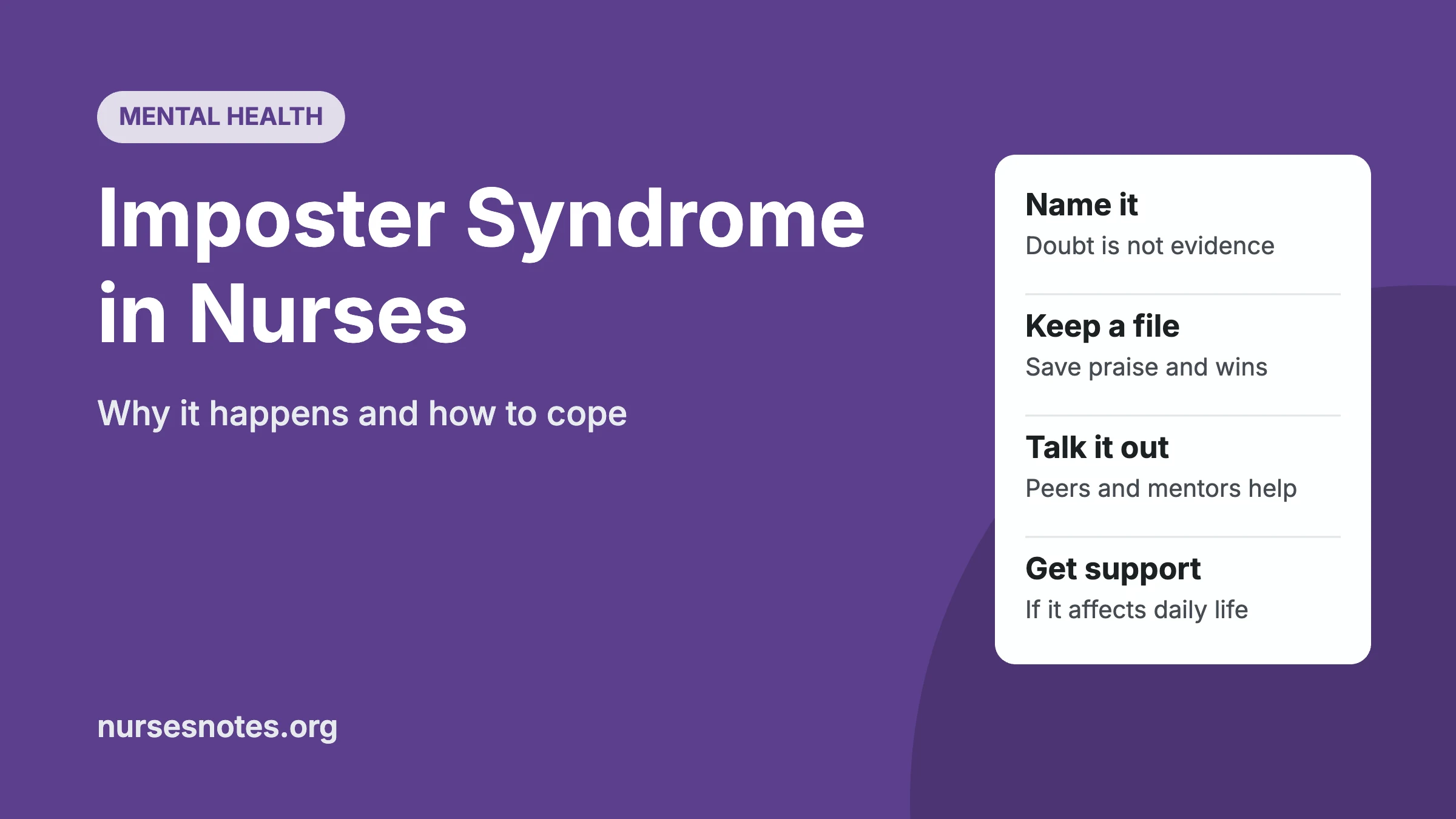
- Name it. Just recognising “this is imposter thinking” can take away some of its power.
- Keep an evidence file. Save thank-you notes, good evaluations, certificates, and the moments you made a difference, and read it when the doubt gets loud.
- Talk to colleagues. You’ll often find that seniors you respect felt the same at your stage, and peer support and debriefs make the feeling less lonely.
- Separate learning from failing. Asking questions is part of safe practice, and patient safety depends on it.
- Find a mentor or preceptor. Regular, specific feedback helps you see your progress as it really is.
- Set realistic standards. Aim for safe, competent care, not perfection in every task.
- Look after the basics. Sleep, breaks, and time off after long runs of shifts make self-doubt easier to handle.
When to get help
Imposter feelings can overlap with anxiety, depression, and burnout. Talk to a doctor, a counsellor, or your employer’s staff support service if self-doubt is affecting your sleep, appetite, or work, if you feel hopeless or constantly on edge, or if you’re thinking of leaving nursing because of how you feel.
- Philippines: National Center for Mental Health crisis hotline 1553 (landline and mobile, nationwide).
- United States: call or text 988 for the 988 Suicide & Crisis Lifeline.
- United Kingdom and Ireland: Samaritans on 116 123.
- Anywhere: if you’re in immediate danger, call your local emergency number or go to the nearest hospital.
Frequently asked questions
Is imposter syndrome a mental illness?
No. It isn’t listed as a diagnosis; it describes a pattern of thoughts and feelings. Researchers have found that it often happens alongside depression and anxiety, though, which are treatable conditions, so symptoms that don’t go away deserve attention.
Is imposter syndrome common in new nurses?
Yes. Imposter feelings tend to be strongest at career transitions, like starting your first job or moving to a new country or specialty. Most nurses find they ease with experience, mentorship, and support.
Can imposter syndrome lead to burnout?
It can contribute to it. A 2020 systematic review linked imposter syndrome with burnout and lower job satisfaction, and a 2025 study of nearly 4,000 nurses in China linked imposter feelings with emotional exhaustion.
Related on Nurses Notes
- Signs of nurse burnout
- Compassion fatigue in nurses
- How to cope with exam anxiety
- More mental health articles
Sources
- Prevalence, predictors, and treatment of impostor syndrome: a systematic review. Bravata DM, et al. Journal of General Internal Medicine (2020).
- Interventions addressing the impostor phenomenon: a scoping review. Para E, et al. Frontiers in Psychology (2024).
- The relationship between impostor phenomenon and emotional exhaustion among Chinese nurses. Li Y, et al. Frontiers in Public Health (2025).
- Cross-sectional study of impostor phenomenon and innovative work behaviour among 255 nursing leaders in Saudi Arabia. BMC Nursing (2025).
- Unmasking impostor phenomenon: a study of nurses in specialist roles. Ord T, et al. British Journal of Nursing (2024).
- DOH: Mental health programs, crisis hotlines available this Undas. Philippine Information Agency (28 October 2025).
- 988 Suicide & Crisis Lifeline. 988 Lifeline (accessed November 2026).
- Samaritans. Samaritans (accessed November 2026).
This article is for education only and doesn’t replace advice from your own doctor, nurse, or other qualified health professional.