On this page
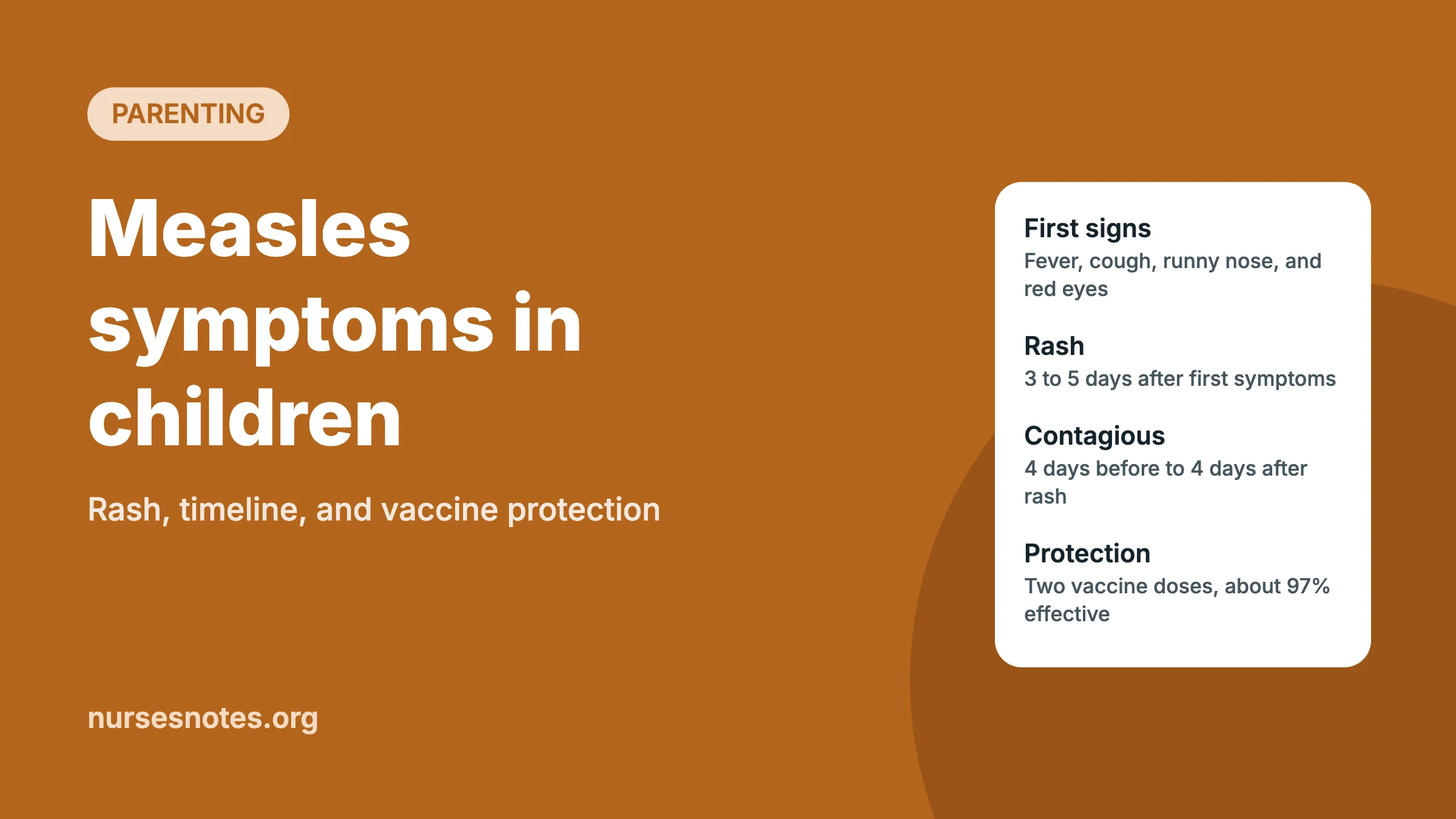
Measles symptoms in children usually start with a high fever, cough, runny nose, and red, watery eyes, followed 3 to 5 days later by a red, blotchy rash that begins on the face and spreads down the body. Measles is highly contagious and can be serious for young children, so call your doctor before visiting if you think your child has it.
Key points
- Symptoms appear 7 to 14 days after exposure, and the rash follows 3 to 5 days after the first symptoms.
- A child is contagious from about 4 days before to 4 days after the rash appears.
- Complications include ear infections, pneumonia, severe diarrhea, and brain swelling.
- Two doses of measles vaccine give strong, long-lasting protection.
What is measles?
Measles is a viral infection that spreads through the air when an infected person breathes, coughs, or sneezes. The virus can stay active in the air or on surfaces for up to two hours, so a child can catch it in a room the sick person has already left.
It is one of the most contagious diseases known. The CDC says up to 9 out of 10 unprotected people who are close to someone with measles will catch it. WHO estimates that about 95,000 people died from measles in 2024, most of them children under 5.
Measles symptoms timeline
| When | What you may notice |
|---|---|
| 7 to 14 days after exposure | First symptoms: high fever, cough, runny nose, sneezing, and red, watery eyes |
| 2 to 3 days after symptoms start | Tiny white spots inside the cheeks (Koplik spots) |
| 3 to 5 days after symptoms start | Flat red spots begin at the hairline and face, then spread to the neck, body, arms, legs, and feet |
| Rash lasts about 4 to 8 days | The rash fades, and the child usually starts to feel better within about a week |
Signs and symptoms of measles
- High fever, which can go above 40°C (104°F).
- Cough, runny nose, and sneezing.
- Red, sore, watery eyes.
- Small white spots inside the mouth on the cheeks.
- A red or brown blotchy rash that starts on the face and behind the ears, then spreads.
Early measles can look like a cold or flu. Unlike chickenpox, the measles rash is flat and blotchy rather than made of itchy blisters.
Who is most at risk of complications?
Most children start to get better within about a week, but measles can be dangerous. Children under 5, children who are malnourished (especially those low in vitamin A), pregnant women, and people with weak immune systems face the highest risk. Possible complications include:
- Ear infections, which affect about 1 in 10 children with measles.
- Pneumonia, which affects as many as 1 in 20 children. Read about pneumonia in children.
- Severe diarrhea and dehydration.
- Encephalitis (brain swelling), in about 1 in 1,000 children.
- Blindness, especially in children low in vitamin A.
How to care for a child with measles
- Call first. Phone your doctor or health centre before you go, so staff can protect other patients.
- Rest and fluids. Offer water, breast milk, or other fluids often to prevent dehydration.
- Fever and comfort. Ask your doctor or pharmacist which fever medicine is suitable. Doses depend on the child’s weight and the product, so follow the label or their advice. See how to bring down a child’s fever.
- Vitamin A. WHO recommends vitamin A for children with measles because it can lower the risk of complications and death. Your doctor will decide whether your child needs it and give the right amount.
- Stay home. Keep your child away from school, daycare, and other people for at least 4 days after the rash appears.
There is no specific medicine that cures measles. Antibiotics are only used if a bacterial complication, such as pneumonia or an ear infection, develops.
When to get medical help
Contact your doctor straight away if your child has measles symptoms, has been near someone with measles, is under 1 year old and was exposed, or is not feeding well or is passing less urine. Go to the nearest emergency department or call your local emergency number if your child:
- Has difficulty breathing or is breathing very fast.
- Has a seizure (fit).
- Is very drowsy, hard to wake, limp, or unresponsive.
- Has a stiff neck, finds light painful, or seems suddenly confused.
- Has a rash that does not fade when you press a glass against it.
How to prevent measles
- Vaccinate on time. Two doses are needed. WHO notes that where measles is common, the first dose is usually given at 9 months and the second at 15 to 18 months. Follow your country’s schedule, such as the DOH schedule in the Philippines.
- Know how well it works. The CDC reports that two doses of MMR vaccine are about 97% effective, and one dose about 93% effective.
- Catch up. Older children and adults who missed doses can still be vaccinated; ask your health centre.
- Act fast after exposure. Call your doctor if an unvaccinated child has been near someone with measles, as early action may help.
Frequently asked questions
What does the measles rash look like?
The rash starts as flat red or brown spots at the hairline, on the face, and behind the ears. Over a few days it spreads down to the neck, body, arms, and legs, and the spots may join into blotches. It usually appears 3 to 5 days after the fever and cough begin and lasts about a week.
How long is a child with measles contagious?
A child can spread measles from about 4 days before the rash appears until 4 days after it starts. This means they can infect others before anyone knows it is measles. Keep your child home from school or daycare for at least 4 days after the rash appears, and tell anyone they were near.
Can a vaccinated child still get measles?
It is possible but uncommon. Two doses of measles vaccine are about 97% effective, so a small number of vaccinated people can still catch it. When this happens, the illness is usually milder and less likely to spread. Making sure your child gets both doses on time gives the best protection.
Related on Nurses Notes
- Pneumonia in children: symptoms, danger signs, and care
- Chickenpox in children: symptoms and home care
- Ear infection in children: signs and treatment
- How to bring down a child’s fever safely
- All Parenting articles on Nurses Notes
Sources
- Measles. World Health Organization fact sheet, 15 July 2026.
- Measles Symptoms and Complications. Centers for Disease Control and Prevention (CDC), updated 5 August 2026.
- About Measles. Centers for Disease Control and Prevention (CDC), updated 29 April 2026.
- Measles. NHS, page last reviewed 31 July 2025.
This article is for education only and does not replace advice from your own doctor, nurse, or other qualified health professional.