On this page
A nursing care plan for pneumonia focuses on keeping the airway clear, supporting oxygenation, treating infection on time, and watching closely for deterioration. This study guide walks through assessment, severity scoring, priority nursing diagnoses, interventions, and the exam traps that come up most in NCLEX and Philippine board questions.
Key points
- Pneumonia is a lung infection caused by bacteria, viruses, fungi, or parasites, and it is grouped by where it was caught: community, healthcare, or ventilator.
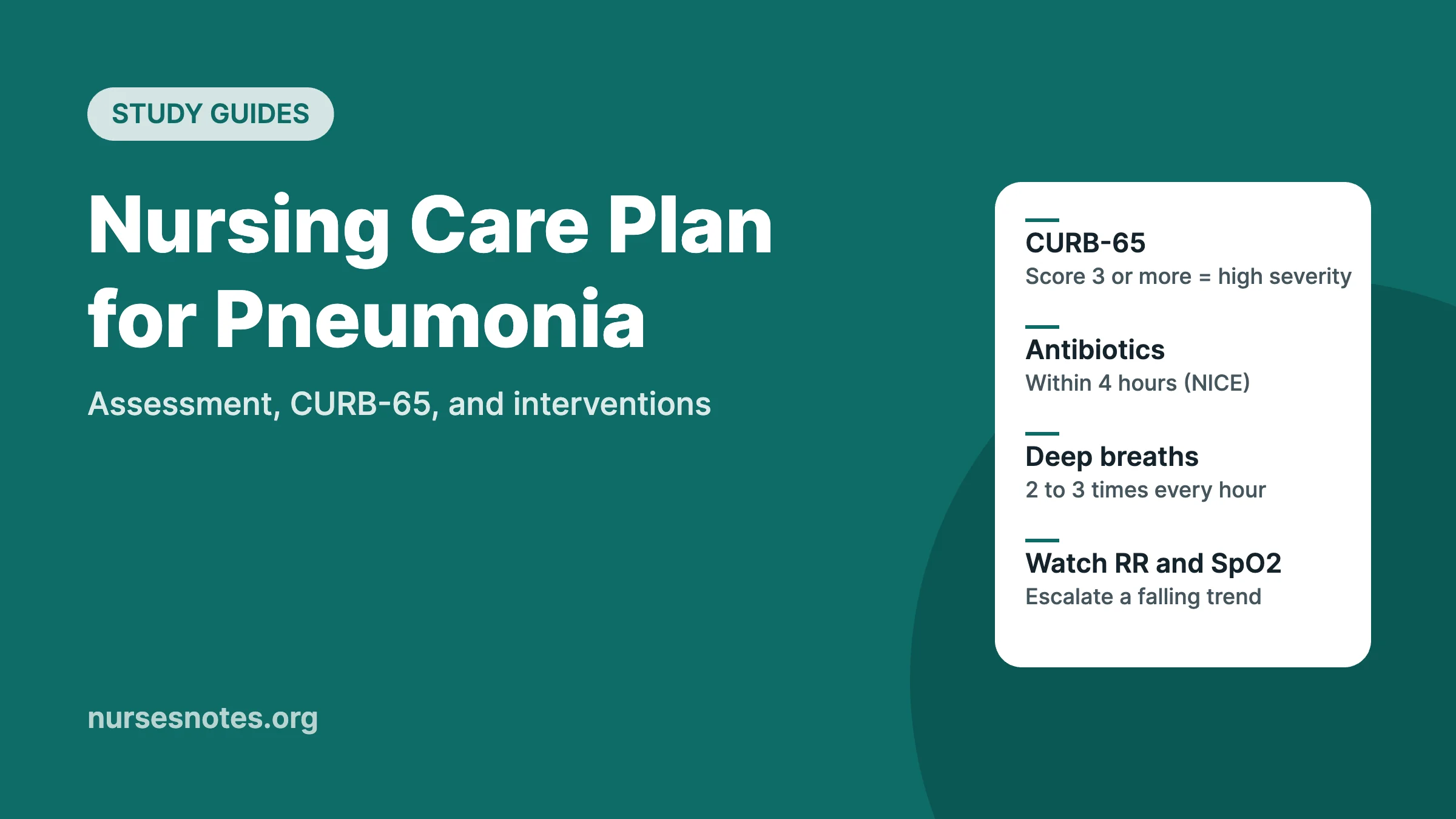
- CURB-65 (hospital) and CRB-65 (community) help estimate severity, but clinical judgement always overrides the score.
- NICE advises starting antibiotics as soon as pneumonia is diagnosed and within 4 hours of hospital presentation.
- Core nursing work: monitor respiratory rate, SpO2, temperature, heart rate, blood pressure, and mental status, and support deep breathing, coughing, fluids, and rest.
What is pneumonia?
Pneumonia is an infection of the lungs that causes inflammation. The CDC lists bacteria, viruses, fungi, and parasites as possible causes, and sometimes no cause is found. It can follow flu, RSV, or COVID-19, and babies, older adults, and people with heart or lung disease are at higher risk of serious illness.
The CDC groups pneumonia by setting:
- Community-acquired pneumonia (CAP): caught outside a hospital.
- Healthcare-associated pneumonia: develops during or after a stay in a healthcare facility.
- Ventilator-associated pneumonia (VAP): develops after a person has been on a ventilator.
Aspiration pneumonia, where food or fluid enters the lungs, is another type you will see in exam questions, especially in patients with swallowing problems.
Signs and symptoms
Common symptoms listed by the CDC and NHS include cough, shortness of breath, fever or chills, chest pain when breathing or coughing, tiredness, loss of appetite, and nausea, vomiting, or diarrhoea. Babies may grunt, and new confusion is common in older people. Symptoms can start suddenly or build over a few days.
Nursing assessment
A focused respiratory assessment is the base of the care plan. Review these at every check and compare with the last set:
- Respiratory: rate, depth, effort, use of accessory muscles, cough, and sputum colour and amount. Listen for crackles or bronchial breath sounds over the affected area (see our guide to abnormal lung sounds).
- Oxygenation: SpO2 by pulse oximetry. NICE notes that oximeters may be less accurate on darker skin, so look at the whole patient, not just the number.
- Vital signs: temperature, heart rate, and blood pressure. Low blood pressure and a fast heart rate can point to sepsis.
- Mental status: new confusion is a red flag and part of the severity score.
- Hydration and intake: fluid balance, oral intake, and ability to eat without help.
Diagnostic tests nurses should know
NHLBI lists these common tests. Know what each one tells the team:
| Test | What it shows | Nursing role |
|---|---|---|
| Chest X-ray | Inflammation in the lungs; confirms diagnosis | NICE: aim for X-ray within 4 hours of hospital presentation |
| Pulse oximetry | Blood oxygen level | Continuous or regular checks; report a falling trend |
| Arterial blood gas (ABG) | Oxygen, carbon dioxide, and acid-base status in very sick patients | Check the site after puncture; see our ABG interpretation steps |
| Complete blood count | Signs the body is fighting infection | Send on time; note raised white cells |
| Sputum test and blood cultures | The germ causing infection and whether it has reached the blood | Collect good-quality samples as ordered |
| Chest CT, bronchoscopy, or pleural fluid test | Extent of disease or complications such as abscess or effusion | Prepare and support the patient |
Severity scoring: CURB-65 and CRB-65
NICE uses CURB-65 in hospital and CRB-65 in the community. Score 1 point for each feature present:
| Letter | Feature | Point if |
|---|---|---|
| C | Confusion | New disorientation, or an abbreviated mental test score of 8 or less |
| U | Urea (hospital only) | Blood urea over 7 mmol/L |
| R | Respiratory rate | 30 breaths per minute or more |
| B | Blood pressure | Systolic under 90 mmHg or diastolic 60 mmHg or less |
| 65 | Age | 65 years or older |
For CURB-65, NICE classes 0 to 1 as low severity, 2 as intermediate, and 3 to 5 as high severity. A score of 3 or more points to inpatient care, with a critical care referral where appropriate. A low score with unusually low oxygen saturation, pleural complications, or several other illnesses may still be treated as more severe.
Priority nursing diagnoses
Common nursing diagnoses in a pneumonia care plan include:
- Ineffective airway clearance related to secretions and inflammation.
- Impaired gas exchange related to fluid and inflammation in the alveoli.
- Hyperthermia related to infection.
- Risk for deficient fluid volume related to fever, fast breathing, and poor intake.
- Activity intolerance related to tiredness and breathlessness.
Nursing interventions
Airway and breathing
- Sit the patient upright to ease breathing, as NHLBI advises during recovery.
- Encourage a couple of deep breaths two to three times every hour, followed by coughing to clear mucus (MedlinePlus).
- Give oxygen as prescribed and titrate to the target saturation set by the prescriber or your facility protocol. Check the device and flow at every round (see our guide to oxygen delivery devices).
- Report rising respiratory rate, falling SpO2, new confusion, or increasing effort straight away.
Infection treatment
- Give the first antibiotic dose promptly: NICE advises starting as soon as the diagnosis is made and within 4 hours of hospital presentation.
- For IV antibiotics, NICE advises a review by 48 hours with a switch to oral if possible. Support this by flagging when the patient can swallow and is improving.
- Teach the patient to finish the full course, even when they feel better.
Comfort, fluids, and rest
- Monitor temperature and give antipyretics and pain relief as prescribed.
- Maintain fluid intake. MedlinePlus suggests 6 to 10 cups (1.4 to 2.4 litres) a day at home if the provider agrees; patients with heart or kidney disease may need a limit.
- Cluster care to allow rest, and increase activity gradually.
- Avoid cough suppressants unless prescribed. The NHS notes that coughing helps clear the infection.
Infection control and prevention
- Use standard precautions, hand hygiene, and cough etiquette, and add transmission-based precautions if the cause requires it.
- Follow your facility’s ventilator-associated pneumonia prevention bundle for ventilated patients.
- Promote vaccination: the CDC lists pneumococcal, Hib, pertussis, influenza, COVID-19, RSV, measles, and varicella immunisations as ways to prevent pneumonia. Encourage stopping smoking.
Complications to watch for
NHLBI lists sepsis, respiratory failure (including ARDS), pleural fluid or pus, lung abscess, and kidney, liver, or heart damage. Escalate signs of sepsis such as low blood pressure, fast heart rate, confusion, or reduced urine output according to your early warning system.
Discharge teaching and recovery
NICE advises against routine discharge if, in the past 24 hours, the patient had two or more of these: temperature over 37.5°C, respiratory rate 24 or more, heart rate over 100, systolic blood pressure 90 mmHg or less, SpO2 under 90% on room air, abnormal mental status, or inability to eat without help.
Teach patients that recovery takes time. NICE says most adults can expect fever to settle by 1 week, chest pain and sputum to reduce by 4 weeks, and cough and breathlessness to reduce by 6 weeks. Tiredness can last up to 3 months, and most people feel back to normal by 6 months.
Tell patients to seek urgent help if breathing gets harder or faster, they cough up blood or dark mucus, their lips or fingertips turn blue, they become sleepy or confused, or the fever comes back.
Exam tips
- CURB-65 memory aid: Confusion, Urea, Respiratory rate, Blood pressure, 65. Drop the U and you have CRB-65 for the community.
- Older adults: new confusion may be the first or only sign of pneumonia. Do not dismiss it as “normal for age.”
- Priority: airway and oxygenation come before comfort measures in “what do you do first” questions.
- Trap: “the patient feels better, so stop antibiotics” is wrong. The full course must be finished.
- Trap: giving a cough suppressant to a patient with a productive cough is usually not the right answer.
Frequently asked questions
What is the priority nursing diagnosis for pneumonia?
Ineffective airway clearance and impaired gas exchange are usually the top priorities, because they affect breathing and oxygen. In exam questions, choose the answer that protects the airway and supports oxygenation first. Fever, fluids, and activity intolerance are important, but they come after airway and breathing problems are addressed.
How quickly should antibiotics be given for pneumonia?
NICE advises starting antibiotics as soon as pneumonia is diagnosed and within 4 hours of presenting to hospital. The same 4-hour target applies to hospital-acquired pneumonia. If the patient shows signs of sepsis, follow your facility’s sepsis pathway, which usually asks for even faster treatment. Always follow local protocols.
What position is best for a patient with pneumonia?
An upright or semi-upright position usually makes breathing easier and helps lung expansion, and NHLBI advises sitting upright during recovery. Reposition regularly, encourage deep breathing and coughing, and get the patient moving as soon as it is safe. Follow any specific positioning orders, especially for patients on ventilators.
Related on Nurses Notes
- Abnormal lung sounds: crackles, wheezes, and rhonchi
- Oxygen delivery devices: flow rates and FiO2
- ABG interpretation steps for nurses
- Pneumonia in children: symptoms and danger signs
- All Study Guides
Sources
- Pneumonia: diagnosis and management (NG250), Recommendations, National Institute for Health and Care Excellence (NICE), 2025
- About Pneumonia, Centers for Disease Control and Prevention (CDC), 2026
- Pneumonia Prevention and Control, CDC, 2026
- Pneumonia: Diagnosis, National Heart, Lung, and Blood Institute (NHLBI), NIH, 2022
- Pneumonia: Recovery, NHLBI, NIH, 2022
- Pneumonia in adults – discharge, MedlinePlus, U.S. National Library of Medicine, 2026
- Pneumonia, NHS, 2026
This article is for education only and does not replace advice from your own doctor, nurse, or other qualified health professional. Always follow your facility’s policies and reference ranges.