On this page
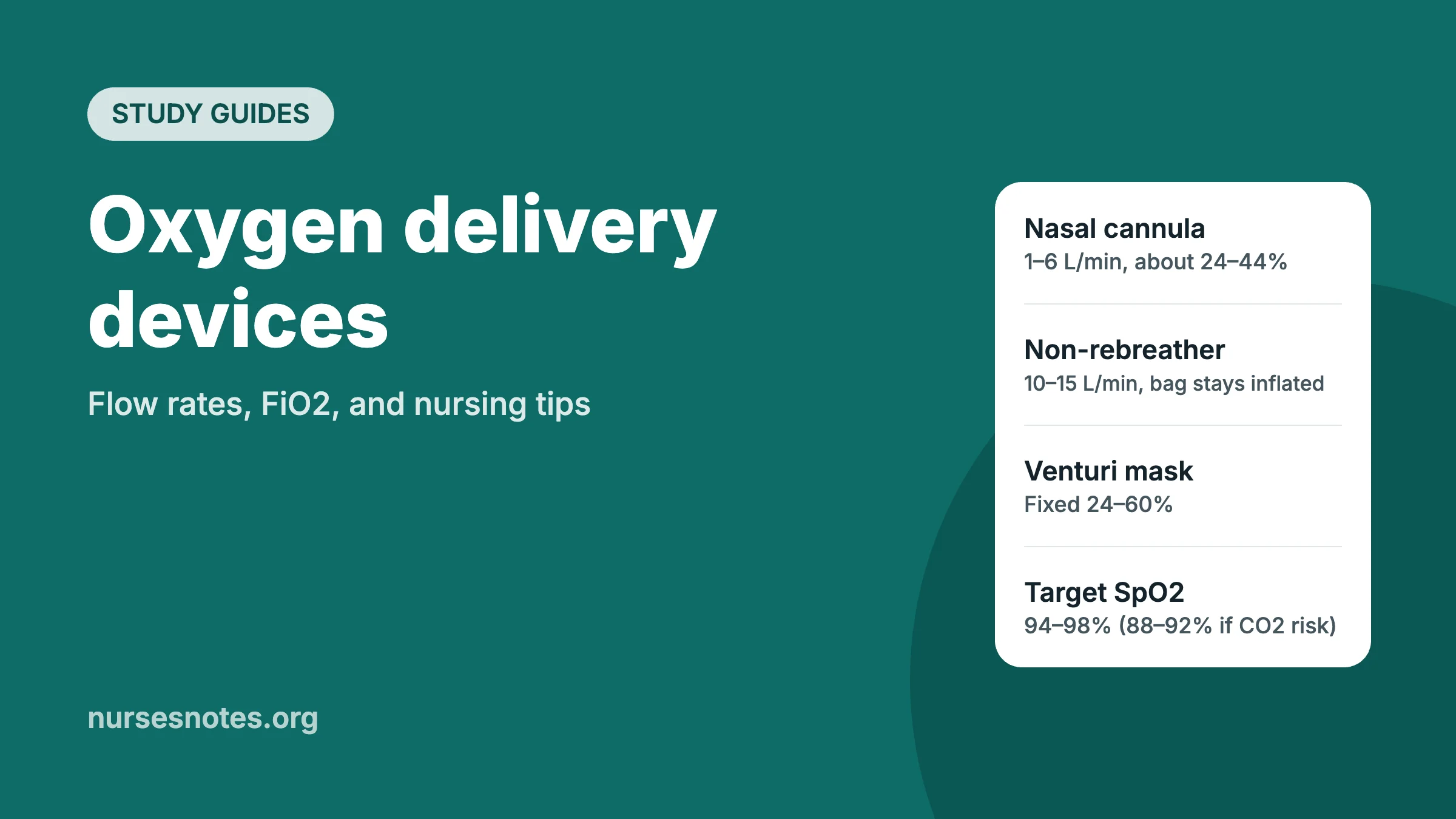
Oxygen delivery devices range from a simple nasal cannula at 1 to 6 L/min to a high-flow nasal cannula that can give up to 60 L/min, and each one delivers a different, approximate amount of oxygen. This study guide compares the main devices, their flow rates, and the nursing checks that exam questions love to test.
Key points
- Low-flow devices (nasal cannula, simple face mask, partial rebreather, and non-rebreather) mix oxygen with room air, so the oxygen a patient actually gets varies with their breathing.
- A simple face mask should not run below about 5 to 6 L/min, or the patient may rebreathe exhaled carbon dioxide.
- A Venturi mask gives the most precise oxygen concentration, which is why it is often chosen for patients at risk of carbon dioxide retention, such as some people with COPD.
- Common adult targets are SpO2 94–98% for most acutely ill patients and 88–92% for those at risk of hypercapnic respiratory failure, as prescribed.
What are oxygen delivery devices?
Oxygen delivery devices are the interfaces that carry prescribed oxygen from a wall outlet, cylinder, or concentrator to the patient. They are grouped into low-flow systems, which supply only part of what the patient inhales, and high-flow or fixed-performance systems, which aim to meet or exceed the patient’s breathing demand.
With a nasal cannula, the flow rate does not equal one exact FiO2. StatPearls explains that the oxygen mixes with room air, so the result depends on the patient’s respiratory rate and tidal volume. Treat every percentage below as an approximation.
Oxygen delivery devices comparison table
| Device | Usual flow (L/min) | Approx. oxygen delivered | Key nursing point |
|---|---|---|---|
| Nasal cannula | 1–6 | About 24–44% | Check the nares and ears for pressure injury; humidify at higher flows or long-term use |
| Simple face mask | 5–10 (Open RN: at least 6) | About 35–50% (other sources up to 55–60%) | Keep flow high enough to flush out exhaled CO2 |
| Partial rebreather | 10–15 | 35–50% (Open RN) | No one-way valves, so some exhaled air mixes with inhaled air |
| Non-rebreather (reservoir) mask | 10–15 | About 60–80% (Breathe: 80–95%) | Inflate the bag first; it must never fully collapse |
| Venturi mask | Set by the adaptor | 24–60% | The adaptor, not the flowmeter, sets the concentration |
| High-flow nasal cannula | Up to 60 | Up to 100% | Heated and humidified; flow and FiO2 are set separately |
Low-flow devices
- Nasal cannula: comfortable for eating and talking. Open RN advises humidification above 4 L/min or for long-term use, and Breathe notes that flows above 6 L/min can dry the nasal lining. Use a water-based lubricant, never a petroleum-based one.
- Simple face mask: used for moderate oxygen needs. Keep the exhalation ports open.
- Partial rebreather: has a reservoir bag but no one-way valves. Only part of the exhaled air re-enters the bag.
- Non-rebreather: used short term for critically ill patients. The British Thoracic Society (BTS) recommends a reservoir mask at 15 L/min in critical illness or when the initial SpO2 is below 85%.
Venturi mask and high-flow nasal cannula
A Venturi mask uses the Bernoulli principle to pull in a fixed amount of room air, so it delivers a steady concentration. The percentage and the matching flow are printed on each adaptor. For patients at risk of hypercapnia, BTS suggests starting with a 24% Venturi mask at 2–3 L/min or a 28% mask at 4 L/min, adjusted to the target range.
A high-flow nasal cannula delivers heated, humidified gas through wide-bore prongs at up to 60 L/min. A respiratory therapist or trained clinician usually sets it up, and the nurse monitors the patient, the circuit, and the humidifier.
Target oxygen saturation
BTS guidance aims for SpO2 94–98% in most acutely ill adults and 88–92% in those at risk of hypercapnic respiratory failure, such as some patients with COPD, until blood gases are known. StatPearls gives slightly different ranges, so use the target your patient’s prescriber documents. To read the blood gas side of this picture, see our ABG interpretation steps.
Nursing assessment
- Respiratory rate, effort, use of accessory muscles, and ability to speak in full sentences.
- SpO2, heart rate, and level of consciousness. Compare with normal vital signs for the patient’s age.
- Early hypoxia signs: restlessness, anxiety, confusion, a fast heart rate, and fast breathing.
- Late signs: cyanosis, falling consciousness, and exhaustion.
- Skin under tubing and mask straps, especially the nares, ears, and bridge of the nose.
Nursing interventions
- Check the prescription: device, flow or percentage, and target SpO2 range.
- Position the patient upright, if not contraindicated, to ease breathing.
- Fill the non-rebreather reservoir before placing the mask and watch that it stays inflated.
- Pad pressure points and reposition tubing to prevent skin breakdown.
- Titrate oxygen up or down only as ordered to keep within the target range, and document each change.
- Report a rising oxygen need, a falling SpO2, or new confusion promptly.
Oxygen safety
Oxygen does not burn by itself, but it makes fire burn faster and hotter. StatPearls reports facial burns and deaths in patients who smoked while using oxygen.
- No smoking or open flames near oxygen; post “No smoking” signs.
- Keep oxygen away from heaters, candles, and gas stoves (MedlinePlus advises about 2 metres; Open RN says at least 5 feet).
- Store cylinders upright and secured.
- Avoid petroleum-based creams on the face; use water-based products.
Too much oxygen can also harm. StatPearls warns that a high FiO2 over time may injure the lungs, and BTS notes that patients at risk of hypercapnia can retain carbon dioxide when given more oxygen than they need. Do not stop oxygen suddenly in these patients, because rebound hypoxaemia can occur.
Exam tips
- “Bag stays fat”: a non-rebreather reservoir bag should never fully deflate. If it does, act at once.
- “Five or more on a mask”: a simple mask below 5 to 6 L/min risks CO2 rebreathing. A nasal cannula is the choice for low flows.
- Precision = Venturi: when a question asks for the most exact oxygen concentration, pick the Venturi mask.
- Restlessness first: new restlessness or confusion is an early hypoxia sign; cyanosis is late.
- Trap: changing the flowmeter on a Venturi mask does not change the percentage. The adaptor does.
Frequently asked questions
How much oxygen does a nasal cannula give per litre?
A table in Breathe (2019) gives about 24–28% at 1–2 L/min, 30–35% at 3–4 L/min, and 38–44% at 5–6 L/min. However, StatPearls stresses that a cannula has no fixed FiO2, because the oxygen mixes with room air and the amount inhaled changes with the patient’s breathing rate and depth.
What is the difference between a non-rebreather and a partial rebreather mask?
Both have a reservoir bag. A non-rebreather has one-way valves that stop exhaled air from entering the bag, so it gives a higher concentration, about 60–80% in most sources. A partial rebreather has no one-way valves, so some exhaled air mixes back in, and it delivers less oxygen.
Why is a Venturi mask used for COPD?
A Venturi mask delivers a fixed, predictable oxygen percentage, from 24% upward, regardless of how fast the patient breathes. This helps keep SpO2 in the prescribed 88–92% range for patients at risk of carbon dioxide retention, avoiding both too little and too much oxygen. Always follow the prescribed percentage and target.
Related on Nurses Notes
- ABG interpretation steps for nurses
- Normal vital signs by age
- Pneumonia in children: signs and care
- More nursing study guides
Sources
- Chapter 11 Oxygen Therapy, Nursing Skills (Open RN), NCBI Bookshelf, 2021
- Oxygen Therapy, StatPearls, NCBI Bookshelf, updated January 2025
- Oxygen devices and delivery systems, Hardavella et al., Breathe (European Respiratory Society), 2019
- BTS Guideline for oxygen use in adults in healthcare and emergency settings, British Thoracic Society, 2017
- Hypoxia and Hypoxemia, StatPearls, NCBI Bookshelf, updated March 2024
- Oxygen safety, MedlinePlus, U.S. National Library of Medicine, reviewed January 2026
This article is for education only and does not replace advice from your own doctor, nurse, or other qualified health professional. Always follow your facility’s policies and reference ranges.