On this page
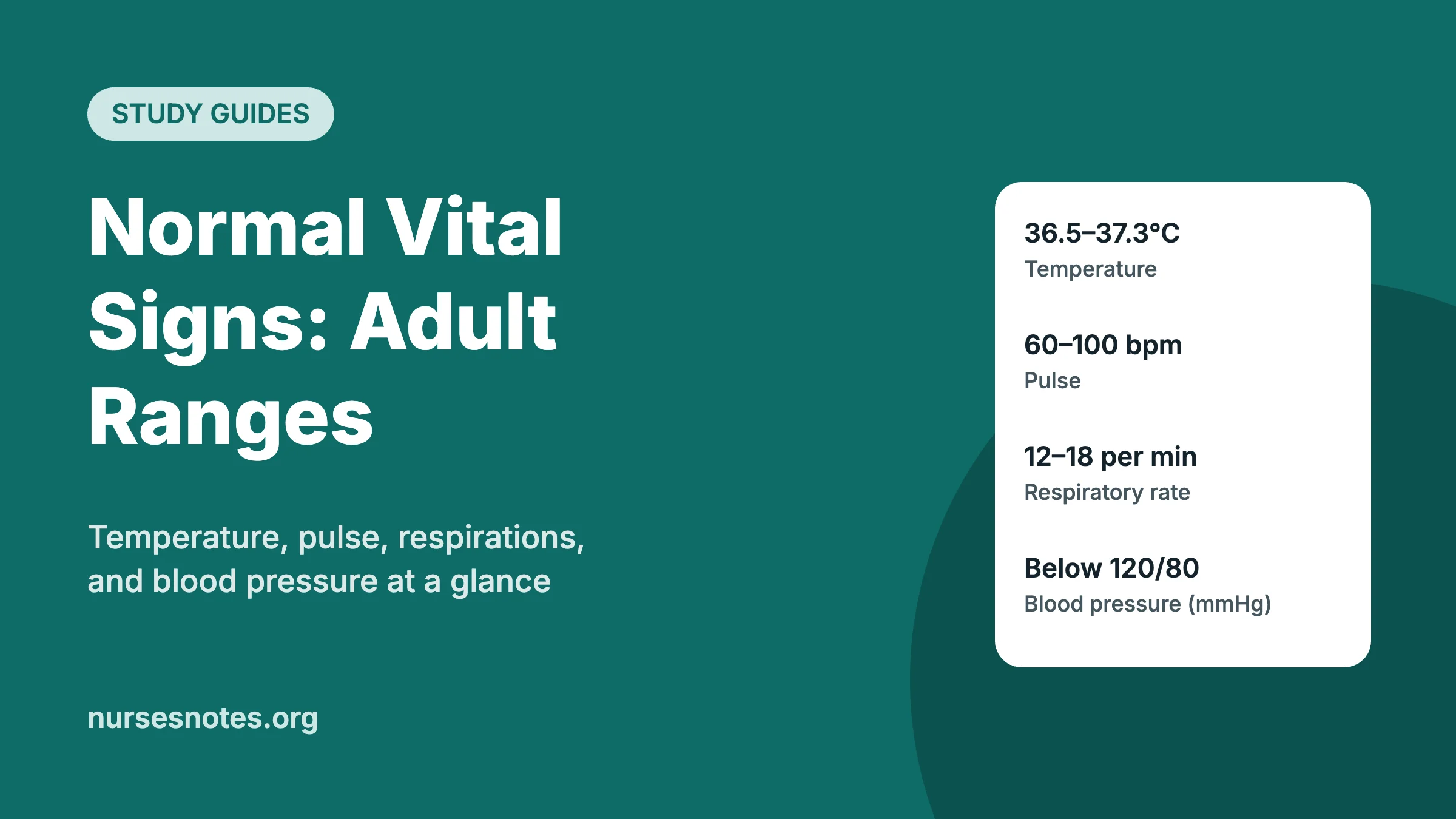
Normal vital signs for a healthy adult at rest are a temperature of about 36.5°C to 37.3°C, a pulse of 60 to 100 beats per minute, a respiratory rate of 12 to 18 breaths per minute, and a blood pressure below 120/80 mmHg. This study guide sets out the normal ranges, how to measure each sign accurately, which findings to report, and the exam traps that catch nursing students.
Key points
- Adult resting ranges: temperature 36.5°C to 37.3°C, pulse 60 to 100 bpm, respirations 12 to 18 per minute, and blood pressure under 120/80 mmHg.
- Fever is usually defined as a temperature above 38°C (100.4°F), and hypothermia as below 35°C (95°F).
- Values change with age, sex, activity, emotion, and illness, so compare each reading with the patient’s own baseline.
- Reference ranges and escalation criteria vary by laboratory, facility, and guideline, so always follow your local policy.
What are vital signs?
Vital signs are the basic measurements that show how well the body is maintaining its essential functions. The four classic vital signs are body temperature, pulse (heart rate), respiratory rate, and blood pressure.
Many facilities also record oxygen saturation and a pain score alongside these four. Johns Hopkins Medicine points out that blood pressure is not strictly a vital sign but is usually measured with them; in nursing practice it is charted as part of the core set.
Normal vital signs for adults: quick table
| Vital sign | Normal adult range (at rest) | Notes |
|---|---|---|
| Temperature | 36.5°C to 37.3°C (97.8°F to 99.1°F); average about 37°C (98.6°F) | MedlinePlus gives a lower limit of 97.7°F; Johns Hopkins gives an upper limit of 99°F (37.2°C) |
| Pulse (heart rate) | 60 to 100 beats per minute | Well-trained athletes may have resting rates near 40 bpm without problems |
| Respiratory rate | 12 to 18 breaths per minute | Johns Hopkins uses 12 to 16; under 12 or over 25 at rest may signal a problem |
| Blood pressure | Below 120/80 mmHg (MedlinePlus: 90/60 to 120/80 mmHg) | 90/60 mmHg or lower is low, though it can be normal for some people |
Blood pressure categories
Blood pressure is reported as systolic over diastolic in mmHg. One elevated reading does not mean hypertension; Johns Hopkins advises looking at several readings over days or weeks before a diagnosis is made.
| Category | Systolic (mmHg) | Diastolic (mmHg) |
|---|---|---|
| Normal | Less than 120 | and less than 80 |
| Elevated | 120 to 129 | and less than 80 |
| Stage 1 hypertension | 130 to 139 | or 80 to 89 |
| Stage 2 hypertension | 140 or higher | or 90 or higher |
| Seek emergency care | 180 or higher | or 110 or higher |
For a full plan of care for a patient with high readings, see our nursing care plan for hypertension.
Normal vital signs in children
Children have faster heart rates and lower blood pressure than adults, and their normal values change as they grow. Cleveland Clinic notes that a baby’s pulse may range from 110 to 160 bpm. Its guide to children’s blood pressure lists these typical ranges:
| Age | Systolic (mmHg) | Diastolic (mmHg) |
|---|---|---|
| 0 to 3 months | 65 to 85 | 45 to 55 |
| 3 to 6 months | 70 to 90 | 50 to 65 |
| 6 to 12 months | 80 to 100 | 55 to 65 |
| 1 to 3 years | 90 to 105 | 55 to 70 |
| 3 to 6 years | 95 to 110 | 60 to 75 |
| 6 to 12 years | 100 to 120 | 60 to 75 |
| 12 to 17 years | 100 to 120 | 70 to 80 |
How to take vital signs: nursing assessment
Before you start
- Check the patient’s identity, explain the procedure, and perform hand hygiene.
- Let the patient rest quietly for a few minutes, because activity, emotion, and recent food or drink can change readings.
- Use calibrated equipment and the correct cuff size for blood pressure.
Temperature
Use the route your facility specifies and record it with the reading. According to Johns Hopkins, rectal readings run about 0.5°F to 0.7°F higher than oral readings, while axillary readings run about 0.3°F to 0.4°F lower.
Pulse
Palpate the radial pulse at the wrist, or use the carotid (side of the neck) or brachial (inside of the elbow) site. Count for a full 60 seconds, or for 15 seconds and multiply by four if the rhythm is regular; note rate, rhythm, and strength.
Respiratory rate
Count breaths for 60 seconds, ideally without telling the patient, since people change their breathing when they know they are being watched. Note depth, effort, and any difficulty breathing. Abnormal breathing patterns may need follow-up such as an arterial blood gas; see our ABG interpretation steps.
Blood pressure
Seat the patient with feet flat, back supported, and the arm resting at heart level in a quiet room. Cleveland Clinic warns that automated machines in shops and pharmacies are not considered accurate, so use a validated device. Orthostatic vital signs compare lying and standing blood pressure and pulse.
Factors that affect vital signs
- Age: infants and children have higher pulse and respiratory rates; older adults may show temperature changes more often.
- Sex and hormones: females aged 12 and older tend to have faster heart rates, and temperature varies with the menstrual cycle.
- Activity and emotion: exercise, pain, anxiety, and stress raise pulse and blood pressure.
- Illness: fever, infection, injury, and other conditions can raise pulse and respiratory rate.
- Time of day, food, and fluids: all can shift body temperature.
Nursing considerations: what to report
Report any reading outside your facility’s range, any sudden change from the patient’s baseline, and any abnormal value with symptoms. Escalate promptly if you find:
- Temperature above 38°C (100.4°F) or below 35°C (95°F).
- Pulse persistently below 60 or above 100 bpm, especially with dizziness, chest pain, or breathlessness.
- Respiratory rate under 12 or over 25 at rest, or signs of breathing difficulty.
- Blood pressure of 180 systolic or higher, or 110 diastolic or higher, or a low reading with confusion or poor perfusion.
Always document the time, route or site, position, and the patient’s condition, and recheck after any intervention.
Exam tips
- Remember “60 to 100, 12 to 18, under 120/80”: pulse, respirations, and blood pressure for a resting adult.
- Trap: a rate of 50 bpm in a fit athlete with no symptoms may be normal; always assess the whole patient, not one number.
- Trap: do not tell the patient you are counting respirations, because their breathing pattern will change.
- Route matters: rectal is highest and axillary is lowest; never compare readings from different routes without noting them.
- Priority questions: when a question shows an abnormal vital sign plus symptoms, assess and report before giving routine care.
Frequently asked questions
What are the 5 vital signs?
The four classic vital signs are temperature, pulse, respiratory rate, and blood pressure. Many hospitals add a fifth, either pain or oxygen saturation, to their routine set. Check your facility’s observation chart, because the signs recorded and the early warning scores used can differ between hospitals and countries.
What is a normal pulse rate for adults?
A normal resting pulse for an adult is 60 to 100 beats per minute. Rates outside this range are not always a problem: fit athletes may sit near 40 bpm, while anxiety, pain, and exercise push the rate up. A pulse that stays below 60 or above 100 at rest should be discussed with a health professional.
What temperature is considered a fever?
Cleveland Clinic defines a fever as a temperature higher than 38°C (100.4°F). Normal body temperature averages about 37°C (98.6°F) but changes with the time of day, activity, and the route used. Rectal readings run slightly higher and axillary readings slightly lower than oral readings, so always record the route.
Related on Nurses Notes
- Nursing care plan for hypertension
- ABG interpretation steps for nurses
- Glasgow Coma Scale: scoring and nursing tips
- All Study Guides on Nurses Notes
Sources
- Vital signs. MedlinePlus Medical Encyclopedia, U.S. National Library of Medicine, reviewed January 2025.
- Vital Signs. Cleveland Clinic, updated March 2023.
- Vital Signs (Body Temperature, Pulse Rate, Respiration Rate, Blood Pressure). Johns Hopkins Medicine, accessed November 2026.
This article is for education only and does not replace advice from your own doctor, nurse, or other qualified health professional. Always follow your facility’s policies and reference ranges.