On this page
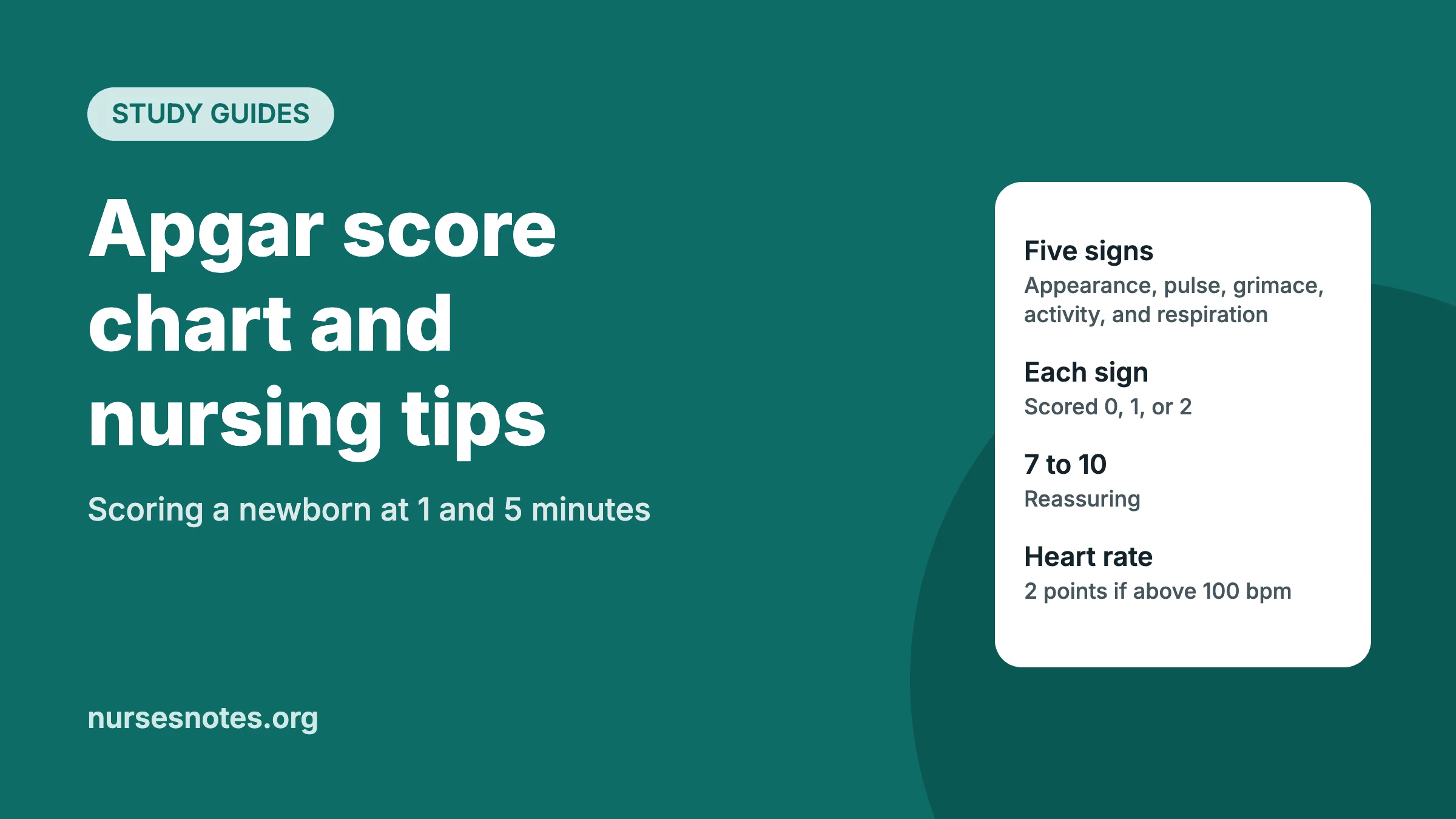
The Apgar score is a quick check of a newborn’s condition at 1 and 5 minutes after birth, using five signs scored 0, 1, or 2 for a total of 0 to 10. A score of 7 to 10 is reassuring, while a lower score tells the team the baby needs more support and closer watching.
Key points
- APGAR stands for Appearance, Pulse, Grimace, Activity, and Respiration.
- Heart rate is the most important sign: 0 if absent, 1 if below 100 bpm, and 2 if above 100 bpm.
- Scores of 7 to 10 are reassuring, 4 to 6 moderately abnormal, and 0 to 3 low.
- Resuscitation is never delayed to wait for the 1-minute Apgar score.
What is the Apgar score?
The Apgar score is a standard assessment of a baby’s status right after birth. It was introduced in 1952 by Dr. Virginia Apgar, an anaesthesiologist, and it is still considered the gold standard for assessing newborns at birth.
It is scored at 1 minute and 5 minutes after birth. If the 5-minute score is low or the baby needs resuscitation, scoring continues every 5 minutes, usually up to 20 minutes, to track how the baby is responding.
Apgar score chart
| Sign | 0 points | 1 point | 2 points |
|---|---|---|---|
| Appearance (skin colour) | Blue or pale all over | Body pink, hands and feet blue | Pink all over |
| Pulse (heart rate) | Absent | Below 100 bpm | Above 100 bpm |
| Grimace (reflex irritability) | No response to stimulation | Grimace | Grimace with cough, sneeze, or vigorous cry |
| Activity (muscle tone) | Limp and floppy | Some flexion | Active movement |
| Respiration (breathing effort) | Absent | Slow or irregular | Good, strong cry |
Apgar score interpretation
| Total score | Meaning | Usual response |
|---|---|---|
| 7 to 10 | Reassuring | Usually routine newborn care and observation |
| 4 to 6 | Moderately abnormal | The baby may need help, such as stimulation or breathing support; repeat scoring |
| 0 to 3 | Low | The baby needs immediate medical care; repeat scoring every 5 minutes |
A perfect 10 is unusual. MedlinePlus notes that most healthy newborns lose a point because their hands and feet are still bluish (acrocyanosis) in the first minutes of life.
What the Apgar score can and cannot tell you
- It can show how the baby is adapting to life outside the womb and how well they respond to resuscitation.
- It cannot decide when to start resuscitation. Neonatal Resuscitation Program guidance says interventions must begin before the 1-minute score is even assigned.
- It does not predict a child’s future intelligence, development, or health on its own, and a low score alone is not proof of birth asphyxia.
- A low 1-minute score that improves by 5 minutes is common and usually reassuring. Low scores at 5 minutes and later carry more weight.
Factors that can lower the Apgar score
- Prematurity and low birth weight.
- Maternal medicines, anaesthesia, or drug use.
- A difficult labour or birth, or an emergency caesarean section.
- Fluid or mucus in the baby’s airway.
- Congenital anomalies.
Some parts of the score are subjective, so two observers may score the same baby differently. Skin colour can also be harder to assess in babies with darker skin, so give careful attention to the other four signs as well.
Nursing assessment
- Note the exact time of birth and start timers for 1 and 5 minutes.
- Assess heart rate with a stethoscope, or with an ECG monitor if your unit uses one.
- Watch breathing effort and listen to the cry.
- Check muscle tone and flexion of the arms and legs.
- Test reflex irritability by watching the baby’s response to stimulation.
- Look at colour of the trunk and the hands and feet.
- Add the five scores and document each one with the time.
Nursing considerations
- Never pause newborn care or resuscitation to finish the score.
- Follow the Neonatal Resuscitation Program (NRP) algorithm for apnoea, gasping, or a low heart rate, regardless of the Apgar score.
- Keep scoring every 5 minutes when the 5-minute score is low, and record any interventions given at each time point.
- Explain to parents that the score is a quick snapshot, not a prediction of their child’s future health.
- Continue routine newborn checks afterwards, including temperature, feeding, and watching for jaundice. See our guide to newborn jaundice.
Exam tips
- Remember the acronym: A-P-G-A-R = Appearance, Pulse, Grimace, Activity, Respiration.
- Heart rate is king: it is the most important sign. Exactly 100 bpm is a common trick; know that 1 point is below 100 and 2 points is above 100.
- Expect 8 or 9: acrocyanosis usually costs a healthy baby one point for colour.
- Timing trap: resuscitation starts immediately if needed, not after the 1-minute score.
- Worked example: pink body with blue hands (1), heart rate 120 (2), grimace only (1), some flexion (1), and strong cry (2) gives a total of 7.
- Compare scales: like the Glasgow Coma Scale, the Apgar total is less useful than the individual components behind it.
Frequently asked questions
What is a normal Apgar score?
A score of 7 to 10 is considered reassuring. Most healthy babies score 8 or 9, because their hands and feet are often still bluish right after birth. A score below 7 means the baby needs more help, such as stimulation, airway clearing, or breathing support, and the score is repeated to check the response.
Does a low Apgar score mean brain damage?
Not on its own. Many babies with a low 1-minute score recover fully and score well by 5 minutes. The Apgar score is not designed to predict long-term health or development, and a low score alone is not proof of oxygen deprivation. Doctors look at the full clinical picture, including later scores and other tests.
Why is the Apgar score checked at 1 and 5 minutes?
The 1-minute score shows how the baby tolerated birth, while the 5-minute score shows how well they are adapting to life outside the womb. If the 5-minute score is low, scoring continues every 5 minutes, usually up to 20 minutes, to track the baby’s response to care and resuscitation.
Related on Nurses Notes
- Newborn jaundice: signs and when to worry
- Safe sleep for babies
- Glasgow Coma Scale: scoring and nursing tips
- All Study Guides on Nurses Notes
Sources
- APGAR Score. Simon LV, Shah M, Bragg BN. StatPearls, StatPearls Publishing (NCBI Bookshelf), last updated 31 January 2026.
- Apgar score. MedlinePlus Medical Encyclopedia, U.S. National Library of Medicine, reviewed 20 October 2024.
- Apgar Score. Cleveland Clinic, last updated 30 April 2025.
- Apgar Scores. American Academy of Pediatrics, HealthyChildren.org, updated 25 September 2015.
This article is for education only and does not replace advice from your own doctor, nurse, or other qualified health professional. Always follow your facility’s policies and reference ranges.