On this page
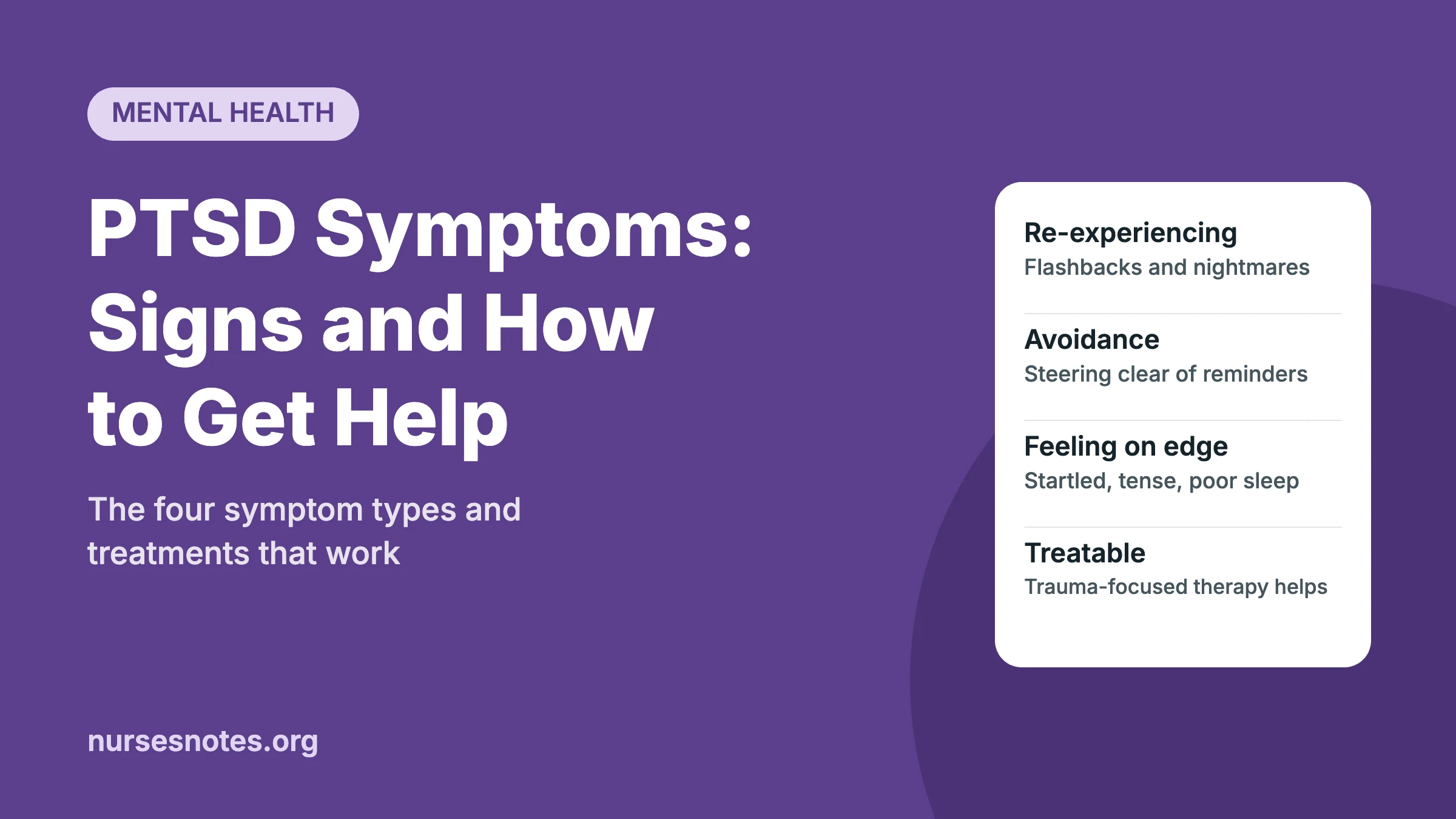
PTSD symptoms include reliving a traumatic event through flashbacks or nightmares, avoiding reminders of it, feeling constantly on edge, and lasting changes in mood and thinking. PTSD is common and treatable, and with the right support most people find their symptoms improve.
Key points
- NIMH groups PTSD symptoms into four types: re-experiencing, avoidance, arousal and reactivity, and changes in thinking and mood.
- Symptoms usually begin within 3 months of the event and must last more than 1 month for a diagnosis.
- The NHS lists jobs such as healthcare work, policing, and paramedic work among the causes, so nurses are not immune.
- Trauma-focused talking therapies and some medicines work well, so it is worth asking for help.
What is PTSD?
Post-traumatic stress disorder (PTSD) is a mental health condition that can develop after very stressful, frightening, or distressing events. It is normal to feel shaken after something traumatic, and NIMH notes that most people recover with time. PTSD is when the reactions continue, or keep coming back, and get in the way of daily life.
NIMH states that anyone can develop PTSD at any age. About 6 in every 100 people will have PTSD at some point in their lives, and women are more likely to develop it than men.
The four types of PTSD symptoms
| Symptom group | Examples |
|---|---|
| Re-experiencing | Flashbacks, upsetting memories or dreams, distressing thoughts, and physical signs of stress |
| Avoidance | Staying away from places, people, or events that are reminders, and trying not to think or talk about what happened |
| Arousal and reactivity | Being easily startled, feeling tense or on edge, trouble sleeping or concentrating, irritability, angry outbursts, or risky behaviour |
| Thinking and mood | Trouble remembering parts of the event, negative thoughts about yourself or the world, guilt or blame, loss of interest, and feeling cut off from others |
The NHS adds that some people also have repeated headaches, stomach problems, or body pain, and some feel detached or numb (dissociation). For anxiety that comes in sudden waves, our guide to signs of anxiety may also help.
When do PTSD symptoms start?
According to NIMH, symptoms usually begin within 3 months of the traumatic event, but they can start later. To meet the criteria for PTSD, symptoms must last longer than 1 month.
The NHS points out that symptoms can appear months or even years after the event.
PTSD symptoms in children
Young children may show trauma differently. NIMH lists signs in children under 6 such as wetting the bed after being toilet trained, forgetting how to talk, acting out the event in play, and being unusually clingy with a parent or carer. Older children and teens tend to show symptoms more like adults, and may also become disruptive or destructive.
PTSD in nurses and healthcare workers
The NHS lists doing certain jobs, such as being a police officer, paramedic, or healthcare worker, among the causes of PTSD. It also mentions serious illness, such as time in intensive care, and a difficult birth.
For nurses, repeated exposure to emergencies, deaths, and distressing cases can build up. PTSD is different from burnout, but the two can overlap; see our guide to signs of nurse burnout if exhaustion is the main problem.
Treatment for PTSD
NIMH explains that the main treatments are psychotherapy, medicines, or both. Talking therapy usually runs for 6 to 12 weeks, though some people need longer.
- Trauma-focused cognitive behavioural therapy (CBT): helps you process the memory and change unhelpful thoughts about it.
- Eye movement desensitisation and reprocessing (EMDR): a structured therapy recommended by the NHS and described by Mind.
- Medicines: usually an antidepressant; NIMH notes two SSRIs are FDA-approved for PTSD. A doctor will discuss whether medicine is right for you.
Self-help steps that can support recovery
Self-help does not replace treatment, but NIMH and the NHS suggest these steps can help alongside it:
- Talk to someone you trust about how you are feeling.
- Keep a regular routine for meals, exercise, and sleep (our sleep hygiene tips may help).
- Try breathing exercises, mindfulness, or the 5-4-3-2-1 grounding technique when you feel overwhelmed.
- Stay active, even with short walks.
- Write down what triggers your symptoms so you can share it with a professional.
- Avoid alcohol and recreational drugs, which can make symptoms worse.
- Set small, realistic goals and expect gradual progress rather than instant change.
When to get medical help
See a doctor or mental health professional if you think you may have PTSD, if symptoms are affecting your daily life, or if you have been diagnosed and treatment is not helping. If someone you care about is struggling, NIMH suggests encouraging them to talk to a health professional if their symptoms do not improve after 6 to 8 weeks.
Get help straight away if you feel unable to keep yourself safe, or if you are worried someone else is in danger. Use the contacts below or go to your nearest emergency department.
Where to get help
If you are in crisis, feel unable to keep yourself safe, or are worried about someone else, please reach out now. You do not have to cope alone.
- Philippines: NCMH Crisis Hotline – call 1553 (toll-free landline nationwide); Globe/TM 0917-899-8727 or 0966-351-4518
- USA: 988 Suicide & Crisis Lifeline – call or text 988 (free and available 24/7)
- UK and Ireland: Samaritans – call 116 123 (free, any time, day or night)
- Anywhere: call your local emergency number or go to the nearest emergency department
Frequently asked questions
Can PTSD go away on its own?
Some people recover from a traumatic event without treatment, and NIMH notes that some recover within 6 months. For others, symptoms last a year or longer, especially without support. Effective treatments exist, so if symptoms have lasted more than a month or are affecting your life, it is worth speaking to a doctor or therapist.
How is PTSD diagnosed?
A doctor or mental health professional makes the diagnosis after talking with you about your experiences and symptoms. NIMH explains that an adult needs, for at least 1 month, at least one re-experiencing symptom, at least one avoidance symptom, at least two arousal and reactivity symptoms, and at least two thinking and mood symptoms.
Can nurses get PTSD from work?
Yes. The NHS names healthcare work among the jobs that can lead to PTSD, because staff may witness deaths, emergencies, and distressing events repeatedly. If you notice flashbacks, avoidance, or feeling constantly on edge after work events, talk to your occupational health team, a doctor, or a trusted colleague. Seeking help is a sign of strength, not weakness.
Related on Nurses Notes
- Signs of nurse burnout and how to recover
- Signs of anxiety: when worry becomes an anxiety disorder
- The 5-4-3-2-1 grounding technique for anxiety
- All Mental Health articles on Nurses Notes
Sources
- Post-Traumatic Stress Disorder. National Institute of Mental Health (NIMH) fact sheet; revised 2023.
- Traumatic Events and Post-Traumatic Stress Disorder (PTSD). National Institute of Mental Health (NIMH); reviewed December 2024.
- PTSD (post-traumatic stress disorder). NHS; reviewed April 2026.
- Post-traumatic stress disorder (PTSD). Mind (UK); updated January 2026.
- 988 Suicide & Crisis Lifeline. 988 Lifeline (USA).
- Contact Samaritans. Samaritans (UK and Ireland).
- World Suicide Prevention Day (NCMH Crisis Hotline numbers). Quezon City Government, Philippines.
This article is for education only and does not replace advice from your own doctor, nurse, or other qualified health professional.